- Animals
- ›Chordates
- ›Vertebrates
- ›Ray-finned Fishes
- ›Carps, Characins, Catfishes and Allies
- ›Minnows, Suckers, Carps, and Loaches
- ›Suckers
- ›Suckers
- ›Typical Suckers
- ›Xyrauchen
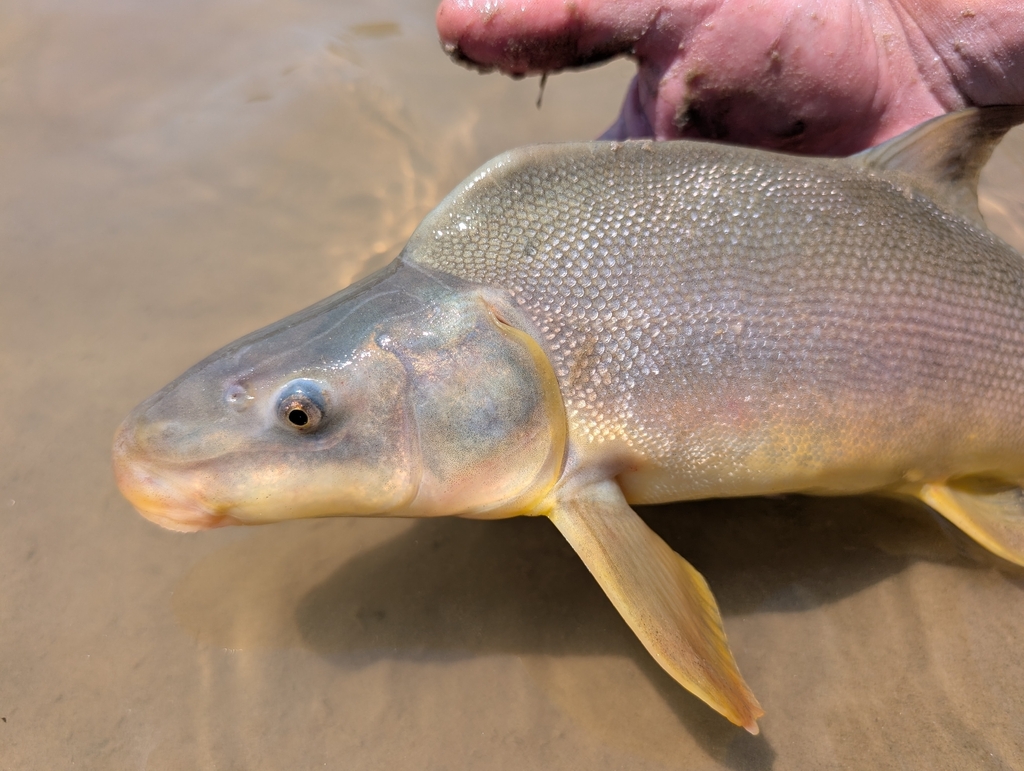
Razorback Sucker
Xyrauchen texanus
The razorback sucker (Xyrauchen texanus) is a suckerfish found in rivers and lakes in the southwestern United States and formerly northwestern Mexico. It can grow to 91 cm (3 ft) in length and is recognisable by the keel between its head and dorsal fin. It used to inhabit much of the Colorado River Basin but commercial fishing, river damming, and habitat loss have caused great declines in populations. It is now restricted to the Colorado River upstream of the Grand Canyon and to four reservoirs, Lake Mead, Lake Mohave, Lake Havasu, and Lake Powell.
It usually moves from deep water to suitable spawning grounds to breed, and research into its habits and breeding locations is ongoing. It has been a federally protected fish since 1991 and is rated as "Critically Endangered" by the International Union for Conservation of Nature, and Critically Imperiled by NatureServe. There are some signs of recovery, with fish being observed in the lower Grand Canyon in 2012 and 2013.
From the article Razorback sucker on Wikipedia (CC BY-SA), quoted section by section
Description
The razorback sucker is most notable for the sharp-edged bulge on the anterior part of its back, between the head and dorsal fin, giving rise to its common name, as well as to the alternative name "humpback sucker". The fish can attain lengths of up to 91 cm (3 ft) and weights of 6 kg (13.2 lb). A common length is 50 cm (1.6 ft). The fish has an olivaceous to brown-black color on top grading to a lighter yellow below. Adult razorbacks are easily distinguished from other suckers by the predorsal keel.
Range & habitat
The species originally occurred throughout the medium-sized and large rivers of the Colorado River Basin, including to the states of Baja California and Sonora in Mexico, but its range has shrunk to the river above the Grand Canyon, and to Lake Mead, Lake Mohave, and Lake Havasu on the lower part of the river. It is also considered extirpated from Wyoming. The reason for the decline is largely due to habitat loss. The state of California designated it as endangered in 1974, followed by the United States government in 1991. A population of over 3,000 fish in Lake Mohave has been created by an augmentation program using fry that were produced naturally in the lake. In addition, reintroduction programs have released hatchery-raised fish into Lake Havasu, the Colorado River below Parker Dam, and the Verde River. In 2012 and again in 2013, razorback sucker have been detected in the lower Grand Canyon. These were the first recorded sightings in the Grand Canyon National Park since the 1990s. In March 2014, in an effort to find out more about this wild population, nine tagged adult razorback sucker were released into the River Colorado below the Lava Falls. …
Wikipedia: “Distribution”
Where it lives
Recorded sightings
—
geo-referenced records in GBIF, from museums, herbaria and field observers.
Drag the globe to turn it. Dots are where records exist, not a range map; darker means more records.
In the stacks
Searching the stacks…
Every page naming Xyrauchen texanus in the Biodiversity Heritage Library →
This page is assembled live from iNaturalist, GBIF, Wikipedia, the Source Library and the Internet Archive. It is not yet part of the hand-edited codex. iNaturalist taxon 115179.