On eBird ↗
Kori Bustard
Live sightings near you, the range map, bar charts of when it is seen, and Macaulay Library photos and recordings.
Kori Bustard
Ardeotis kori
The kori bustard (Ardeotis kori) is the largest flying bird native to Africa. It is a member of the bustard family, which all belong to the order Otidiformes and are restricted in distribution to the Old World. It is one of the four species (ranging from Africa to India to Australia) in the large-bodied genus Ardeotis. The male kori bustard may be the heaviest living animal capable of flight.
This species, like most bustards, is a ground-dwelling bird and an opportunistic omnivore. Male kori bustards, which can be more than twice as heavy as the female, attempt to breed with as many females as possible and take no part in the raising of the young. The nest is a shallow hollow in the earth, often disguised by nearby obstructive objects such as trees.
From the article Kori bustard on Wikipedia (CC BY-SA), quoted section by section
Description
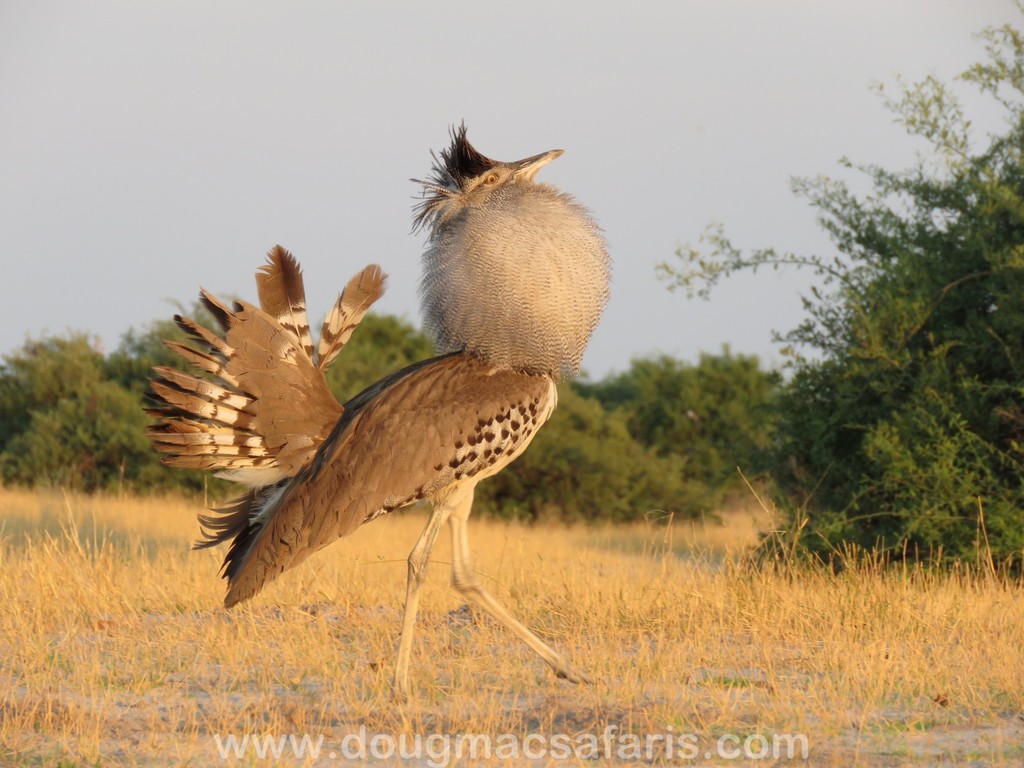
The kori bustard is cryptically coloured, being mostly grey and brown, finely patterned with black and white coloring. The upper parts and neck are a vermiculated black and greyish-buff colour. The ventral plumage is more boldly colored, with white, black and buff. The crest on its head is blackish in coloration, with less black on the female's crest. There is a white eye stripe above the eye. The chin, throat and neck are whitish with thin, fine black barring. A black collar at the base of the hind-neck extends onto the sides of the breast. The feathers around the neck are loose, giving the appearance of a thicker neck than they really have. The belly is white and the tail has broad bands of brownish-gray and white coloration. Their feathers contain light sensitive porphyrins, which gives their feathers a pinkish tinge at the base- especially noticeable when the feathers are shed suddenly. The head is large and the legs are relatively long. The eye is pale yellow, while the bill is light greenish horn coloured, relatively long, straight and rather flattened at the base. The legs are yellowish. The feet have three forward facing toes. Females are similar in plumage but are much smaller, measuring about 20–30% less in linear measurements and often weighing one third to half of the males. The female is visibly thinner legged and slimmer necked. …
Range & habitat
The kori bustard is found throughout southern Africa, except in densely wooded areas. They are common in Botswana and Namibia, extending into southern Angola and marginally into southwestern Zambia. In Zimbabwe they are generally sparse but locally common, particularly on the central plateau. Their distribution range extends along the Limpopo River valley into southern Mozambique and the eastern lowveld of South Africa. In South Africa they are also infrequent to rare in the Free State, North West and Northern Cape Provinces, extending southwards into the interior of the Western and Eastern Cape Provinces. Kori bustards are absent from the coastal lowlands along the south and east of South Africa and from high mountainous areas. This species is common in Tanzania at Ngorongoro National Park, Kitulo National Park and Serengeti National Park. A geographically disjunct population also occurs in the deserts and savanna of northeastern Africa. Here, the species ranges from extreme southeast South Sudan, north Somalia, Ethiopia through all of Kenya (except coastal regions), Tanzania and Uganda. Kenya may hold the largest population of kori bustards of any country and it can even border on abundant in the North Eastern Province. …
Wikipedia: “Distribution and habitat”
What it does
Kori bustards spend most of their time on the ground, with up to 70% of their time being on foot, although they do occasionally forage in low bushes and trees. This bustard is a watchful and wary bird. Their behavior varies however, and they are usually very shy, running or crouching at the first sign of danger; at other times they can be completely fearless of humans. They have a hesitant, slow manner of walking, and when they detect an intruder they try to escape detection by moving off quietly with the head held at an unusual angle of between 45° and 60°. Being a large and heavy bird, it avoids flying if possible. When alarmed it will first run and, if pushed further, will take to the air on the run with much effort, its wings making heavy wingbeats. Once airborne it flies more easily with slow, measured wingbeats, with the neck extended and the legs folded. It usually remains low and lands again within sight. When they land, kori bustards keep their wings spread and only fold them when the bird has slowed down to a walking speed. Kori bustards have no preen gland, so to keep clean, they produce a powder down. Sunbathing and dust bathing are practiced. Mostly residential, kori bustards may engage in nomadic movements. These migratory movements are probably influenced by rainfall and there is no evidence suggesting any regular pattern. …
Wikipedia: “Behaviour”
Listen
Looking for field recordings…
Where it lives
Recorded sightings
—
geo-referenced records in GBIF, from museums, herbaria and field observers.
Drag the globe to turn it. Dots are where records exist, not a range map; darker means more records.
In the stacks
Searching the stacks…
Every page naming Ardeotis kori in the Biodiversity Heritage Library →
This page is assembled live from iNaturalist, GBIF, Wikipedia, the Source Library and the Internet Archive. It is not yet part of the hand-edited codex. iNaturalist taxon 115.