- Animals
- ›Arthropods
- ›Hexapods
- ›Insects
- ›Winged and Once-winged Insects
- ›Butterflies and Moths
- ›Butterflies
- ›Swallowtails and Parnassians
- ›Swallowtails
- ›Teinopalpini
- ›Teinopalpus
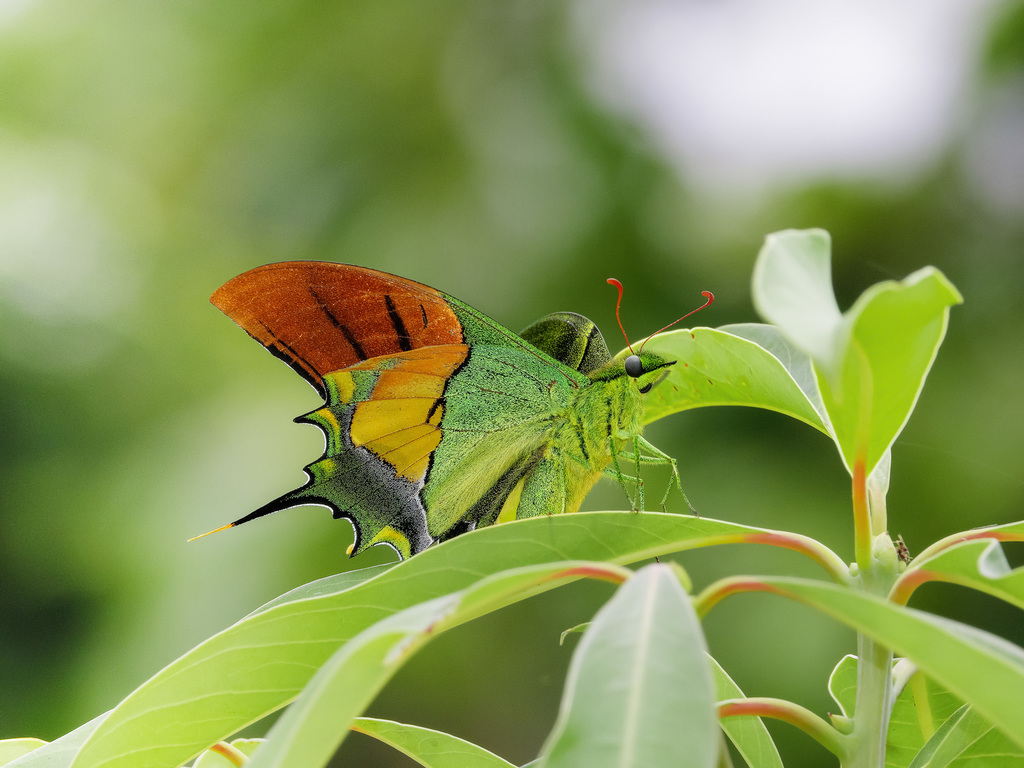
Kaiser-i-Hind
Teinopalpus imperialis
Teinopalpus imperialis, the Kaiser-i-Hind, is a rare species of swallowtail butterfly found from Nepal and north India east to north Vietnam. The common name literally means "emperor of India". The Kaiser-i-Hind is much sought after by butterfly collectors for its beauty and rarity. The green iridiscence of the wings has been found to be due to three-dimensional photonic structure of the scales and is the subject of much research.
From the article Teinopalpus imperialis on Wikipedia (CC BY-SA), quoted section by section
Description
The Kaisar-i-Hind has a predominantly green swallowtail. The male has a bright chrome-yellow patch on each hind wing. The following descriptions are from Charles Thomas Bingham (1907) The Fauna of British India, Including Ceylon and Burma, Butterflies Volume 2.
Male. Upperside black, densely irrorated with green scales. Forewing: an outwardly oblique, slightly concave subbasal band and a narrow terminal edging jet-black due to the ground colour there being devoid of the green scaling; beyond the subbasal band the irroration of scales a much brighter green, especially along the outer edge of the subbasal band itself; but along obscure, broad and convergent discal and postdiscal transverse bands and along a subterminal much narrower band, the green scaling thins out and the black ground colour of the wing shows through; in some specimens, owing to the transparency of the wings, the rich ochraceous-brown colour of the underside gives the black on these bands a reddish tint. …
Range & habitat
The butterfly is found in small pockets of Nepal, Bhutan and along the Eastern Himalayas in India (West Bengal, Meghalaya, Assam, Sikkim and Manipur). It is also found in northern Myanmar, northern Vietnam and in the Sichuan province of China. Mostly seen above 6,000 feet (1,800 m).
Wikipedia: “Distribution”
What it does
Flies in Sikkim in April and May and later in Manipur from May to July. Probably have two broods. The larvae feed on Magnolia campbellii (Magnoliaceae). Eggs: Smooth, spherical, pale purplish red. Laid on underside of leaves. Larva: Spindle shaped, green larva with broad heads and tapering tails. The larva has minute spines on the head and hair-like long spines on the segments. Pupa: Resembles that of Graphium species. It has a smooth head and prominent dorsal horn. It has a green mesothorax and broad yellow dorsal zones on the abdomen.
Wikipedia: “Life cycle”
Listen
Looking for field recordings…
Where it lives
Recorded sightings
—
geo-referenced records in GBIF, from museums, herbaria and field observers.
Drag the globe to turn it. Dots are where records exist, not a range map; darker means more records.
In the stacks
Searching the stacks…
Every page naming Teinopalpus imperialis in the Biodiversity Heritage Library →
This page is assembled live from iNaturalist, GBIF, Wikipedia, the Source Library and the Internet Archive. It is not yet part of the hand-edited codex. iNaturalist taxon 113820.