- Animals
- ›Chordates
- ›Vertebrates
- ›Ray-finned Fishes
- ›Spiny-rayed fishes
- ›Pipefishes and Allies
- ›Syngnathoidei
- ›Pipefishes, Seahorses, and Seadragons
- ›Tail-brooding Pipefishes
- ›Syngnathus
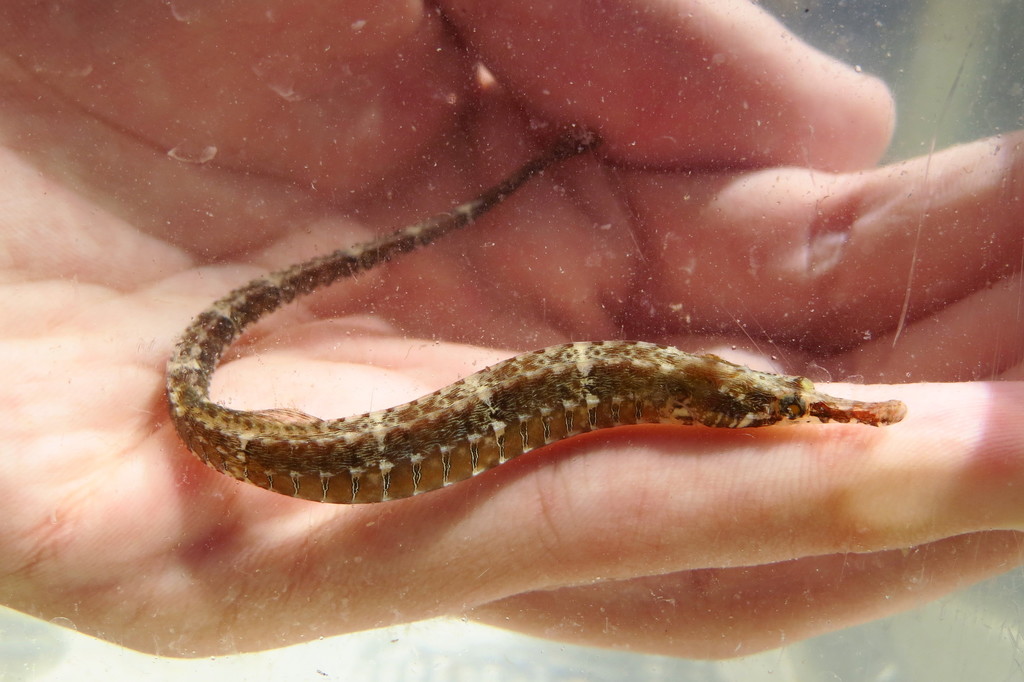
Gulf Pipefish
Syngnathus scovelli
The Gulf pipefish (Syngnathus scovelli) is a species of pipefish in the member of the taxonomic family Sygnathidae. Syngnathus scovelli is native to the region of south Florida, United States, the Atlantic Ocean, etc. S. scovelli is similar to Microphis brachyurus.
From the article Gulf pipefish on Wikipedia (CC BY-SA), quoted section by section
Description
S. scovelli is an elongated fish encased in body rings. They are uniformly brown or dark olive green in color, with silvery, white vertical bars along the sides, sometimes appearing Y-shaped. Their maximum size is 183 mm SL, although most gulf pipefish rarely exceed 100 mm SL. They have a short snout, its length going into its HL 1.9-2.3 times. This species has 18-19 trunk rings and 30-34 tail rings. The dorsal fin is moderate in length and spans 2-4 trunk rings and 3-5 tail rings. In females, the dorsal fin is usually banded. The caudal fin is present and rounded. The anal fin is greatly reduced, and the pelvic fins are absent. Females have a well-developed keel on their abdomen that is reduced in both juveniles and males. Mature males have a brood pouch on their underside that spans 10-13 tail rings.
Range & habitat
The gulf pipefish is a marine-estuarine species. It commonly inhabits shallow, highly vegetated shoreline areas with clear, tannin-stained streams and rivers. They also commonly inhabit estuarine seagrass meadows. However, their species population have been declining due to the impact of growing human (Homo sapiens) population size. This cause negative effects such as nutrient loading, pollution, harmful algae blooms and habitat degeneration. There has been large substantial declines in the waters of the Atlantic Ocean coast and the coast of Florida, United states. The loss of much of the seagrass Meadows in the Indian River Lagoon along with the harmful ongoing algae blooms is causing a decline in the gulf pipefish species.
Wikipedia: “Habitat”
What it does
Gulf pipefish feed during the day time with their diet mainly consists of crustaceans such as copepods, amphipods, tanaids, and isopods, among other small crustaceans. Individuals less than 50 mm SL feed almost exclusively on copepods. Larger individuals feed more on amphipods, crustacean eggs, and caridean shrimp.
Wikipedia: “Diet”
In human culture
Sygnathus: jaw together; scovelli: named in honor of Josiah T. Scovell, who helped collect the original specimens
Wikipedia: “Etymology”
Where it lives
Recorded sightings
—
geo-referenced records in GBIF, from museums, herbaria and field observers.
Drag the globe to turn it. Dots are where records exist, not a range map; darker means more records.
In the stacks
Searching the stacks…
Every page naming Syngnathus scovelli in the Biodiversity Heritage Library →
This page is assembled live from iNaturalist, GBIF, Wikipedia, the Source Library and the Internet Archive. It is not yet part of the hand-edited codex. iNaturalist taxon 113583.