- Animals
- ›Chordates
- ›Vertebrates
- ›Ray-finned Fishes
- ›Carps, Characins, Catfishes and Allies
- ›Minnows, Suckers, Carps, and Loaches
- ›Carps and Minnows
- ›True Minnows
- ›Old World Minnows
- ›Squalius
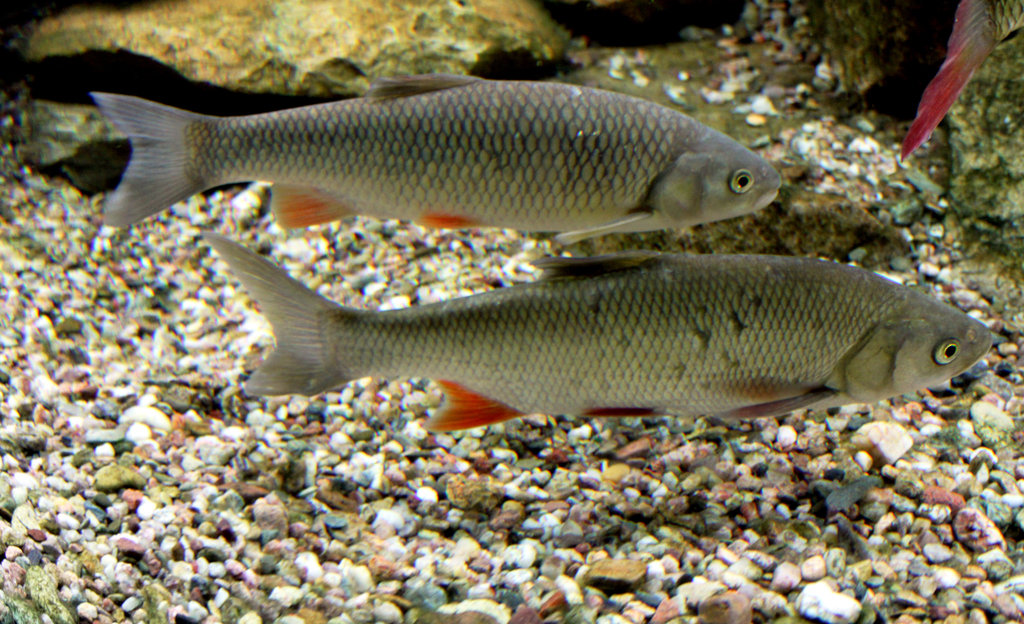
European Chub
Squalius cephalus
Squalius cephalus, the common chub, European chub or simply chub, is a species of freshwater ray-finned fish belonging to the family Leuciscidae, the daces, Eurasian minnows and related fishes. This species is found in Europe where it frequents both slow and moderate rivers, as well as canals, lakes and still waterbodies of various kinds.
From the article Squalius cephalus on Wikipedia (CC BY-SA), quoted section by section
Description
It is a stocky fish with a large rounded head. Its body is long and cylindrical in shape and is covered in large greenish-brown scales which are edged with narrow bands of black across the back, paling to golden on the flanks and even paler on the belly. The tail is dark brown or black, the dorsal fin is a greyish-green in colour and all the other fins are orange-red. The dorsal fin has 3 spines and 7–9 soft rays while the anal fin has 3 spines and 7–10 rays. The vertebrae count is 42–48. It can grow to 60 cm standard length but most fish are around 30 cm. Eggs are round with a 1.8 mm diameter, and first day larvae are 6–7 mm long and weigh about 120 mg.
Range & habitat
The chub is distributed throughout most of northern Eurasia, it can be found in the rivers flowing into the North, Baltic, northern Black, White, Barents and Caspian Sea basins, the Atlantic basins south to Adour drainage in France and in Great Britain north to 56°, in Scandinavia in southern Finland and southern Sweden north to around Stockholm. In the Mediterranean basin it is found in France from the Var to the Hérault, and may also be present in the Aude and drainages. It is absent as a native species from Ireland and Italy, but has been introduced to both countries. In Italy, S. cephalus is present and acclimatised since decades, but it seems marginally found here and there (mainly in the Po river basin), never forming well established populations.
Wikipedia: “Distribution”
What it does
It is most abundant in small rivers and large streams in the "barbel zone" where there are riffles and pools. It occurs along the banks of slow-flowing lowland rivers in large lake and even in mountain streams. Chub in lakes undertake spawning migrations into inflowing streams. The adult fish are solitary but the juvenile fish are sociable and occur in shoals. The larvae and juveniles prefer rather shallow habitats along shorelines and these smaller fish have a varied diet of aquatic and terrestrial animals while the large, solitary adults prey mainly on freshwater shrimp and small fishes. In the United Kingdom, chub have been recorded feeding on worms, molluscs, crustaceans, and various insect larvae while large chub eat considerable numbers of small fish, such as chub, eels, common dace, common roach, gudgeon and minnows as well as frogs, crayfish, voles and young water birds. They have also been observed eating berries such as blackberries and elderberry from trees overhanging the water. They feed throughout the year if there are opportunities, even in the coldest days of midwinter.
Spawning happens when the water temperature reaches 14 °C, and lasts from May to September. They spawn in fast-flowing water above gravel substrates but only infrequently will they spawn among submerged vegetation. …
Wikipedia: “Habitat and ecology”
Where it lives
Recorded sightings
—
geo-referenced records in GBIF, from museums, herbaria and field observers.
Drag the globe to turn it. Dots are where records exist, not a range map; darker means more records.
In the stacks
Searching the stacks…
Every page naming Squalius cephalus in the Biodiversity Heritage Library →
This page is assembled live from iNaturalist, GBIF, Wikipedia, the Source Library and the Internet Archive. It is not yet part of the hand-edited codex. iNaturalist taxon 113003.