On eBird ↗
Udzungwa Partridge
Live sightings near you, the range map, bar charts of when it is seen, and Macaulay Library photos and recordings.
Udzungwa Partridge
Xenoperdix udzungwensis
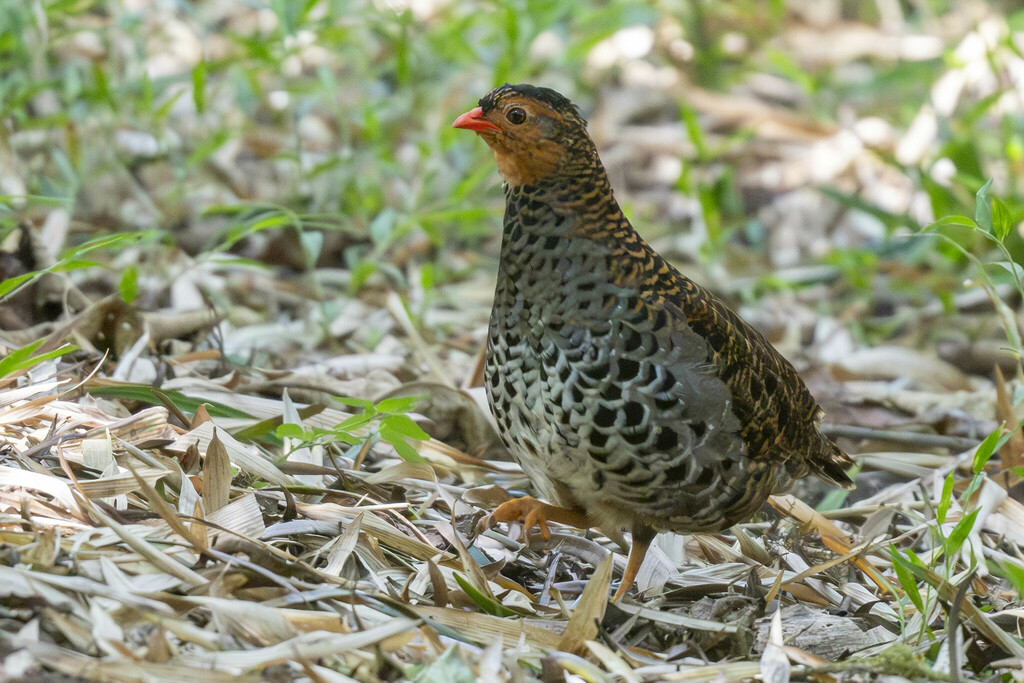
The Udzungwa forest partridge (Xenoperdix udzungwensis), also known as the Udzungwa partridge, is a small, approximately 29 centimetres (11 in) long, boldly barred, brownish partridge with rufous face, grey underparts, olive-brown crown and upperparts. It has a red bill, brown iris and yellow legs. The sexes are similar.
From the article Udzungwa forest partridge on Wikipedia (CC BY-SA), quoted section by section
Range & habitat
The Udzungwa forest partridge is endemic to eastern Tanzania, where it is two disjunct populations in the Udzungwa and Rubeho mountain ranges. The nominate subspecies is found in the Udzungwa Mountains, where it is inhabits the Ndundulu-Luhombero Forest and Nyumbanitu Forest. In Ndundulu-Luhombero Forest, the partridges occurs at elevations of 1,350–2,060 m. Nyumbanitu Forest is separated from Ndundulu-Luhombero by 5 km of grassland habitat. The Udzungwa forest partridge was formerly known from this forest at elevations of 1,500–1,700 m, but has not been recorded here since 2012. A 2018 survey that involved the use of widespread playback failed to locate the species at Nyumbanitu, suggesting that the species has been extirpated from the area. The subspecies obscuratus is known only from Chugu Hill, in the northern Mafwemiro Forest in the Rubeho Mountains. It occurs at elevations of 1,700–1,900 m. The partridge inhabits montane evergreen forest with closed or semi-closed canopies. It prefers forests with open understoreys, leaf litter, and Cyperus sedges, but does not have a strong preference for any specific microhabitat. In the Ndundulu-Luhombero Forest, its abundance is not affected by slope or the proximity of villages.
Wikipedia: “Distribution and habitat”
What it does
The Udzungwa forest partridge is a fairly confiding species, coming as close as 3 m to human observers while foraging. However, they are fairly elusive and hard to see, with days of fieldwork typically only leading to a few sightings of the species. It typically runs away when approached, only resorting to flying when startled and dropping back to ground within less than 10 m after flushing. They form flocks of up to eight birds, with an average flock size of around three birds. Flocks tend to be smaller during the breeding season, when more birds are part of breeding pairs. Roosting takes place on branches in trees. Udzungwa forest partridges are known to feed on beetles, ants, flies, insect larvae, woodlice, and seeds. Foraging takes place in small flocks that travel slowly through the forest floor. The partridges pick up and throw away dead leaves to find seeds and prey. They also catch insects by snapping at leaves. Foraging sometimes takes place near trails at dusk. Breeding in the species is poorly known and its nest has never been observed. Females with brood patches have been observed in January. Chicks have been seen from November to January, sugegsting that the breeding season starts with the rainy season. Adults have only been seen with one or two chicks, suggesting that the Udzungwa forest partridge has much lower brood sizes than other partridges.
Wikipedia: “Behaviour and ecology”
Listen
Looking for field recordings…
Where it lives
Recorded sightings
—
geo-referenced records in GBIF, from museums, herbaria and field observers.
Drag the globe to turn it. Dots are where records exist, not a range map; darker means more records.
In the stacks
Searching the stacks…
Every page naming Xenoperdix udzungwensis in the Biodiversity Heritage Library →
This page is assembled live from iNaturalist, GBIF, Wikipedia, the Source Library and the Internet Archive. It is not yet part of the hand-edited codex. iNaturalist taxon 1129.