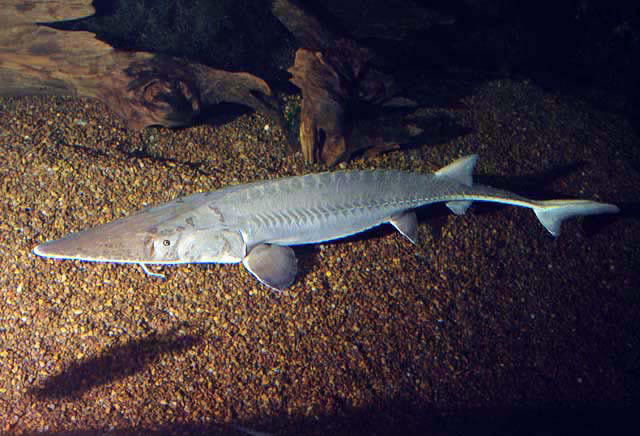
Pallid Sturgeon
Scaphirhynchus albus
The pallid sturgeon (Scaphirhynchus albus) is an endangered species of ray-finned fish, endemic to the waters of the Missouri and lower Mississippi River basins of the United States. It may have even reached the St. Croix River before colonization.
Named for its pale coloration, it is closely related to the more common shovelnose sturgeon (Scaphirhynchus platorynchus), but is much larger, averaging between 30 and 60 inches (76 and 152 cm) in length and 85 pounds (39 kg) in weight at maturity. This species takes 15 years to mature and spawns infrequently, but can live up to a century. A member of the sturgeon family, Acipenseridae, which originated during the Cretaceous period 70 million years ago, the pallid sturgeon has changed little since then.
From the article Pallid sturgeon on Wikipedia (CC BY-SA), quoted section by section
Range & habitat
The pallid sturgeon's historical range spanned the entire Missouri River and into the Mississippi River. Historically, the species was rare to nonexistent in the upper Mississippi, probably due to a lack of proper habitat. Currently, the species is considered imperiled throughout its entire range. As of 2008, pallid sturgeon can still be found throughout their original range, but their population numbers have severely declined from the mid-20th century. The Missouri and Mississippi rivers from Montana to Louisiana, as well as the Atchafalaya River in Louisiana, continue to harbor an aging population of pallid sturgeon. Pallid sturgeon have never been very common; as early as 1905 when the species was first identified, they represented only one in five of all sturgeon in the lower Missouri River and as few as one in 500 where the Illinois River meets the Mississippi. Between 1985 and 2000, the ratio of pallid sturgeon to all sturgeon netted declined from one in about 400 to one in nearly 650. A 1996 study concluded that between 6,000 and 21,000 pallid sturgeon remained in their natural habitat at that time.
Six areas were studied for wild pallid sturgeon population estimates and recovery recommendations by the United States Fish and Wildlife Service (USFWS) between 1990, when the species was declared endangered, and 2006. …
Wikipedia: “Distribution”
What it does
Pallid sturgeon have a long lifespan, living in excess of 50 and perhaps as long as 100 years. They lack bones and scales, which makes it more difficult to establish their age and determine exactly how long they live. As is true for many long-lived species, pallid sturgeon reach reproductive maturity relatively late. Males reach sexual maturity between the ages of 5 and 7 years, while females are believed to become capable of reproduction when they are at least 15 years old. One study of nine females indicated that they begin egg development between the ages of 9 and 12 years, but do not reach reproductive maturity until they are 15 years old. Reproduction does not take place every year; the average interval between spawnings is three years, although other studies suggest an interval as long as 10 years. Spawning usually takes place May to July.
Prior to the construction of dams on the Missouri, pallid sturgeon migrated hundreds of miles upstream to spawn, and sought out rocky or hard surfaces to deposit hundreds of thousands of eggs. One female pallid sturgeon caught in the upper Missouri River was estimated to be carrying 170,000 eggs, representing over 11 percent of its total body weight. After fertilization, pallid sturgeon eggs hatch in 5 to 8 days, after which the larvae drift back downstream for several weeks. …
Wikipedia: “Reproduction and lifecycle”
In human culture
Taxonomists S. A. Forbes and R. E. Richardson classified the pallid sturgeon in 1905, grouping it in the genus Parascaphirhynchus and the family Acipenseridae, which includes all sturgeon worldwide. Its closest relatives are the shovelnose sturgeon (Scaphirhynchus platorynchus), which is still relatively common, and the critically endangered Alabama sturgeon (Scaphirhynchus suttkusi), which may soon become extinct. These three species belong to the subfamily Scaphirhynchinae, which has only one other genus, Pseudoscaphirhynchus, represented by three species found in west-central Asia. The word pallid means "deficient in color", and compared to other species of sturgeon, the pallid is noticeably paler. The scientific name for the fish is derived from Scaphirhynchus, a Greek word meaning "spade snout" and albus which is Latin for "white".
Wikipedia: “Taxonomy and etymology”
Where it lives
Recorded sightings
—
geo-referenced records in GBIF, from museums, herbaria and field observers.
Drag the globe to turn it. Dots are where records exist, not a range map; darker means more records.
In the stacks
Searching the stacks…
Every page naming Scaphirhynchus albus in the Biodiversity Heritage Library →
This page is assembled live from iNaturalist, GBIF, Wikipedia, the Source Library and the Internet Archive. It is not yet part of the hand-edited codex. iNaturalist taxon 112106.