- Animals
- ›Chordates
- ›Vertebrates
- ›Reptiles
- ›Snakes and Lizards
- ›Lizards
- ›Iguanas and Allies
- ›Dragons and Chameleons
- ›Chameleons
- ›Calumma
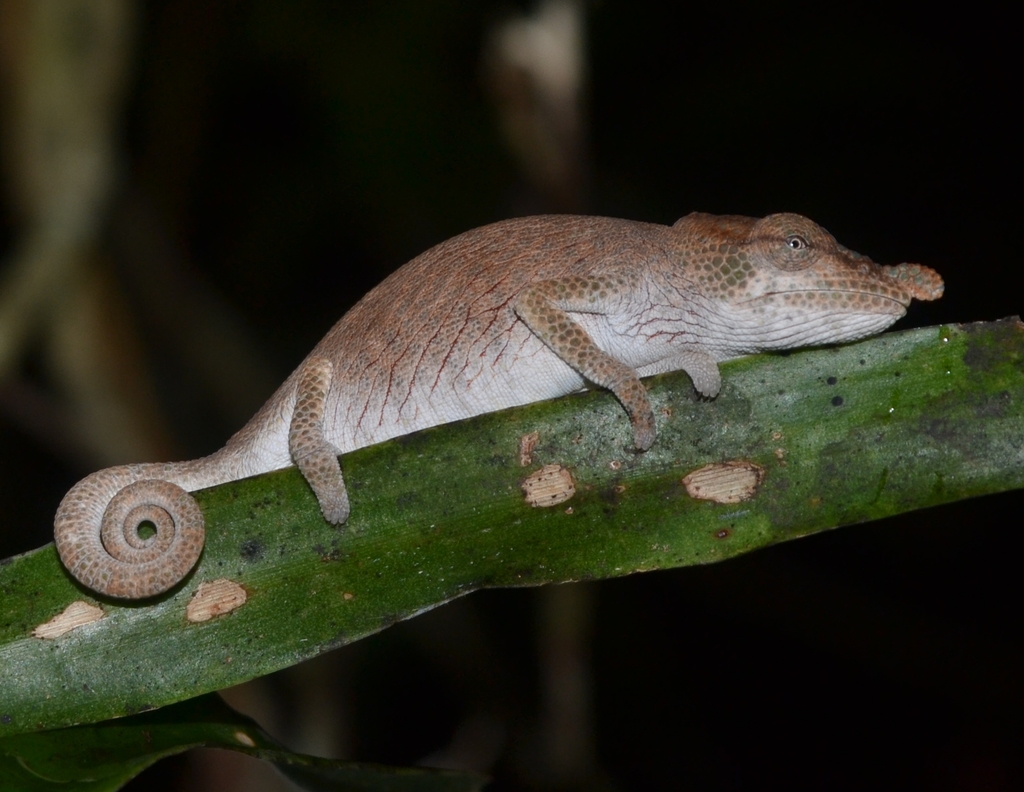
Andasibe Nosed Chameleon
Calumma nasutum
Calumma nasutum, the Madagascar pimple-nose chameleon, is a small species of chameleon found in Madagascar. The taxonomic identity of the species is currently uncertain and in need of revision, and this revision is likely to result in several newly described species. Several different data sets indicate that C. nasutum is a complex of several species.
From the article Calumma nasutum on Wikipedia (CC BY-SA), quoted section by section
Description
The big-nosed chameleon, which is one of the smallest arboreal chameleons usually with a total body length of 11 cm. It gets its name from the huge, paddle-like appendage that protrudes from the nasal region. It is thought that males have a larger, more square-shaped version of this flexible appendage, which is employed for identifying possible mates. The more noticeable casque, or bony head crest, is another feature that sets male big-nosed chameleons apart. Both sexes typically have brown, reddish-brown, tan, or light green skin. Females that are not interested in mating quickly acquire a stunning display of whitish-blue to turquoise dots on the sides of the nasal appendage and on top of the head. This big-nosed species has characteristics with other chameleons, such as a prehensile tail, fused toes, turret-like eyes, and an incredibly long tongue.
Appearance. The small nose-horned chameleon has a sharply pointed snout and a flexible, scale-free body covered in smooth hair. The colouration of the chameleon is generally dull, ranging from grey to brown or dull green, with dark vertical crossbars along the flanks. A white lateral band is present in some specimens. There may be yellow or blue elements, and the legs are greenish.The broad color scheme that goes from green to brown, with the darker hues being more prominent on men. …
Range & habitat
The big-nosed chameleon inhabits primary forest, forest edge and secondary forest where it is found in low vegetation and prefer thin trees, shrubs and bushes, but also thick lianas in the dense rainforest, generally one to two meters above the ground. Only very rarely they are found in open terrain, they prefer dense foliage and deep rainforest.
Wikipedia: “Habitat”
What it does
The nose-horned chameleon is mostly an arboreal and solitary species. This species is primarily nocturnal, searching for food and mating at night. It uses its long tongue to catch prey making it an efficient way. When finding mates they have a distinct difference between male and female which is the size of their nose bumps, females tend to have a smaller bump while the males have a larger one. The remarkable defense strategy of the nose-horned chameleon is its ability to change color which not all chameleons can do, which helps it blend in with the surrounding flora and increases its chances of survival. Chameleons are generally solitary and move about on slender branches and twigs, gripping with their fused toes. The prehensile tail provides an additional 'hand' on this precarious walkway as they scan the surrounding area with their independently mobile eyes for small insect prey.
Wikipedia: “Behavior”
Where it lives
Recorded sightings
—
geo-referenced records in GBIF, from museums, herbaria and field observers.
Drag the globe to turn it. Dots are where records exist, not a range map; darker means more records.
In the stacks
Searching the stacks…
Every page naming Calumma nasutum in the Biodiversity Heritage Library →
This page is assembled live from iNaturalist, GBIF, Wikipedia, the Source Library and the Internet Archive. It is not yet part of the hand-edited codex. iNaturalist taxon 1120116.