- Animals
- ›Chordates
- ›Vertebrates
- ›Ray-finned Fishes
- ›Salmons, Pikes and Mudminnows
- ›Salmons, Trouts, and Whitefishes
- ›Salmons, Trouts, and Whitefishes
- ›Salmons and Trouts
- ›Salvelinus
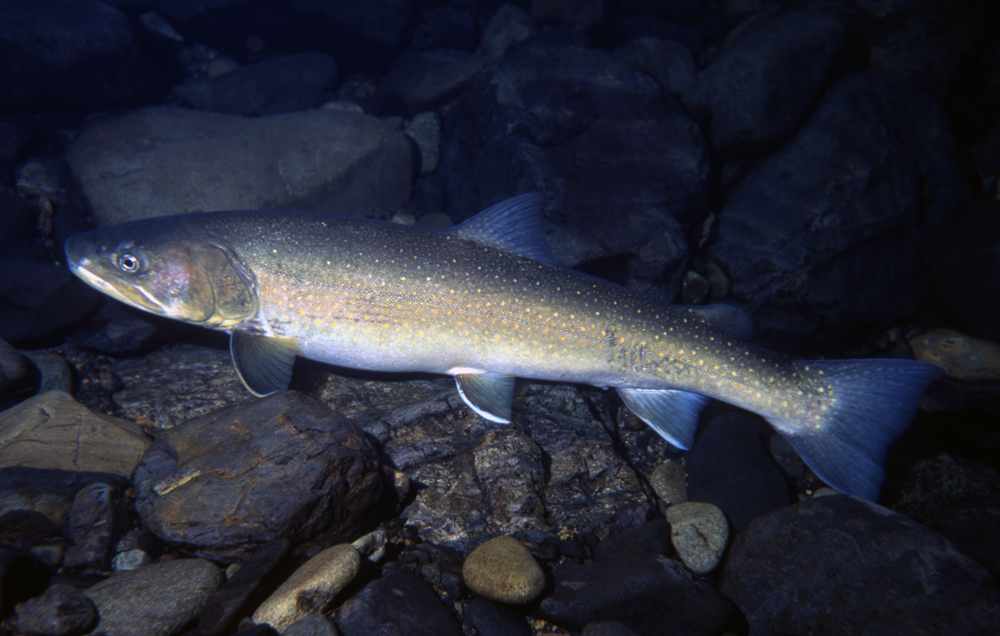
Bull Trout
Salvelinus confluentus
The bull trout (Salvelinus confluentus) is a char of the family Salmonidae native to northwestern North America. Historically, S. confluentus has been known as the "Dolly Varden" (S. malma), but was reclassified as a separate species in 1980. Populations of bull trout in the lower 48 states are listed as threatened under the U.S. Endangered Species Act, and bull trout overall are listed as vulnerable to extinction on the IUCN Red List of Threatened Species. The Saskatchewan-Nelson Rivers population in Alberta, Canada is listed as threatened under the Species at Risk Act.
From the article Bull trout on Wikipedia (CC BY-SA), quoted section by section
Description
Like other species of char, the fins of a bull trout have white leading edges. Its head and mouth are unusually large for salmonids, giving it its name. Bull trout have been recorded measuring up to 103 cm (41 in) in length and weighing 14.5 kg (32 lb). Bull trout may be either migratory, moving throughout large river systems, lakes, and the ocean, or they may be resident, remaining in the same stream their entire lives. Migratory bull trout are typically much larger than resident bull trout, which rarely exceed 2 kg (4.4 lb). Bull trout can be differentiated from brook trout (S. fontinalis) by the absence of distinct spots on the dorsal fin, as well as yellow, orange, or salmon-colored spots on the back as opposed to red spots with blue halos on the brook trout. Bull trout lack the deeply forked tail fin of lake trout (S. namaycush, another char).
Range & habitat
S. confluentus is found in the cold, clear waters of the high mountains and coastal rivers of northwestern North America, including Yukon, Alberta, British Columbia, Washington, Oregon, Idaho, and western Montana, as well as the Jarbidge River of northern Nevada and perhaps Alaska. A population of bull trout exists east of the Continental Divide in Alberta, where it is the provincial fish. The historical range of bull trout also included northern California, but they are likely extirpated. Bull trout have exacting habitat demands, requiring water temperatures generally below 55 °F (13 °C), clean gravel beds, deep pools, complex cover such as snags and cut banks, and large systems of interconnected waterways to accommodate spawning migrations. Thus, they favor the deep pools of cold lakes and large rivers, as well as high, cold mountain headwaters. Bull trout may be anadromous in coastal rivers, and individual bull trout have been found to have migrated from one coastal river to another by the ocean.
Wikipedia: “Distribution and habitat”
What it does
Young bull trout feed on zooplankton and zoobenthos, especially chironomids. As they grow larger, they begin to feed heavily upon other fish. In coastal Washington, some of the southernmost populations of bull trout feed heavily on salmon eggs and fry, as well as fish.
Wikipedia: “Feeding”
At the table
The "Dolly Varden" name is also applied to the other subspecies of S. malma, the S. m. krascheninnikova, and S. m. miyabei, found in Lake Shikaribetsu on the island of Hokkaidō in Japan. The name has also been applied to S. alpinus, today more commonly known as Arctic char.
Wikipedia: “Other uses of "Dolly Varden"”
Where it lives
Recorded sightings
—
geo-referenced records in GBIF, from museums, herbaria and field observers.
Drag the globe to turn it. Dots are where records exist, not a range map; darker means more records.
In the stacks
Searching the stacks…
Every page naming Salvelinus confluentus in the Biodiversity Heritage Library →
This page is assembled live from iNaturalist, GBIF, Wikipedia, the Source Library and the Internet Archive. It is not yet part of the hand-edited codex. iNaturalist taxon 111978.