- Animals
- ›Chordates
- ›Vertebrates
- ›Birds
- ›Perching Birds
- ›Ovenbirds and Woodcreepers
- ›Woodcreepers
- ›Dendrocolaptes
On eBird ↗
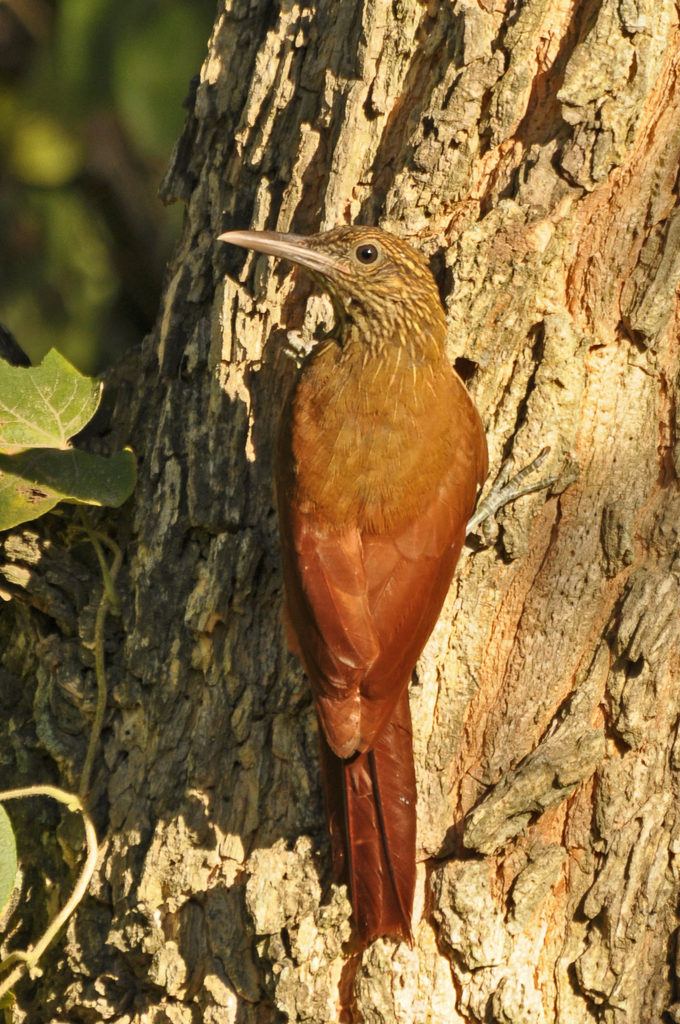
Black-banded Woodcreeper
Live sightings near you, the range map, bar charts of when it is seen, and Macaulay Library photos and recordings.
Black-banded Woodcreeper
Dendrocolaptes picumnus
The black-banded woodcreeper (Dendrocolaptes picumnus) is a species of bird in the Dendrocolaptinae subfamily, the woodcreepers. It is discontinuously spread from Chiapas to Paraguay and northern Argentina. Its natural habitats are subtropical or tropical moist lowland forests and subtropical or tropical moist montane forests.
From the article Black-banded woodcreeper on Wikipedia (CC BY-SA), quoted section by section
Description
The black-banded woodcreeper is one of the larger members of its subfamily. It is slim, with a long tail and a medium-length straight bill. It is 24 to 30.5 cm (9.4 to 12 in) long. Males weigh 47 to 89 g (1.7 to 3.1 oz) and females 48 to 98 g (1.7 to 3.5 oz). The sexes have the same plumage. Adults of the nominate subspecies D. p. picumnus have a dusky face and neck with buffy to tawny streaks and a faint supercilium and eyering. Their forehead, crown, and nape are dark brown; the crown and nape have buff to tawny streaks. Their back, scapulars and wing coverts are olive-brown; their back has fine pale streaks and faint dark bars and the coverts have pale streaks and dark bands near their ends. Their rump, wings, and tail are rufous-chestnut with dusky tips on the primaries. Their throat is whitish to deep buff with faint streaks or mottling. Their breast is olive-brown with bold buff streaks and an underlayment of spots or bars. Their belly, flanks, and undertail coverts are buffy brown with strong black bars and their underwing coverts are brighter buffy brown with blackish bars. Their iris is dark brown, their bill black with lighter edges and base to the mandible, and their legs and feet brown to greenish gray. …
Range & habitat
The subspecies of the black-banded woodcreeper are found thus: "Spot-throated" group
D. p. puncticollis, spottily in highlands of Chiapas, central Guatemala, Honduras, and north-central Nicaragua D. p. seilerni, foothills and highlands of northern Colombia's Sierra Nevada de Santa Marta and the Venezuelan Coastal Range D. p. olivaceus, eastern foothills of the central Bolivian Andes "Black-banded" group
D. p. costaricensis, highlands of central and southeastern Costa Rica and the Pacific slope of western Panama D. p. multistrigatus, the Andes and Sierra de Perijá of Colombia; northwestern and western Venezuela D. p. validus, western Amazon Basin in southeastern Colombia, eastern Ecuador and Peru, northern Bolivia, and western Brazil east to the Rio Negro and Rio Madeira and south to Mato Grosso D. p. picumnus, northern Amazon Basin of southern and eastern Venezuela, the Guianas, and northern Brazil between the Rio Negro and the Atlantic Ocean in Amapá state D. p. transfasciatus, lower Amazon Basin of Brazil between the Rio Tapajós and Rio Xingu and south to Mato Grosso "Pale-billed" group
D. p. pallescens, the Gran Chaco of eastern Bolivia, southern Brazil, and western Paraguay D. p. casaresi, Andean foothills in northwestern Argentina's Jujuy, Salta, and Tucumán provinces The black-banded woodcreeper inhabits a very wide variety of forested landscapes. …
Wikipedia: “Distribution and habitat”
What it does
The black-banded woodcreeper's diet is mostly arthropods including insects, spiders, scorpions, and centipedes, and also includes small vertebrates like lizards and sometimes frogs. Amazonian populations forage mostly by following army ant swarms to feed on prey disturbed by the ants. They also regularly forage alone and sometimes as part of a mixed-species feeding flock. Populations in mountainous areas follow ants much less than do the lowland birds. Ant followers tend to perch on a vertical trunk or branch fairly near the ground and sally from it to pick prey from the ground, trunks and branches, foliage, and epiphytes. Away from ants, birds forage at any forest level up to the sub-canopy.
Wikipedia: “Feeding”
Listen
Looking for field recordings…
Where it lives
Recorded sightings
—
geo-referenced records in GBIF, from museums, herbaria and field observers.
Drag the globe to turn it. Dots are where records exist, not a range map; darker means more records.
In the stacks
Searching the stacks…
Every page naming Dendrocolaptes picumnus in the Biodiversity Heritage Library →
This page is assembled live from iNaturalist, GBIF, Wikipedia, the Source Library and the Internet Archive. It is not yet part of the hand-edited codex. iNaturalist taxon 11131.