- Animals
- ›Arthropods
- ›Hexapods
- ›Insects
- ›Winged and Once-winged Insects
- ›Dragonflies and Damselflies
- ›Damselflies
- ›Coenagrionoid Damselflies
- ›Narrow-winged Damselflies
- ›Pseudagrion
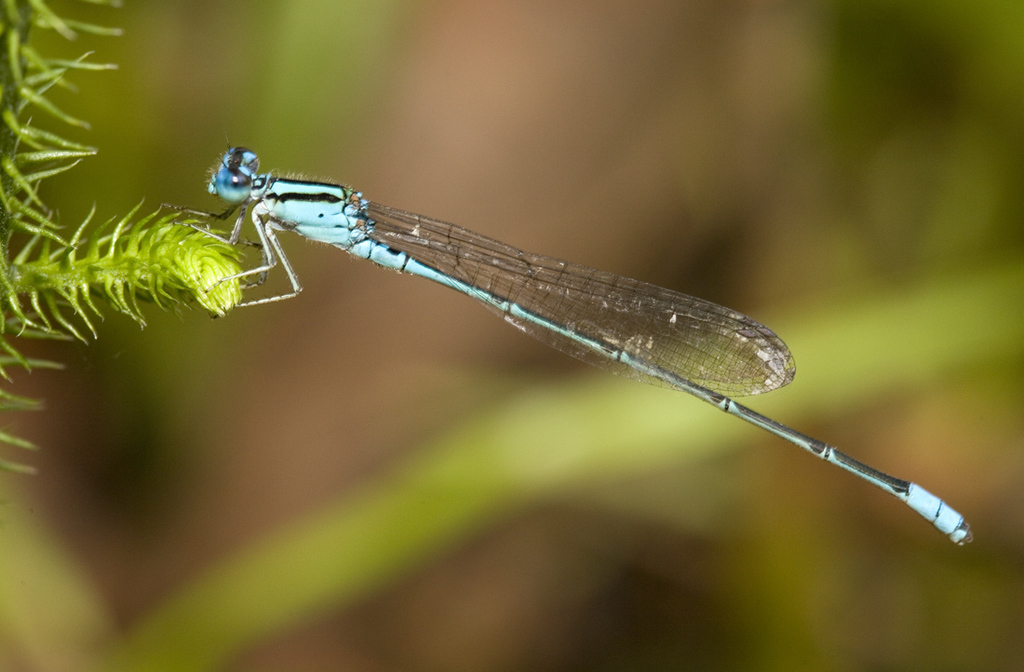
Look-alike Sprite
Pseudagrion australasiae
Pseudagrion australasiae is a species of damselfly in the family Coenagrionidae. It is found in India, China, Indonesia, Malaysia, Myanmar, Singapore and Thailand.
It is a common damselfly, but usually under-recorded due to its similarity with other blue and black colored Pseudagrion species. Laidlaw described Pseudagrion bengalense as a new species, based on the comparison of his type in the Indian Museum with the mislabeled specimen of P. microcephalum as P. australasiae in British Museum. Lieftinck clarified the situation and placed P. bengalense as a synonym of P. australasiae.
From the article Pseudagrion australasiae on Wikipedia (CC BY-SA), quoted section by section
Description
It is a medium sized damselfly with blue eyes, dark on top. The back of the head is pale blue, bordered with black. Its thorax is azure blue with broad black dorsal and humeral stripes. Abdominal segments 1 and 2 are blue with black marks on the dorsum. A mark on segment 2 looks like a vase, broadly expanded at the middle. Segments 3 to 7 are black on the dorsum and blue on the sides. There are narrow blue apical annules on each segment. Segments 8 and 9 are blue with narrow black apical fringe. Segment 10 has an X-shaped, broad black mark on the dorsum and is blue on the sides. The superior anal appendages are black, diverging outward, and curving inward on the apices like hooks. They are bifid at apices and are half the length of segment 10. The inferiors are as long as the superiors. It can be distinguished from Pseudagrion microcephalum, Pseudagrion spencei and Pseudagrion malabaricum by its short anal appendages. It can be further distinguished from Pseudagrion malabaricum by its superior anal appendages being bifid at the apices. The eyes and thorax of the female are bluish green, marked as in the male. The color of the abdomen is similar to the male, but paler. Segments 8 and 9 are also black with fine apical blue rings. Segment 10 is pale blue. It breeds in ponds, lakes, paddy fields and marshes.
Wikipedia: “Description and habitat”
Listen
Looking for field recordings…
Where it lives
Recorded sightings
—
geo-referenced records in GBIF, from museums, herbaria and field observers.
Drag the globe to turn it. Dots are where records exist, not a range map; darker means more records.
In the stacks
Searching the stacks…
Every page naming Pseudagrion australasiae in the Biodiversity Heritage Library →
This page is assembled live from iNaturalist, GBIF, Wikipedia, the Source Library and the Internet Archive. It is not yet part of the hand-edited codex. iNaturalist taxon 110779.