- Animals
- ›Arthropods
- ›Hexapods
- ›Insects
- ›Winged and Once-winged Insects
- ›Butterflies and Moths
- ›Lasiocampoidea
- ›Lappet Moths
- ›Lasiocampinae
- ›Gastropachini
- ›Phyllodesma
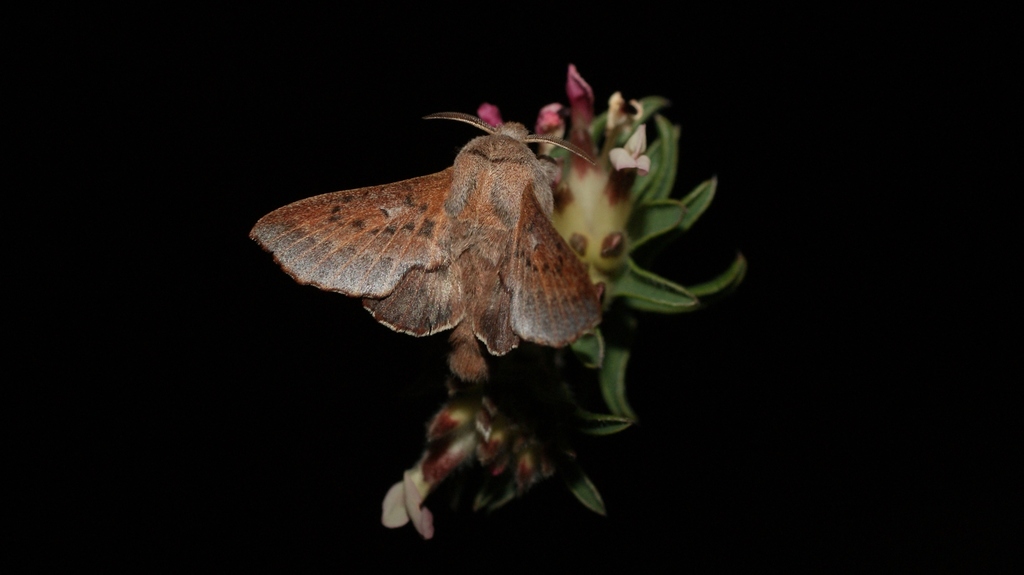
Small Lappet
Phyllodesma ilicifolia
The small lappet moth (Phyllodesma ilicifolia) is a species of moth in the family Lasiocampidae. It is found in Austria, Belarus, Belgium, China, Czech Republic, Denmark, Estonia, Finland, France, Germany, Italy, Malta, Japan, Kazakhstan, Latvia, Lithuania, Mongolia, Norway, Poland, Romania, Russia, Slovakia, Spain, Sweden, Switzerland and Ukraine.
From the article Small lappet moth on Wikipedia (CC BY-SA), quoted section by section
Description
From Meyrick L. 35–40 mm. Forewings with 9 to apex; brownish-ferruginous, slightly whitish-sprinkled; first and second lines dark grey, waved, interrupted, curved near costa; a dark grey discal mark, preceded by a whitish suffusion; a broad terminal band of whitish irroration, including a darker interrupted line, not reaching costa; cilia white, barred with dark ferruginous. Hindwings purplish-fuscous; two suffused whitish bands; 8 connected with 7, with one or two pseudoneuria. Larva grey or reddish, hairs reddish; dorsal line black, interrupted with reddish, edged with whitish; lateral blue-grey, interrupted.
Range & habitat
The moth is found in Austria, Belarus, Belgium, China, Czech Republic, Denmark, Estonia, Finland, France, Germany, Italy, Malta, Japan, Kazakhstan, Latvia, Lithuania, Mongolia, Norway, Poland, Romania, Russia, Slovakia, Spain, Sweden, Switzerland, and Ukraine. Its local extinction in the United Kingdom is considered "probable".
Wikipedia: “Distribution and habitat”
What it does
The larva feeds on Vaccinium and Salix and hibernates as a pupa within a cocoon. The adult emerges in spring, flies at night in summer and lays its eggs in batches.
Wikipedia: “Life cycle and behaviour”
Listen
Looking for field recordings…
Where it lives
Recorded sightings
—
geo-referenced records in GBIF, from museums, herbaria and field observers.
Drag the globe to turn it. Dots are where records exist, not a range map; darker means more records.
In the stacks
Searching the stacks…
Every page naming Phyllodesma ilicifolia in the Biodiversity Heritage Library →
This page is assembled live from iNaturalist, GBIF, Wikipedia, the Source Library and the Internet Archive. It is not yet part of the hand-edited codex. iNaturalist taxon 109387.