- Animals
- ›Chordates
- ›Vertebrates
- ›Ray-finned Fishes
- ›Carps, Characins, Catfishes and Allies
- ›Minnows, Suckers, Carps, and Loaches
- ›Carps and Minnows
- ›True Minnows
- ›Old World Minnows
- ›Petroleuciscus
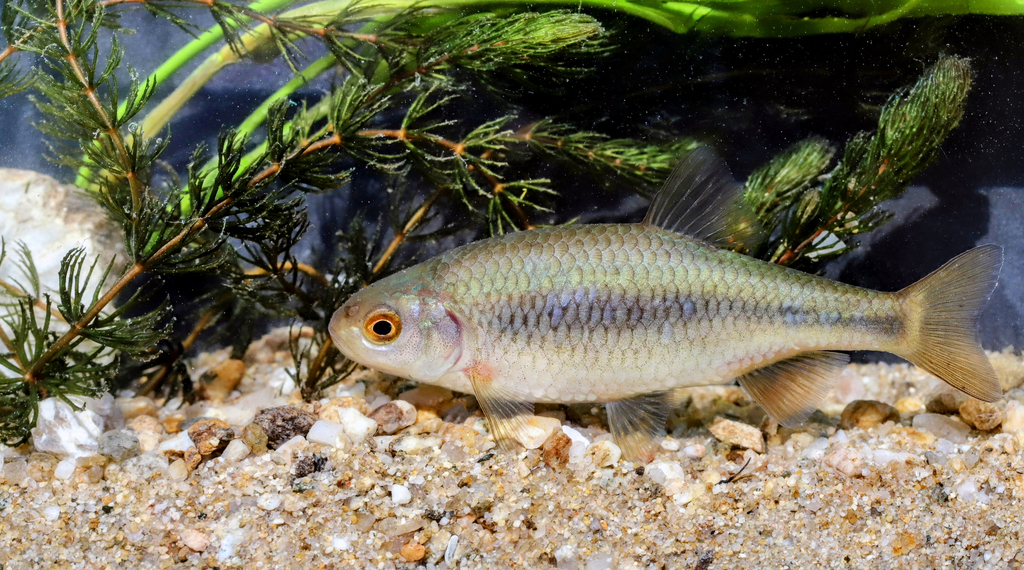
Black Sea Chub
Petroleuciscus borysthenicus
The Dnieper chub or the Black Sea chub (Petroleuciscus borysthenicus) is a species of freshwater ray-finned fish belonging to the family Leuciscidae, the daces, Eurasian minnows and related fishes. This species is found in rivers draining into the Black Sea and Sea of Azov, as well as the rivers] draining into the northern Aegean Sea.
From the article Dnieper chub on Wikipedia (CC BY-SA), quoted section by section
Description
The Dnieper chub has 3 or 4 spines and between 8 and 10 soft rays, 8 to 9+1⁄2 rays being branched, in the dorsal fin while its anal fin has 3 or 4 spines and between 9 and 12 soft rays, 9 to 10+1⁄2 rays being branched. It has an orange to red iris. The lateral line has between 33 and 40 scales. The rear margin of the anal fin is convex. There are no spots on the flank scales. This species has a maximum total length of 40 cm (16 in), although 18 cm (7.1 in) is more typical.
Range & habitat
The Dneiper chub is found in the drainage systems that drain into the Black Sea and Sea of Azov, from Bulgaria to the Dnipr, although it is absent from the Crimea and the Don, then again on the eastern shore of the Black Sea in Georgia and Russia and in northern Anatolia. It also occurs in the northern basin of the Aegean Sea as far west as the Struma. This species is found in lowland rivers, the lower reaches of montane rivers, limans, lakes, deltas, backwaters with moderate to no current. It prefers warmwaters and can tolerate water temperatures up to 30-32°C and it can tolerate quite low oxygen levels, living in marshes and water bodies with dense vegetation. It is typically a freshwater fish, but can tolerate the brackish waters of limans. It prefers substrates of sand, sand-mud or mud.
Wikipedia: “Distribution and habitat”
In human culture
The Dnieper chub is classified in the genus Petroleuciscus, this name was proposed in 2002 by Nina Gidalevna Bogutskaya and it combines Petro, a Latinisation of Petr, the forename of the Romanian ichthyologist Petre Mihai Bănărescu and of Boguskaya's son Petre Naseka, with Leuciscus, the genus many of the fishes classified in this new genus were previously classified in. The specific name, borysthenicus, means "belonging to Borysthenes", the name given to the Dneiper Valley region in ancient times.
Wikipedia: “Etymology”
Where it lives
Recorded sightings
—
geo-referenced records in GBIF, from museums, herbaria and field observers.
Drag the globe to turn it. Dots are where records exist, not a range map; darker means more records.
In the stacks
This page is assembled live from iNaturalist, GBIF, Wikipedia, the Source Library and the Internet Archive. It is not yet part of the hand-edited codex. iNaturalist taxon 109213.