On eBird ↗
Arabian Bustard
Live sightings near you, the range map, bar charts of when it is seen, and Macaulay Library photos and recordings.
Arabian Bustard
Ardeotis arabs
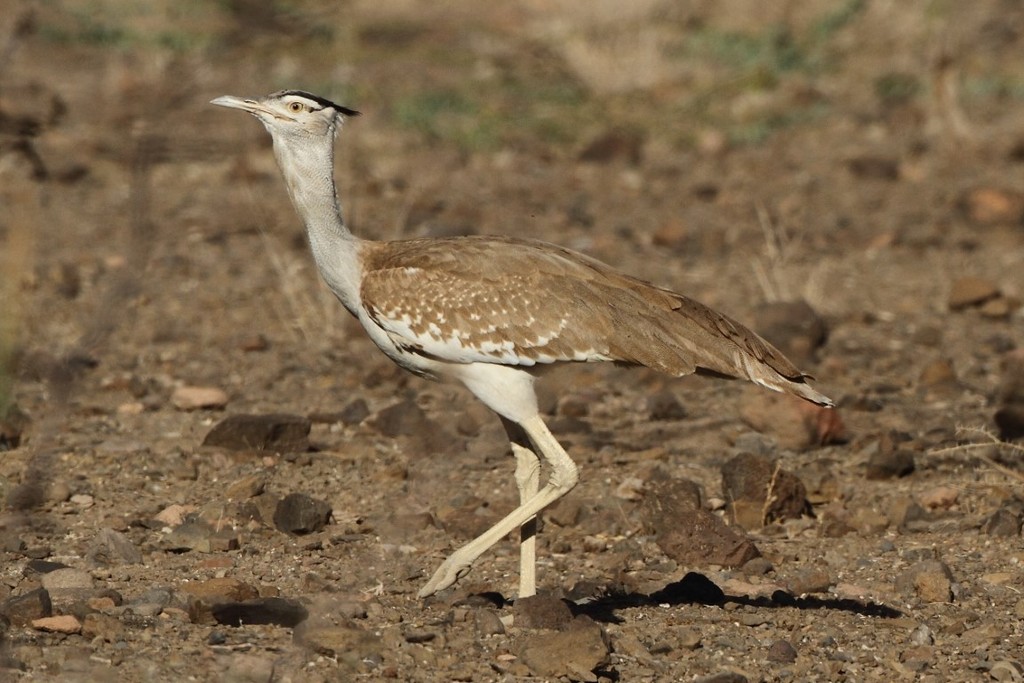
The Arabian bustard (Ardeotis arabs) is a species of bustard which is found across the Sahel region of Africa and south western Arabia. It is part of the large-bodied genus, Ardeotis, and, though little known, appears to be a fairly typical species in that group.
From the article Arabian bustard on Wikipedia (CC BY-SA), quoted section by section
Description
As in all bustards, the male Arabian bustard is much larger than the female. Males have been found to weigh 5.7–10.9 kg (13–24 lb), while females weigh 4.5–7.7 kg (9.9–17.0 lb). The record-sized male Arabian bustard weighed 16.8 kg (37 lb) this makes it rank among the heaviest flying birds on the planet in terms of maximum mass. These birds stand from 70 cm (28 in) tall in females to 92 cm (36 in) tall in males. They are fairly similar in overall appearance to the kori bustard, with a brown body, gray neck and white underside, but are noticeably smaller, with a more elegant, slender build. They also differ in having white checkered covert pattern at the end of the folded wing, as opposed to various black-and-white patterns as seen in other large African bustards.
Range & habitat
It occupies semi-desert and arid grassy plains, as well as Acacia woodlands. It is found in Algeria, Burkina Faso, Cameroon, Chad, Djibouti, Eritrea, Ethiopia, Guinea-Bissau, Iraq, Kenya, Mali, Mauritania, Morocco, Niger, Nigeria, Saudi Arabia, Senegal, Somalia, Sudan, and Yemen. It is a vagrant to Kenya, Gambia, northern Ivory Coast and northern Ghana.
Wikipedia: “Distribution and habitat”
What it does
The Arabian bustard is usually solitary or lives in pairs and family parties. Small flocks have been observed migrating north into the Sahel zone, to breed during the rainy season before returning south when the dry season begins. However the population in Morocco was considered sedentary, as is the population in the Arabian Peninsula. On these movements the Arabian bustard has been known to migrate with Denham's bustards. The clutch size of Arabian bustards is one to two eggs, laid in a shallow scrape on the ground. The females have sole responsibility for incubation of the eggs and rearing the young. When the brood is threatened, the females has been observed to demonstrate diversionary behaviour, e.g. calling, refusing to flee, to distract potential predators from chicks. Arabian bustards are reported to catch and eat locusts, grasshoppers, beetles, reptiles, and small mammals. They have also been recorded feeding on the seeds and fruits of shrubs, such as Cordia sinensis, Grewia villosa, Salvadora persica and wild melon Citrullus as well as Acacia gum.
Wikipedia: “Behaviour and ecology”
Listen
Looking for field recordings…
Where it lives
Recorded sightings
—
geo-referenced records in GBIF, from museums, herbaria and field observers.
Drag the globe to turn it. Dots are where records exist, not a range map; darker means more records.
In the stacks
Searching the stacks…
Every page naming Ardeotis arabs in the Biodiversity Heritage Library →
This page is assembled live from iNaturalist, GBIF, Wikipedia, the Source Library and the Internet Archive. It is not yet part of the hand-edited codex. iNaturalist taxon 109.