- Animals
- ›Arthropods
- ›Hexapods
- ›Insects
- ›Winged and Once-winged Insects
- ›Beetles
- ›Water, Rove, Scarab, Long-horned, Leaf, and Snout Beetles
- ›Cucujiform Beetles
- ›Cucujoidea
- ›Silvanid Flat Bark Beetles
- ›Silvaninae
- ›Silvanoprus
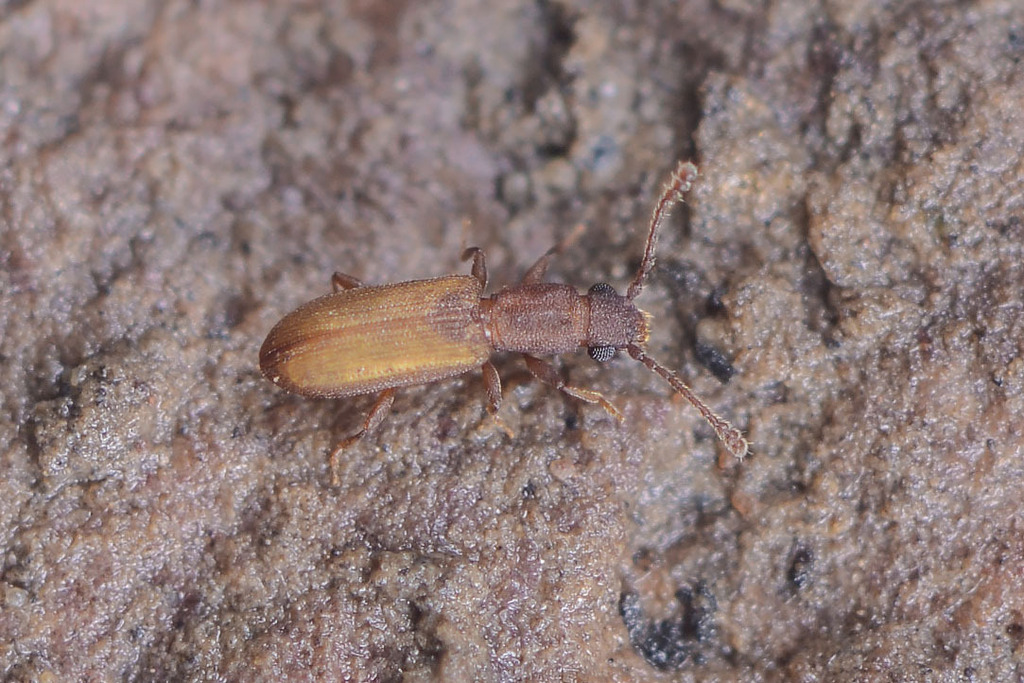
Silvanoprus cephalotes
Silvanoprus cephalotes, is a species of silvan flat bark beetle found with a widespread distribution across Oriental and Papuan regions and also in the Palaearctic Far East.
From the article Silvanoprus cephalotes on Wikipedia (CC BY-SA), quoted section by section
Description
Average length is about 2.20 to 2.42 mm. Temple is very short. Lateral margin of prothorax is slightly rounded. Minute anterior spine of prothorax. The species can be separated by other sympatric species due to the presence of a small denticle on the front femur and the barrel-shaped pro-notum with very small anterior angles. The head is distinctly broader than the pronotum across anterior angles.
Range & habitat
It is found in India, Sri Lanka, Bangladesh, Nepal, Bhutan, China, Taiwan, Japan, Vietnam, Peninsular Malaysia, Indonesian islands such as Borneo, Sumatra, Java; and Papua New Guinea. The species has introduced to United Kingdom and the United States of America particularly with imported products of plant origin and also been found in Tanzania.
Wikipedia: “Distribution”
What it does
Adults are usually located in decomposing plant matter, where they feed on fungal substrates. In domestic environments, beetles can be found in haystacks, under bark, and also on stored products such as grains, copra, and flour. Adults are easily attracted by light.
== References ==
Wikipedia: “Ecology”
Listen
Looking for field recordings…
Where it lives
Recorded sightings
—
geo-referenced records in GBIF, from museums, herbaria and field observers.
Drag the globe to turn it. Dots are where records exist, not a range map; darker means more records.
In the stacks
Searching the stacks…
Every page naming Silvanoprus cephalotes in the Biodiversity Heritage Library →
This page is assembled live from iNaturalist, GBIF, Wikipedia, the Source Library and the Internet Archive. It is not yet part of the hand-edited codex. iNaturalist taxon 1085063.