On eBird ↗
Lesser Prairie-Chicken
Live sightings near you, the range map, bar charts of when it is seen, and Macaulay Library photos and recordings.
Lesser Prairie-Chicken
Tympanuchus pallidicinctus
The lesser prairie chicken (Tympanuchus pallidicinctus), a species in the grouse family, is slightly smaller and paler than its near relative the greater prairie chicken. About half of its current population lives in western Kansas, with the other half in the sandhills and prairies of western Oklahoma, the Texas Panhandle including the Llano Estacado, eastern New Mexico, and southeastern Colorado.
From the article Lesser prairie-chicken on Wikipedia (CC BY-SA), quoted section by section
Description
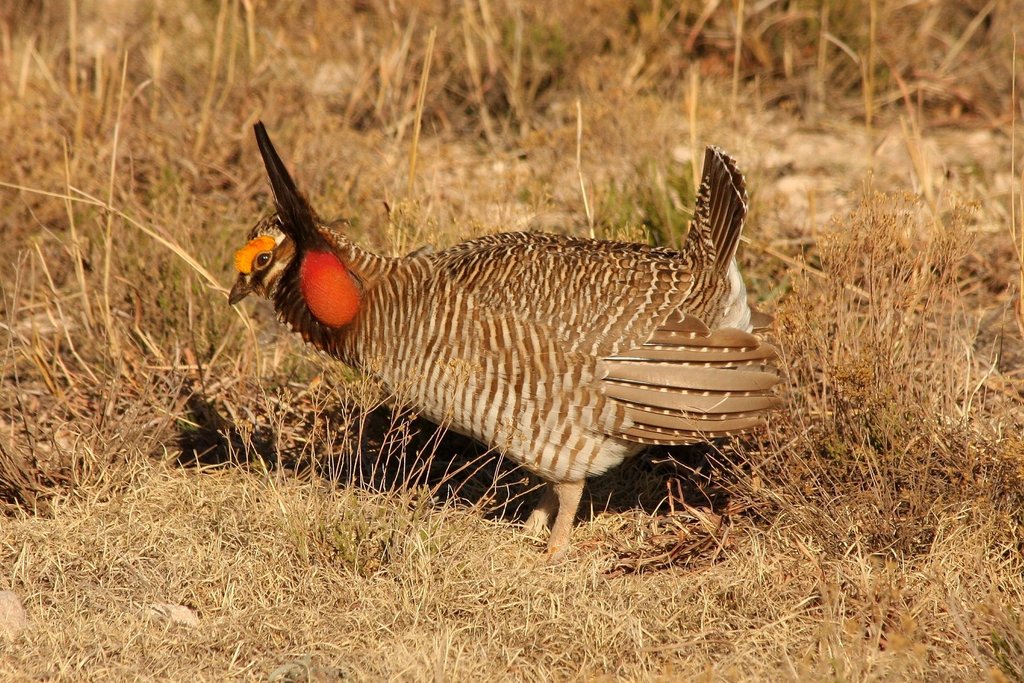
Adult individuals are medium to large birds, striped white and brown like its near relative, the Greater prairie-chicken (T. cupido), though it is smaller and paler. Adults range from 15.0 to 16.1 inches (38 to 41 cm) in length and 22.1 to 28.7 ounces (630 to 810 g) in weight. Mature males sport yellow, comb-like feathers above each eye, as well as long head feathers that can be raised to show their pinkish-red Gular sacs. One is present on each side of the neck, which becomes inflated to be used in mating displays.
Range & habitat
About half of its current population lives in western Kansas, with the other half in the sandhills and prairies of western Oklahoma, the Texas Panhandle including the Llano Estacado, eastern New Mexico, and southeastern Colorado. They prefer environments containing sand sagebrush and shinnery oak, as well as various grasses and shrubs depending on the area.
Wikipedia: “Distribution and habitat”
What it does
Like its larger relative, it is known for its lekking behavior, particularly the "booming" call produced during mating displays. They typically prefer wide, open areas such as hills and ridges with short grass for their leks, however the use of man-made structures such as roads or oil platforms has also been observed. During the months of April and May, males will establish an area for themselves and potential mates, and will typically become territorial as the spring season progresses. This process is repeated to a lesser degree in the fall, beginning as early as late August and reaching a height in October. Males in particular are likely to return to the same territory repeatedly. Females will begin nesting following mating, most frequently in May. Nests are dug about 5–10 cm into the ground, with a width of up to 20cm. These nests are lined with grasses, leaves, and feathers, and may be located within taller grasses or beneath brush and shrubs for shade and shelter. A single brood usually contains 11–14 eggs, hatching about 23 days after being laid. Chicks become fledged within 4 weeks, and after 8–10, will be left on their own as the mother hen leaves to molt.
Wikipedia: “Behavior”
Toxicity
On March 27, 2014, the lesser prairie-chicken was listed as threatened under the Endangered Species Act but the listing was vacated in 2015 following a legal challenge. On June 1, 2021, the US Fish and Wildlife Service (USFWS) proposed splitting the species into two segments. The northern one, covering Oklahoma, Colorado, Kansas, and a portion of Texas, would be listed as threatened, and the southern one, covering New Mexico and a portion of Texas, as endangered. On November 17, 2022, the USFWS published a final rule listing the Southern Distinct Population Segment (DPS) of the lesser prairie-chicken as endangered and the Northern DPS as threatened. Implementation of the rule was delayed, and it took effect on March 27, 2023. In 2015, Senator Jerry Moran (R-Kan) introduced an amendment to legislation authorizing construction of the Keystone XL Pipeline that would overturn the listing. He disputed the listing as, "... another example of unnecessary intrusion into private lives and businesses by the federal government." His action was supported by the American Energy Alliance and opposed by the League of Conservation Voters. When the Senate voted on the Keystone bill, it did not get the 60 votes in favor that was required to pass. …
Wikipedia: “Threatened and endangered species listings”
Listen
Looking for field recordings…
Where it lives
Recorded sightings
—
geo-referenced records in GBIF, from museums, herbaria and field observers.
Drag the globe to turn it. Dots are where records exist, not a range map; darker means more records.
In the stacks
Searching the stacks…
Every page naming Tympanuchus pallidicinctus in the Biodiversity Heritage Library →
This page is assembled live from iNaturalist, GBIF, Wikipedia, the Source Library and the Internet Archive. It is not yet part of the hand-edited codex. iNaturalist taxon 1078.