- Animals
- ›Chordates
- ›Vertebrates
- ›Birds
- ›Perching Birds
- ›Ovenbirds and Woodcreepers
- ›Typical Ovenbirds
- ›Thripadectes
On eBird ↗
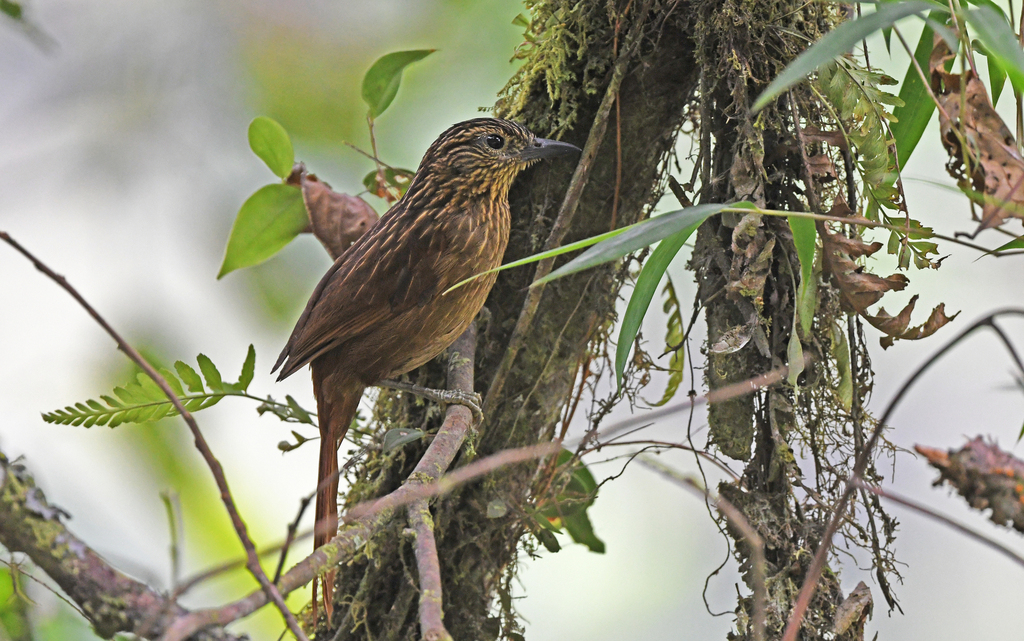
Striped Treehunter
Live sightings near you, the range map, bar charts of when it is seen, and Macaulay Library photos and recordings.
Striped Treehunter
Thripadectes holostictus
The striped treehunter (Thripadectes holostictus) is a species of bird in the Furnariidae family with a dusky-brown coloring with prominent buff streaking on the wings, throat, and breast. It is found in humid to wet montane forests that range locally in the Andes from west Venezuela to west Bolivia (Bolivia, Colombia, Ecuador, Peru, and Venezuela) most often at elevations of 1500–2500 m. It is most often mistaken for and with the larger flammulated treehunter due to many...
From the article Striped treehunter on Wikipedia (CC BY-SA), quoted section by section
Description
The striped treehunter is 20 to 21 cm (7.9 to 8.3 in) long and weighs 38 to 49 g (1.3 to 1.7 oz). It is a bulky, dark furnariid with a thrush-like shape. The sexes have the same plumage. Adults of the nominate subspecies T. h. holostictus have a mostly blackish-brown face with buff streaks, some of which merge to form a supercilium. Their lores are grizzled blackish brown and buff. Their crown is blackish brown with strong buff streaks. Their back is dark brown with buff streaks and their rump dull dark brown that blends to reddish brown uppertail coverts. Their wings are rich brown and their tail dark chestnut-brown. Their throat is tawny-buff with dark feather borders that give a streaked appearance that extends onto the upper breast. The rest of their breast is medium brown with pale buff streaks, their belly similar to the lower breast but becomes unstreaked by its bottom, their flanks darker and more rufescent, and their undertail coverts darker than the belly with a reddish brown tinge. Their iris is brown to dark brown, their bill black with sometimes a lighter base to the mandible, and their legs and feet olive-brown to greenish gray. Juveniles have narrower streaks on the upperparts than adults and a mottled, rather than streaked, belly. Subspecies T. h. …
Range & habitat
The striped treehunter has a somewhat disjunct distribution. The nominate subspecies is found from the Andes of western Venezuela through Colombia's Eastern and Central Andes and eastern Ecuador into Peru as far as the Department of La Libertad. Subspecies T. h. striatidorsus is found from Cauca Department in Colombia's Western Andes south into western Ecuador as far as Chimborazo Province. T. h. moderatus is found in the Andes from the Department of Huánuco in Peru south and east into central Bolivia. The striped treehunter inhabits montane evergreen forest in the subtropical zone and highly favors thickets of Chusquea bamboo, though it also occurs locally in secondary forest. It tends to stay in the undergrowth. In elevation it mostly ranges from 1,500 to 2,500 m (4,900 to 8,200 ft). In Colombia it occurs as low as 700 m (2,300 ft) and as high as 3,150 m (10,300 ft). In Ecuador it occurs as high as 3,000 m (9,800 ft).
Wikipedia: “Distribution and habitat”
What it does
The striped treehunter's diet is mostly arthropods and may also include small vertebrates. It forages in dense undergrowth, usually by itself, and only occasionally joins mixed-species feeding flocks. It gleans and probes for its prey in dead leaves and debris in the forest understory, usually within about 1 m (3.5 ft) of the ground. It might specialize in hunting in dead leaves.
Wikipedia: “Feeding”
Listen
Looking for field recordings…
Where it lives
Recorded sightings
—
geo-referenced records in GBIF, from museums, herbaria and field observers.
Drag the globe to turn it. Dots are where records exist, not a range map; darker means more records.
In the stacks
Searching the stacks…
Every page naming Thripadectes holostictus in the Biodiversity Heritage Library →
This page is assembled live from iNaturalist, GBIF, Wikipedia, the Source Library and the Internet Archive. It is not yet part of the hand-edited codex. iNaturalist taxon 10773.