- Animals
- ›Chordates
- ›Vertebrates
- ›Ray-finned Fishes
- ›Salmons, Pikes and Mudminnows
- ›Salmons, Trouts, and Whitefishes
- ›Salmons, Trouts, and Whitefishes
- ›Salmons and Trouts
- ›Oncorhynchus
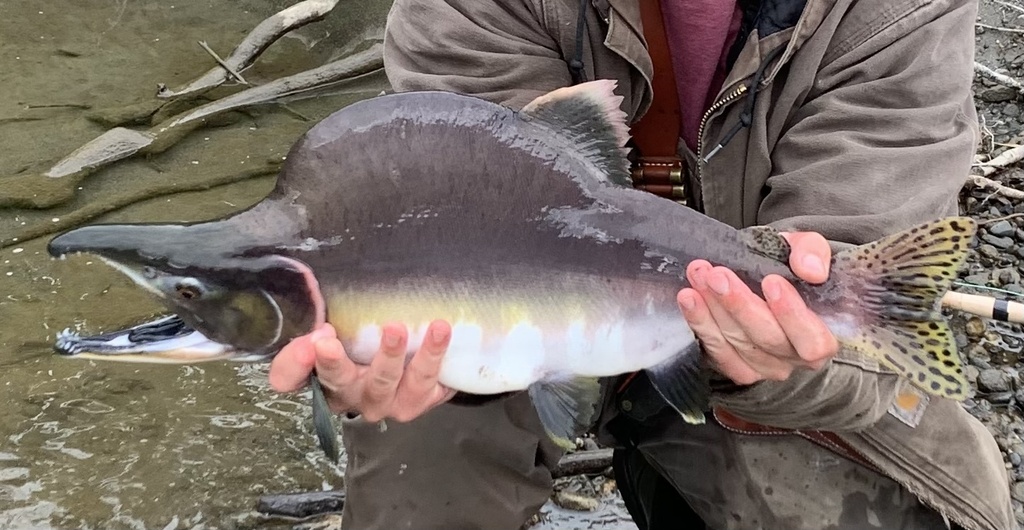
Pink Salmon
Oncorhynchus gorbuscha
Pink salmon or humpback salmon (Oncorhynchus gorbuscha) is a species of euryhaline ray-finned fish in the family Salmonidae. It is the type species of the genus Oncorhynchus (Pacific salmon), and is the smallest and most abundant of the seven officially recognized species of salmon. The species' scientific name is based on the Russian common name for this species gorbúša (горбуша), which literally means humpie.
From the article Pink salmon on Wikipedia (CC BY-SA), quoted section by section
Description
In the ocean, pink salmon are bright silver fish. After returning to their spawning streams, their coloring changes to pale grey on the back with yellowish-white belly (although some turn an overall dull green color). As with all salmon, in addition to the dorsal fin, they also have an adipose fin. The fish is characterized by a white mouth with black gums, no teeth on the tongue, large oval-shaped black spots on the back, a v-shaped tail, and an anal fin with 13–17 soft rays. During their spawning migration, males develop a pronounced humped back, hence their nickname "humpies". Pink salmon average 4.8 pounds (2.2 kg) in weight. The maximum recorded size was 30 inches (76 cm) and 15 pounds (6.8 kg).
Range & habitat
The native range of the species is in the Pacific and Arctic coastal waters and rivers, from the Sacramento River in northern California to the Mackenzie River in Canada; and in the west from the Lena River in Siberia to Korea and Honshu in Japan. In North America, pink salmon spawn from the Mackenzie River in the Arctic to as far south as tributaries of Puget Sound, Washington, although they were also reported in the San Lorenzo River near Santa Cruz, California, in 1915, and the Sacramento River in northern California in the 1950s. In 2013, a new record for the southernmost extent of spawning pink salmon was published for the Salinas River. In the fall of 2017, a dozen pink salmon were counted in Lagunitas Creek about 25 miles (40 km) north of San Francisco, California. Populations were also stocked on the coast of Maine and Maryland, but disappeared by 1973. Pink salmon were introduced into the Great Lakes of North America. The first recorded release was of about 100 salmon in 1956, which escaped into Thunder Bay of Lake Superior while being transported via seaplane to a hatchery. A population of about 21,000 fingerlings from a hatchery at Port Arthur, Ontario, were also released as surplus in the Current River, a tributary of the lake. Second-generation fish were first caught in 1959, showing that reproduction was occurring. …
Wikipedia: “Distribution”
What it does
Pink salmon in their native range have a strict two year life cycle, thus odd and even-year populations do not interbreed. In the state of Washington, pink salmon runs occur on odd years. Adult pink salmon enter spawning streams from the ocean, usually returning to the stream where they originated. Spawning occurs between late June and mid-October, in coastal streams and some longer rivers, and in the intertidal zone or at the mouth of streams if hyporheic freshwater is available. Using her tail, the female digs a trough-shaped nest, called a redd or rede (Scandinavian word for "nest"), in the gravel of the stream bed, where she deposits her eggs. As she expels the eggs, she is approached by one or more males, which fertilize them as they fall into the redd. Subsequently, the female covers the newly deposited zygotes, again with thrusts of her tail, against the gravel at the top of the redd. The female lays from 1,000 to 2,000 eggs in several clutches within the redd, often fertilized by different males. Females guard their redds until death, which comes within days of spawning. In dense populations, a major source of mortality for embryos is a superposition of redds by later-spawning fish. …
Wikipedia: “Reproduction”
Where it lives
Recorded sightings
—
geo-referenced records in GBIF, from museums, herbaria and field observers.
Drag the globe to turn it. Dots are where records exist, not a range map; darker means more records.
In the stacks
Searching the stacks…
Every page naming Oncorhynchus gorbuscha in the Biodiversity Heritage Library →
This page is assembled live from iNaturalist, GBIF, Wikipedia, the Source Library and the Internet Archive. It is not yet part of the hand-edited codex. iNaturalist taxon 107570.