- Animals
- ›Chordates
- ›Vertebrates
- ›Ray-finned Fishes
- ›Carps, Characins, Catfishes and Allies
- ›Catfishes
- ›Siluroidei
- ›North American Freshwater Catfishes
- ›Noturus
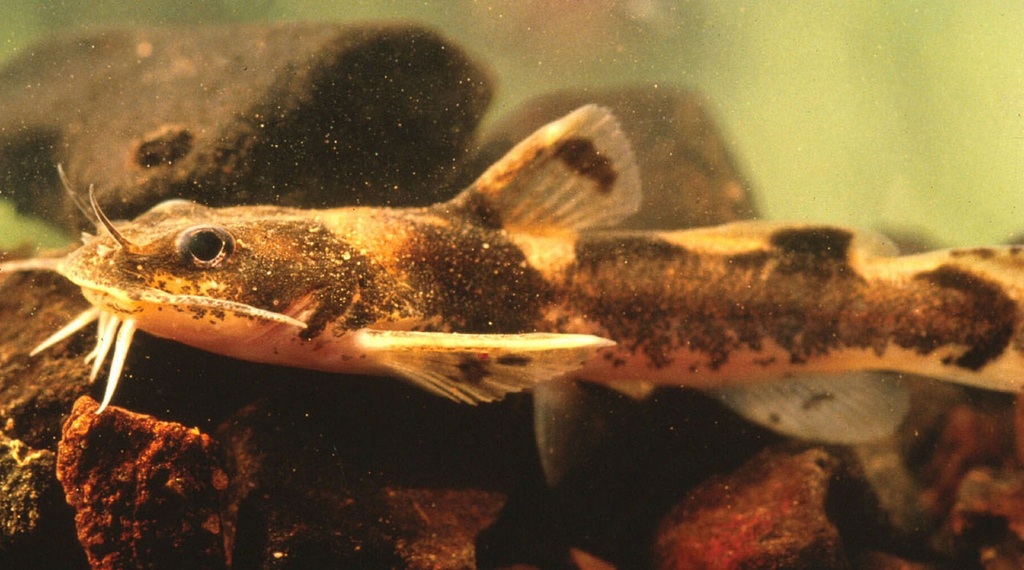
Carolina Madtom
Noturus furiosus
The Carolina madtom (Noturus furiosus) is an endangered species of fish in the family Ictaluridae. It is endemic to North Carolina. It is a small catfish, reaching a maximum length of nearly five inches. Described in the late-1800s by ichthyologists Jordan and Meek, this fish is the only madtom that is endemic to North Carolina, as indicated by its common name.
From the article Carolina madtom on Wikipedia (CC BY-SA), quoted section by section
Description
When compared to other madtoms, the Carolina madtom has a short, chunky body and a distinct color pattern. Three dark saddles along its back connect a wide, black stripe along its side extending from its snout to the base of its tail. The adipose fin has a dark blotch that does not quite reach the fin's edge, giving the impression of a fourth saddle. Yellowish to tan blotches space the saddles, while the rest of the fish is tan. The belly is un-speckled, and the tail has crescent-shaped brown bands near its edge and center. Its pectoral spines have well-defined serrated (saw-like) projections along both margins. Stinging spines in its pectoral fins, earn this fish the "furiosus" title that is part of its scientific name.
Wikipedia: “Appearance”
Range & habitat
The Carolina madtom lives in medium to large freshwater streams and rivers throughout the Piedmont and Coastal Plain areas, specifically in riffles, runs, and pools where there's a constant flow of water and a moderate gradient. They inhabit substrate which is stable, made up of gravel and cobble, and primarily free of any silt. Furthermore, they require the use of cover, such as under rocks, bark, mussel shells, and more, for their nesting areas. Carolina madtoms have a relatively limited habitat distribution and population abundance, only being found in specific regions of the Tar and Neuse river basins of North Carolina. Because of this, they are classified as "Significantly Rare" in the Tar River basin and of "Special Concern" in the Neuse River basin according to the N.C. Natural Heritage Program.
Artificial cover units. In response to recent habitat degradation and cover loss, scientists have experimented with the use of implementing artificial cover units throughout the Tar and Neuse River basins. These artificial cover units are made up of terra cotta and aim to improve the habitat conditions for Carolina madtoms by providing them with adequate cover and protection. …
Wikipedia: “Habitat”
What it does
The Carolina madtom is a sight feeder most active during the night, with peaks at dawn and dusk. It eats bottom-dwelling invertebrates such as larval midges, mayflies, caddisflies, dragonflies and beetle larvae.
Wikipedia: “Diet”
How it is grown
Streams with urbanized or agriculturally dominated riparian corridors tend to have more sediment in the water and unstable banks and/or impervious surface runoff, resulting in less suitable streams for fish as compared to habitat with forested corridors. For example, increased sedimentation can lead to less sunlight reaching the lower depths of the water. This negatively affects the growth and survival of plants and other primary producers, which Carolina madtoms and other species depend on for feeding and respiration. Increased sedimentation can also degrade the Carolina madtom's suitable habitat by filling in areas of cover.
Wikipedia: “Agriculture and development”
In human culture
Female Carolina madtoms lay around 80 to 300 eggs each season while the male Carolina madtoms protect and watch over the eggs. Spawning season typically starts in May and may continue through July. Carolina madtoms fully mature at around two to three years old, and during their first two years of life, they grow to a length of roughly two inches. While their exact lifespan is currently unknown, Carolina madtoms live to at least four years old.
Wikipedia: “Life history”
Where it lives
Recorded sightings
—
geo-referenced records in GBIF, from museums, herbaria and field observers.
Drag the globe to turn it. Dots are where records exist, not a range map; darker means more records.
In the stacks
Searching the stacks…
Every page naming Noturus furiosus in the Biodiversity Heritage Library →
This page is assembled live from iNaturalist, GBIF, Wikipedia, the Source Library and the Internet Archive. It is not yet part of the hand-edited codex. iNaturalist taxon 107284.