- Animals
- ›Chordates
- ›Vertebrates
- ›Ray-finned Fishes
- ›Spiny-rayed fishes
- ›Rivulines, Killifishes, and Livebearers
- ›Rivulines
- ›African Rivulines
- ›Nothobranchius
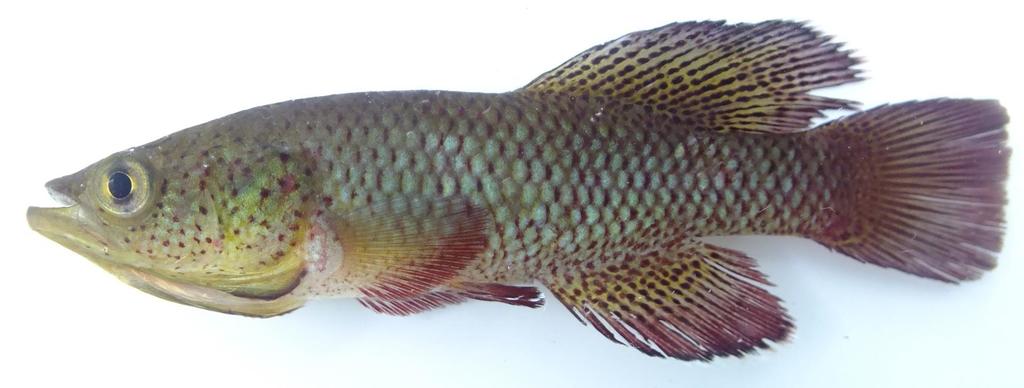
Spotted Killifish
Nothobranchius orthonotus
The spotted killifish (Nothobranchius orthonotus) is a small, short lived species of fish, an African rivuline from the family Nothobranchiidae. These fish are native to many isolated freshwater pools located in the savannah depressions of east Africa, specifically Malawi, Mozambique, Zimbabwe, and South Africa. This species of fish occurs in ephemeral waters and killifish eggs can survive long periods of dehydration. The word killifish likely comes from the Dutch kil for kill (small stream).
From the article Spotted killifish on Wikipedia (CC BY-SA), quoted section by section
Description
Fish with the genus Nothobranchius show a striking level of sexual dichomatism, where the males portray bright colors, and the females are dull. The adult spotted killifish is one of the largest of its genus, and can grow up to 10 centimetres (3.9 in) in length.
Wikipedia: “Characteristics”
Range & habitat
The spotted killifish is native to isolated freshwater pools located in the savannah depressions of east Africa, specifically Malawi, Mozambique, Zimbabwe, and South Africa. This species was found to share these pools with N. furzeri, N. kadleci and N.rachovii, all congeners. The natural environments inhabited can range from non-vegetated and shallow with cloudy water, all the way to densely overgrown pools, that are fairly deep and have clear water. This species may also be present in swamps intermittently connected to floodplains. Given the lifecycle of the spotted killifish, it has adapted to varying dry and wet weather conditions that persist in this part of the world. However, due to recent anti-malarial and tsetse fly spraying programs, the populations of spotted killifish are becoming threatened. Though this species is threatened, it is at lower risk, and not yet in need of acts of conservation given that the threats are localized.
Wikipedia: “Habitat and ecology”
What it does
The spotted killifish consumes both aquatic invertebrates and vertebrates, its diet consists mainly of juvenile lungfish (Protopterus annectens) and larval amphibia. In addition to these, this species also consumes a relatively high proportion of insect larvae from the orders Odonata, Coleoptera and Ephemeroptera. Diets such as these may be deemed as profitable for the trade-offs in item size and ease of catching.
Wikipedia: “Diet”
Where it lives
Recorded sightings
—
geo-referenced records in GBIF, from museums, herbaria and field observers.
Drag the globe to turn it. Dots are where records exist, not a range map; darker means more records.
In the stacks
Searching the stacks…
Every page naming Nothobranchius orthonotus in the Biodiversity Heritage Library →
This page is assembled live from iNaturalist, GBIF, Wikipedia, the Source Library and the Internet Archive. It is not yet part of the hand-edited codex. iNaturalist taxon 107138.