On eBird ↗
Red-billed Pied Tanager
Live sightings near you, the range map, bar charts of when it is seen, and Macaulay Library photos and recordings.
Red-billed Pied Tanager
Lamprospiza melanoleuca
The red-billed pied tanager (Lamprospiza melanoleuca) is a species of bird in the family Mitrospingidae. It is found in Bolivia, Brazil, French Guiana, Guyana, Peru and Suriname. Placed in family Thraupidae, the "true" tanagers, for over two centuries, the International Ornithological Committee reclassified this species to Mitrospingidae in 2018.
From the article Red-billed pied tanager on Wikipedia (CC BY-SA), quoted section by section
Description
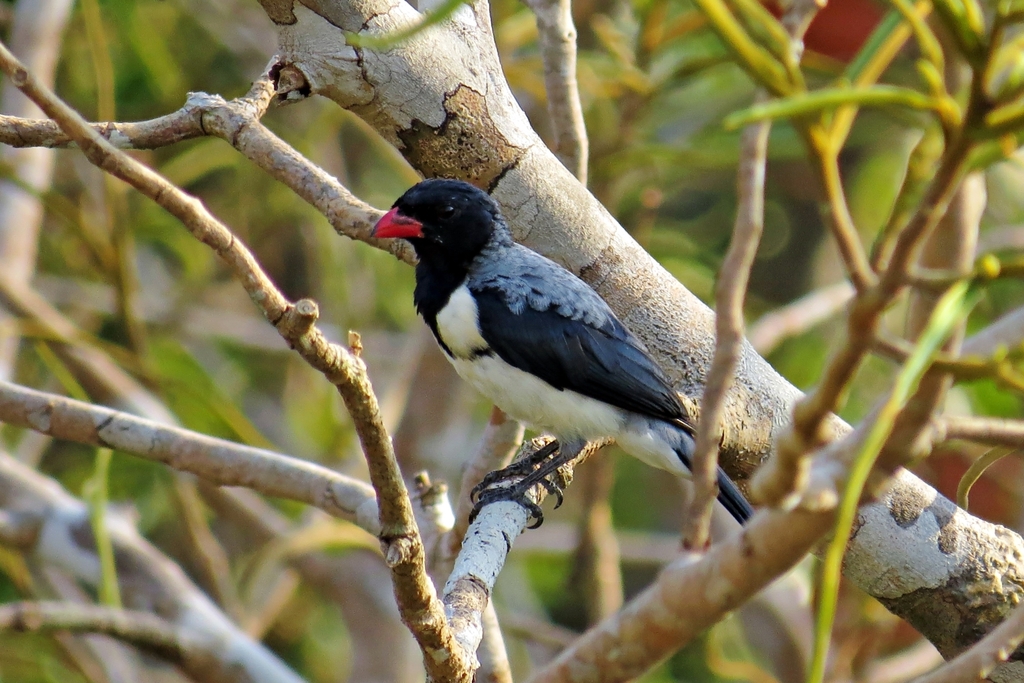
The red-billed pied tanager is 17 to 18 cm (6.7 to 7.1 in) long and weighs 24 to 42 g (0.85 to 1.48 oz). The male's head and upper parts are glossy blue-black, its throat and chest black, and the rest of the underparts white. The female is similar but the nape, back, and rump are gray. Both have the eponymous red bill. The juvenile is quite different; it has a black bill and head. Its upper back is white and the lower back mottled black and white. The underparts are white with some black mixed in.
Range & habitat
The red-billed pied tanager is found in the upper Amazon Basin from eastern and southeastern Peru and northern Bolivia east to central Brazil and north into the Guianas. There it inhabits the canopy and emergent trees of humid terra firme forest up to about 900 m (3,000 ft) elevation. It can also be found on the edges of the forest.
Wikipedia: “Distribution and habitat”
What it does
The red-billed pied tanager's diet includes berries, seeds, beetles, and Cecropia catkins. It typically forages in groups of three to eight individuals that may associate with mixed-species feeding flocks. It hops between branches and occasionally sallies out for flying prey.
Wikipedia: “Feeding”
Listen
Looking for field recordings…
Where it lives
Recorded sightings
—
geo-referenced records in GBIF, from museums, herbaria and field observers.
Drag the globe to turn it. Dots are where records exist, not a range map; darker means more records.
In the stacks
Searching the stacks…
Every page naming Lamprospiza melanoleuca in the Biodiversity Heritage Library →
This page is assembled live from iNaturalist, GBIF, Wikipedia, the Source Library and the Internet Archive. It is not yet part of the hand-edited codex. iNaturalist taxon 10713.