On eBird ↗
Black-masked Finch
Live sightings near you, the range map, bar charts of when it is seen, and Macaulay Library photos and recordings.
Black-masked Finch
Coryphaspiza melanotis
The black-masked finch (Coryphaspiza melanotis) is a species of bird traditionally placed in the Emberizidae family, but it may be more closely related to the Thraupidae. Its current family status is incertae sedis. It is the only member of the genus Coryphaspiza.
From the article Black-masked finch on Wikipedia (CC BY-SA), quoted section by section
Description
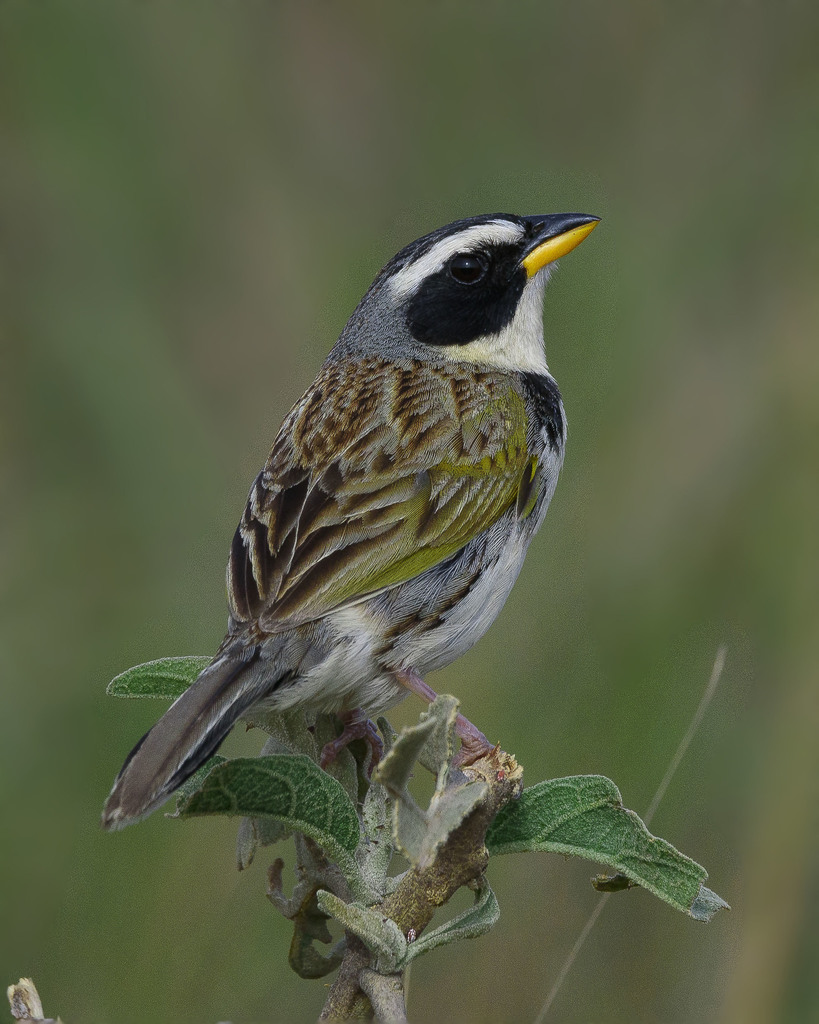
The black-masked finch is about 13.5 cm (5.3 in) long and weighs about 16 g (0.56 oz). The sexes have the same plumage. Adults of the nominate subspecies have a black forehead and crown, a long and wide white supercilium, and a large triangular black mask from the lores to the grayish nape. Most individuals have a black-streaked, grayish olive mantle and upper back and a grayish lower back and rump. Their upperwing is greenish, their marginal coverts yellow, their inner greater coverts grayish, and their tertials greenish with grayish edges. (Some instead have a pale-edged chestnut-brown mantle, scapulars, greater coverts, and tertials.) Their tail's innermost pair of feathers are gray and the rest blackish with large white tips on the inner web. Their throat is white; their underparts are also white with a black spur on the side of the breast, blackish patches or streaking on the flanks, and sometimes a creamy buff tinge throughout. They have a dark iris, a stout thick-based bill with a black maxilla and a bright yellow mandible, and dull pink legs and feet. Subspecies C. m. marajoara is slightly smaller than the nominate and has wider and blacker streaks on it its back.
Range & habitat
The black-masked finch has a disjunct distribution; the subspecies are widely separated. The nominate subspecies has the more southerly and by far the larger range. It is found from the Pampas del Heath in extreme southeastern Madre de Dios Department in southeastern Peru east across northern Bolivia into western Brazil. In Brazil its range is roughly bounded by a line from the Bolivian border in west-central Mato Grosso east to northern Goiás, then southeast to southeastern Minas Gerais, and then west into Paraguay and extreme northeastern Argentina from western Paraná. Subspecies C. m. marajoara is found only on Marajó Island in the Amazon Delta of northeastern Brazil. A few records in eastern Brazil's Rio Grande do Norte have not been assigned to a subspecies. The black-masked finch inhabits tall and tussock grasslands with minimal shrubs. In elevation it ranges from near sea level to 1,200 m (3,900 ft).
Wikipedia: “Distribution and habitat”
What it does
The black-masked finch's diet is not known. In the breeding season it typically forages in pairs and may form flocks in the non-breeding season. It usually forages under grass but sometimes on bare soil.
Wikipedia: “Feeding”
Listen
Looking for field recordings…
Where it lives
Recorded sightings
—
geo-referenced records in GBIF, from museums, herbaria and field observers.
Drag the globe to turn it. Dots are where records exist, not a range map; darker means more records.
In the stacks
Searching the stacks…
Every page naming Coryphaspiza melanotis in the Biodiversity Heritage Library →
This page is assembled live from iNaturalist, GBIF, Wikipedia, the Source Library and the Internet Archive. It is not yet part of the hand-edited codex. iNaturalist taxon 10704.