On eBird ↗
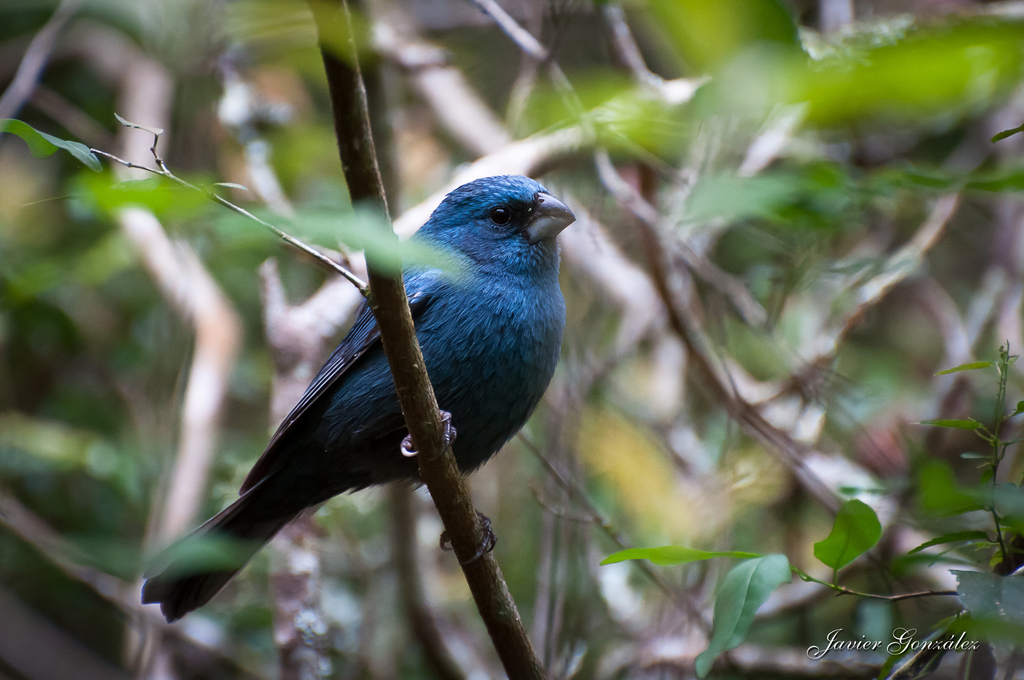
Glaucous-blue Grosbeak
Live sightings near you, the range map, bar charts of when it is seen, and Macaulay Library photos and recordings.
Glaucous-blue Grosbeak
Cyanoloxia glaucocaerulea
The glaucous-blue grosbeak (Cyanoloxia glaucocaerulea), also known as the indigo grosbeak, is a species of bird in the family Cardinalidae. The South American Classification Committee of the American Ornithological Society assigns three more species to Cyanoloxia.
From the article Glaucous-blue grosbeak on Wikipedia (CC BY-SA), quoted section by section
Description
The glaucous-blue grosbeak is approximately 14 cm (5.5 in) long. Three birds weighed from 16 to 19.5 g (0.56 to 0.69 oz). The male is generally dark sky blue that is lighter on the forehead and rump and is grayish on the lower belly. It has a small black "mask". The female is brown overall, warm and dark above and orange-tinged below. The immature is orange-brown that is darker on the back, and it has a hint of blue on the forehead and cheek.
Range & habitat
The glaucous-blue grosbeak nests in northeastern Argentina, southeastern Brazil, and much of Uruguay. During the austral winter, some move into southeastern Paraguay and further north in Brazil. It inhabits low, somewhat dense, vegetation such as along forest edges, on river islands, in marshes, and in secondary forest. In elevation it ranges from near sea level to 1,700 m (5,600 ft) in Brazil.
Wikipedia: “Distribution and habitat”
What it does
The glaucous-blue grosbeak is known to forage in pairs but other details and its diet have not been published.
Wikipedia: “Feeding”
Listen
Looking for field recordings…
Where it lives
Recorded sightings
—
geo-referenced records in GBIF, from museums, herbaria and field observers.
Drag the globe to turn it. Dots are where records exist, not a range map; darker means more records.
In the stacks
Searching the stacks…
Every page naming Cyanoloxia glaucocaerulea in the Biodiversity Heritage Library →
This page is assembled live from iNaturalist, GBIF, Wikipedia, the Source Library and the Internet Archive. It is not yet part of the hand-edited codex. iNaturalist taxon 10690.