- Animals
- ›Chordates
- ›Vertebrates
- ›Ray-finned Fishes
- ›Spiny-rayed fishes
- ›Gobies, cardinalfishes and allies
- ›Gobies and allies
- ›Gobies
- ›Gobiinae
- ›Neogobius
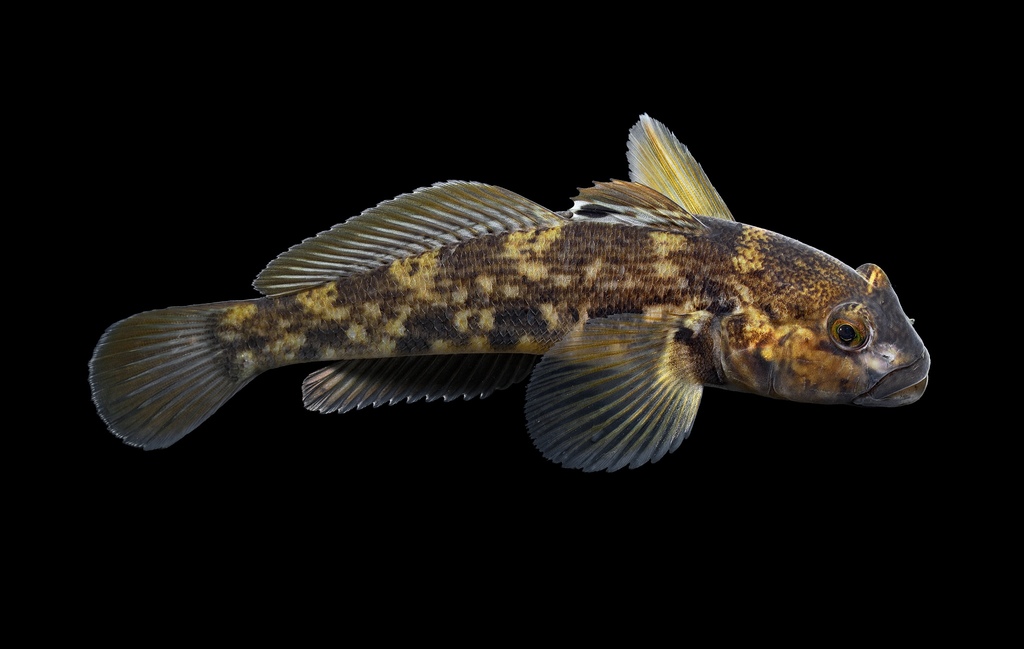
Round Goby
Neogobius melanostomus
The round goby (Neogobius melanostomus) is a euryhaline bottom-dwelling species of fish of the family Gobiidae. It is native to Central Eurasia, including the Black Sea and the Caspian Sea. Round gobies have established large non-native populations in the Baltic Sea, several major Eurasian rivers, and the North American Great Lakes.
From the article Round goby on Wikipedia (CC BY-SA), quoted section by section
Description
Round gobies are small, soft-bodied fish characterized by a distinctive black spot on the first dorsal fin. The eyes are large and protrude slightly from the top of the head and, like most gobies, the pelvic fins are fused to form a single disc (shaped like a suction cup) on the belly. Round gobies range in length from 10 to 25 centimetres (4 to 10 inches), with a maximum size of 24.6 cm (9.7 in). They weigh between 5.0 and 79.8 grams (0.176 and 2.816 ounces), their weight increasing with age. Male round gobies are larger than females. Juvenile round gobies (less than one year old) are grey. Upon maturation, round gobies become mottled with grey, black, brown, and olive green markings. Adult male round gobies turn inky black during the spawning season and develop swollen cheeks. Male and female round gobies are easily differentiated by the shape of their urogenital papilla, which in males is white to grey and long and pointed and in females is brown, short, and blunt-tipped.
Wikipedia: “Characteristics”
Range & habitat
Round gobies are widespread in the Sea of Marmara and in the rivers of its basin and can also be found in the Black Sea and the Sea of Azov, along all coasts and fresh waters of their basins as well as in the coastal lakes and lagoons. They are also found in the rivers of Crimea and the Caucasus (Mezib, Pshada, Vulan, Kodori, and Çoruh) and in the Caspian Sea, represented by subspecies Neogobius melanostomus affinis. Round gobies are euryhaline (salt-tolerant) and live in both freshwater and marine ecosystems, up to a mineralization of 18–24%. They are commonly found on continental shelves with sandy and rocky bottoms with low silting at depths from 1–2 m (3.3–6.6 ft) to 10–17 m (33–56 ft).
Introduced range. Since 1990, the round goby has been registered as introduced in the North American Great Lakes, in parts of Europe, and in the Baltic Sea as an invasive species. The first catch in North America was documented by Jude et al. 1992 and Crossman et al. 1992, caught by an angler in Sarnia, Ontario, fishing the St. Clair River on June 28, 1990. The studies of Jude, Crossman, together with Jude et al. 1995 found a range of sizes between 29 and 180 millimetres (1+1⁄8 and 7+1⁄8 in) in the St. Clair. …
Wikipedia: “Distribution and habitat”
What it does
Round gobies actively feed both nocturnally and diurnally and are believed to detect prey only while stationary. The primary diet of round gobies includes mollusks, crustaceans, worms, zebra mussels, insect larvae, and other small invertebrates (insects and amphipods) living on the bottom of lakes and streams. In spring, the main elements of their diet in the Sasyk Lagoon are Hydrobia, Cerastoderma, and Abra. In the same season, near the Romanian coasts of the Black Sea, the round goby feeds on polychaetes, crustaceans (Idotea balthica, Pachygrapsus marmoratus, Xantho poressa, etc.), and juvenile gobies. Near Sevastopol, the round goby feeds on molluscs (Mytilaster lineatus and Abra sp.). In the Baltic Sea, they impact Mytilus edulis populations. In the Gulf of Odessa, twenty-three items are identified in the diet of the round goby; Mytilus galloprovincialis, Setia pulcherrima, Mytilaster lineatus, Lentidium mediterraneum, Idotea balthica, and Alitta (Nereis) succinea dominate in the spring, while in the summer, the diet consists mainly of Sphaeroma pulchellum and L. mediterraneum. The mussels M. galloprovincialis and M. lineatus are important in all seasons. In the Great Lakes, where it is invasive, they prey on Dreissena polymorpha, another Great Lakes exotic from the same native region.
Wikipedia: “Feeding”
Where it lives
Recorded sightings
—
geo-referenced records in GBIF, from museums, herbaria and field observers.
Drag the globe to turn it. Dots are where records exist, not a range map; darker means more records.
In the stacks
Searching the stacks…
Every page naming Neogobius melanostomus in the Biodiversity Heritage Library →
This page is assembled live from iNaturalist, GBIF, Wikipedia, the Source Library and the Internet Archive. It is not yet part of the hand-edited codex. iNaturalist taxon 106743.