On eBird ↗
Pale-throated Pampa-Finch
Live sightings near you, the range map, bar charts of when it is seen, and Macaulay Library photos and recordings.
Pale-throated Pampa-Finch
Embernagra longicauda
The serra finch (Embernagra longicauda), also known as the pale-throated Pampa-finch, is a species of bird traditionally placed in the family Emberizidae, though recent research suggests it is either very close to the Thraupidae or even part thereof. It is endemic to Brazil. Its natural habitats are dry savanna and subtropical or tropical high-altitude shrubland. It is becoming rare due to habitat loss.
From the article Serra finch on Wikipedia (CC BY-SA), quoted section by section
Description
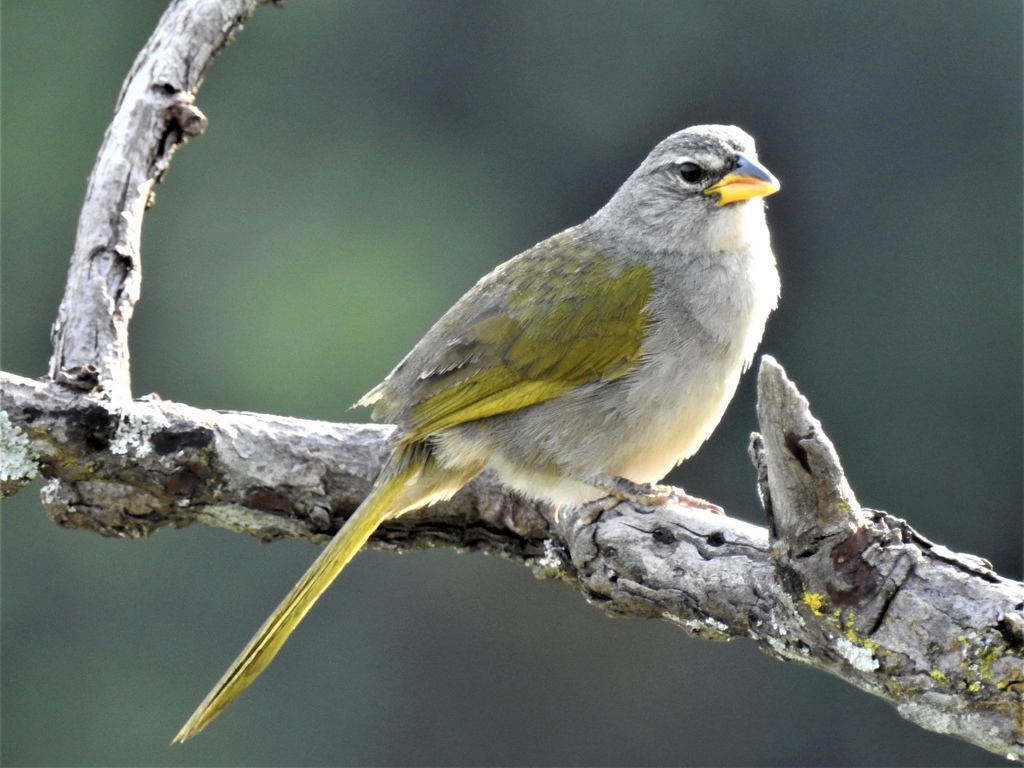
The serra finch is about 21.5 cm (8.5 in) long. It has short wings, a long tail, and a long and thick bill. The sexes have the same plumage. Adults have a dark line from the lores through the eye, a pale spot above the lores, and white crescents above and below the eye on an otherwise gray head. Their upperparts are greenish gray. Their wings are greenish gray with wide grass-green edges on the feathers, and so look brighter than the upperparts. Their tail's central feathers are greenish and the rest dusky with wide grass-green edges. Their throat is white, their breast grayer, their flanks slightly browner, their belly and vent off-white, and their undertail coverts have a warm buff wash. They have a dark iris, a yellow to orange-yellow bill with a black culmen, grayish to pinkish orange legs, and somewhat more olive feet.
Range & habitat
The serra finch is found in eastern Brazil from central Bahia south to southern Minas Gerais. There are also scattered records further north, west, and south of the core range. There are also a few recent records in Espírito Santo. The serra finch primarily inhabits campos rupestres, a biome characterized by grasses, open woodlands, and rock outcroppings. Within it the species prefers woodlands and scrubby areas to open grassland. Sources differ on its elevational range. One states it is between 900 and 2,100 m (3,000 and 6,900 ft) while another places it much lower between 700 and 1,300 m (2,300 and 4,300 ft).
Wikipedia: “Distribution and habitat”
What it does
The serra finch feeds mostly on arthropods and fleshy fruits but also includes some dry seeds in its diet. Pairs and family groups forage on the ground.
Wikipedia: “Feeding”
Listen
Looking for field recordings…
Where it lives
Recorded sightings
—
geo-referenced records in GBIF, from museums, herbaria and field observers.
Drag the globe to turn it. Dots are where records exist, not a range map; darker means more records.
In the stacks
Searching the stacks…
Every page naming Embernagra longicauda in the Biodiversity Heritage Library →
This page is assembled live from iNaturalist, GBIF, Wikipedia, the Source Library and the Internet Archive. It is not yet part of the hand-edited codex. iNaturalist taxon 10669.