- Plants
- ›Vascular Plants
- ›flowering plants
- ›Dicots
- ›Legumes, Milkworts, and Allies
- ›Legumes
- ›Peacock Flower Subfamily
- ›Caesalpinieae
- ›Biancaea
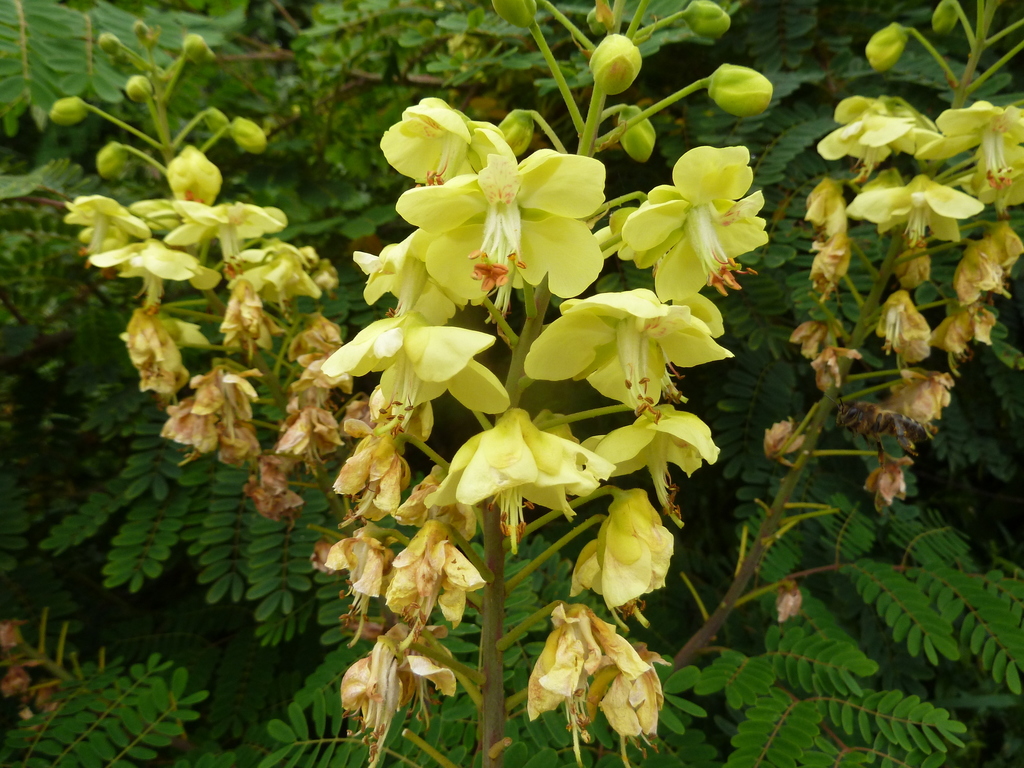
Mysore Thorn
Biancaea decapetala
Biancaea decapetala, commonly known as shoofly, Mauritius or Mysore thorn or the cat's claw, is a tropical tree species originating in India.
From the article Biancaea decapetala on Wikipedia (CC BY-SA), quoted section by section
Description
B. decapetala is as a robust, thorny, evergreen shrub 2–4 m (6.6–13.1 ft) high or climber up to 10 m (33 ft) or higher; often forming dense thickets; the stems are covered with minute golden hair; the stem thorns are straight to hooked, numerous, and not in regular rows or confined to nodes. The leaves are dark green, paler beneath, not glossy, up to 300 mm (12 in) long; leaflets up to 8 mm (0.31 in) wide. The flowers are pale yellow, in elongated, erect clusters 100–400 mm (3.9–16 in) long. Fruit are brown, woody pods, flattened, unsegmented, smooth, sharply beaked at apex, about 80 mm (3.1 in) long.
Range & habitat
B. decapetala has been introduced to Fiji, French Polynesia, Hawai‘i, New Caledonia, Norfolk Island, Australia, China, Japan, Korea, Indonesia, Malaysia, Philippines, Thailand, Vietnam, Mauritius, Réunion, Rodrigues, Kenya and South Africa. It has become a seriously problematic invasive species in many locations.
Wikipedia: “Introduced range”
What it does
In Hawai‘i, where B. decapetala has the local name pōpoki, it forms impenetrable brambles, climbs high up trees, closes off pastures to animals and impedes forest pathways. Trailing branches root where they touch the ground. The medium-sized seeds may be dispersed by rodents and granivorous birds and running water.
Wikipedia: “Habit and reproduction”
At the table
Mauritius Thorn has been employed in primate conservation to dissuade apes from entering farmland in West Africa. However, this is no longer suggested due to its invasive nature.
Wikipedia: “Uses”
Where it lives
Recorded sightings
—
geo-referenced records in GBIF, from museums, herbaria and field observers.
Drag the globe to turn it. Dots are where records exist, not a range map; darker means more records.
In the stacks
Searching the stacks…
Every page naming Biancaea decapetala in the Biodiversity Heritage Library →
This page is assembled live from iNaturalist, GBIF, Wikipedia, the Source Library and the Internet Archive. It is not yet part of the hand-edited codex. iNaturalist taxon 1065370.