- Animals
- ›Chordates
- ›Vertebrates
- ›Ray-finned Fishes
- ›Spiny-rayed fishes
- ›Perches, Scorpionfishes, Sticklebacks, and Allies
- ›Perches, groupers and allies
- ›Groupers
- ›Mycteroperca
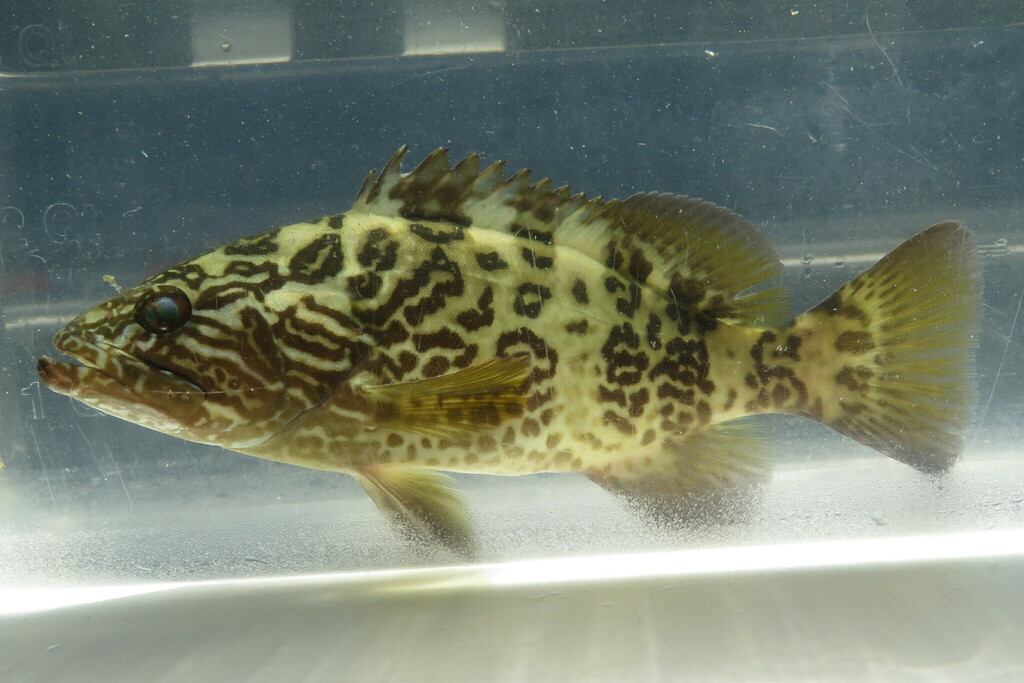
Gag Grouper
Mycteroperca microlepis
The gag grouper (Mycteroperca microlepis), also known as velvet rockfish, the gag, or charcoal belly, is a species of marine ray-finned fish, a grouper from the subfamily Epinephelinae which is part of the family Serranidae, which also includes the anthias and sea basses. It comes from warmer parts of the West Atlantic, including the Caribbean and Gulf of Mexico. It is a drab, mottled-gray fish lacking the distinguishing features of most other groupers. Its pattern of markings resemble the box-shaped spots of the black grouper (Mycteroperca bonaci). It lacks the streamer-points on the tail fin that scamp (M. phenax) and yellowmouth grouper (M. interstitialis) have and lacks yellow coloration around the mouth.
From the article Mycteroperca microlepis on Wikipedia (CC BY-SA), quoted section by section
Description
The gag grouper has an oblong, robust body which is laterally compressed. The depth of the body is normally less than the length of the head and it is usually roughly equal in depth at the origin of the dorsal fin and at the anal fin origin. The standard length is three to three and a half times the depth of the body. The dorsal profile of the head is convex and the preopercle has a rounded lobe at its angle which has enlarged serrations. The dorsal fin contains 11 spines and 16 to 18 soft rays while the anal fin contains 3 spines and 10 to 12 soft rays. The membranes between the dorsal fin spines are notched with the third and fourth spines being the longest. The caudal fin is square. The adult females and the juveniles are normally pale grey to brown-grey marked with darker blotches and wavy lines that give a marbled appearance to the upper flanks and back. The pelvic, anal and caudal fins have bluish-black margins. When resting they often assume a camouflage pattern with 5 dark brown saddles separated by white bars along the base of the dorsal fin. The large adult males are typically pale to medium grey in colour, with an indistinct reticulated pattern underneath the dorsal fin. …
Range & habitat
The gag grouper is found in the western Atlantic Ocean where it has a disjunct distribution. The northern population is found around Bermuda and along the eastern coast of the United States from North Carolina south to Yucatan Peninsula of Mexico but it is largely absent from Cuba, apart from one record of a vagrant. The southern population is found in southern Brazil from Rio de Janeiro State to Santa Catarina State. Juveniles have been recorded in as far north as Massachusetts.
Wikipedia: “Distribution”
Where it lives
Recorded sightings
—
geo-referenced records in GBIF, from museums, herbaria and field observers.
Drag the globe to turn it. Dots are where records exist, not a range map; darker means more records.
In the stacks
Searching the stacks…
Every page naming Mycteroperca microlepis in the Biodiversity Heritage Library →
This page is assembled live from iNaturalist, GBIF, Wikipedia, the Source Library and the Internet Archive. It is not yet part of the hand-edited codex. iNaturalist taxon 106308.