On eBird ↗
White-capped Tanager
Live sightings near you, the range map, bar charts of when it is seen, and Macaulay Library photos and recordings.
White-capped Tanager
Sericossypha albocristata
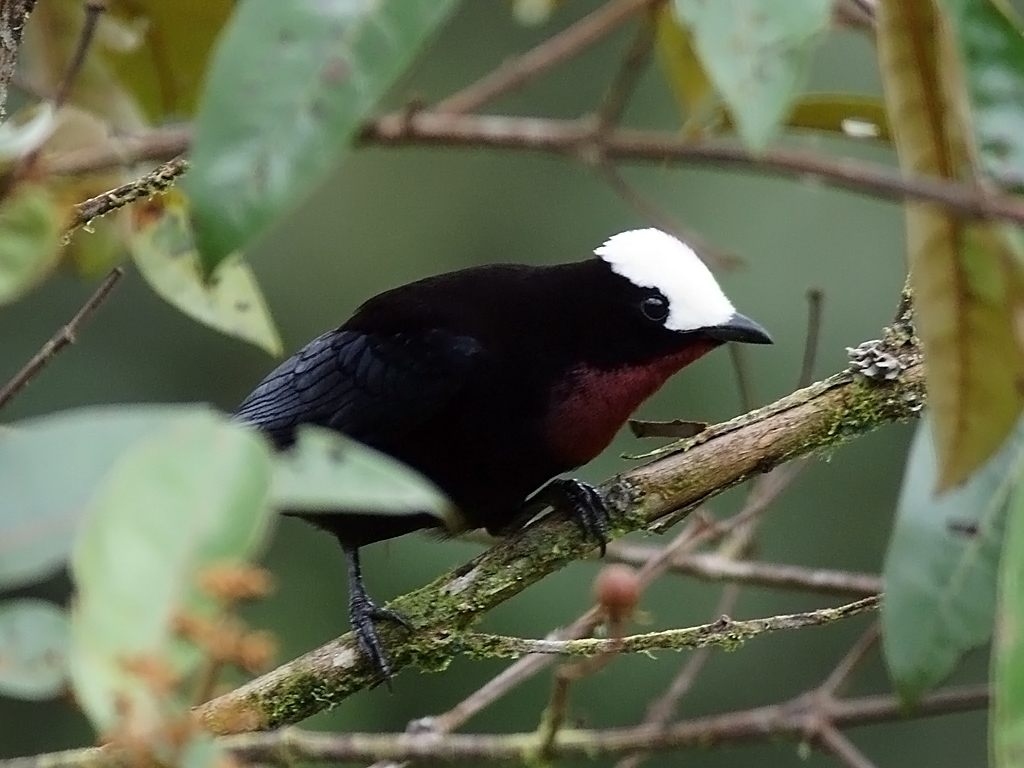
The white-capped tanager (Sericossypha albocristata) is the heaviest but not the longest species of tanager, at a weight of 114 g (4 oz) and a length of 24 cm (9.5 in). This species is glossy black overall with a large white crown and a red throat (which is brightest in adult males). It occurs in Colombia, Venezuela, Ecuador and Peru at elevations of 1600–3200 m. It lives in humid forest in groups of up to 20 individuals. Flocks of these tanagers...
From the article White-capped tanager on Wikipedia (CC BY-SA), quoted section by section
Description
The white-capped tanager is the heaviest member of its family. It averages 24 cm (9.4 in) long and weighs 95 to 125 g (3.4 to 4.4 oz). The species is slightly sexually dimorphic. Adult males have pure white lores, forehead, and crown with a plush texture. Their body is mostly velvety black with a bright crimson throat and breast. Their wings and tail are glossy bluish black. Adult females are less glossy than males and have a duskier throat and breast that is almost purple. Juveniles have a buffy gray crown and only a small amount of red on their chin and upper throat.
Range & habitat
The white-capped tanager has a disjunct distribution. It is found intermittently on the eastern slope of the Andes from extreme southern Táchira in western Venezuela south along Colombia's Eastern Andes and eastern Ecuador into Peru as far as Junín Department. It also is found in Colombia in the upper Magdalena River valley and on both slopes of the Central Andes. The white-capped tanager inhabits the interior of humid montane forest heavy with mosses. It is found less frequently on the forest edges and secondary forest. In elevation it ranges between 1,800 and 3,000 m (5,900 and 9,800 ft) in Venezuela, between 2,000 and 3,300 m (6,600 and 10,800 ft) in Colombia, mostly between 1,900 and 2,700 m (6,200 and 8,900 ft) in Ecuador, and between 1,700 and 2,800 m (5,600 and 9,200 ft) in Peru.
Wikipedia: “Distribution and habitat”
What it does
The white-capped tanager's diet has not been studied but specimens' stomachs have contained a variety of larval and adult insects, seeds, and fruit, and a snail shell. It typically forages in what appear to be family groups of up to eight individuals but flocks of up to 20 are known. It seldom joins mixed-species feeding flocks but does associate with a few other species. It forages mostly near or in the forest canopy but will do so lower at the forest edge. It apparently has large foraging ranges.
Wikipedia: “Feeding”
Listen
Looking for field recordings…
Where it lives
Recorded sightings
—
geo-referenced records in GBIF, from museums, herbaria and field observers.
Drag the globe to turn it. Dots are where records exist, not a range map; darker means more records.
In the stacks
Searching the stacks…
Every page naming Sericossypha albocristata in the Biodiversity Heritage Library →
This page is assembled live from iNaturalist, GBIF, Wikipedia, the Source Library and the Internet Archive. It is not yet part of the hand-edited codex. iNaturalist taxon 10609.