On eBird ↗
Black-throated Shrike-Tanager
Live sightings near you, the range map, bar charts of when it is seen, and Macaulay Library photos and recordings.
Black-throated Shrike-Tanager
Lanio aurantius
The black-throated shrike-tanager (Lanio aurantius) is a species of bird in the family Thraupidae. It is found in Belize, Guatemala, Honduras, and Mexico. Its natural habitat is subtropical or tropical moist lowland forests.
From the article Black-throated shrike-tanager on Wikipedia (CC BY-SA), quoted section by section
Description
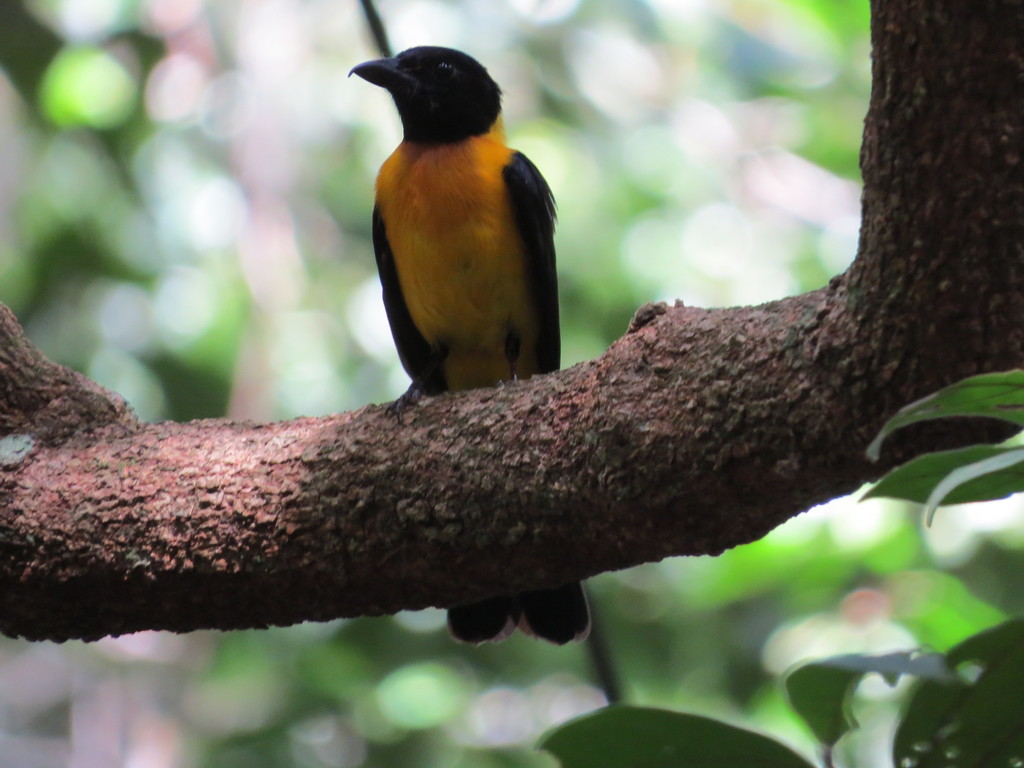
The black-throated shrike-tanager is 19 to 20 cm (7.5 to 7.9 in) long. It has a shrike-like "toothed" bill with a hooked end. The species is sexually dimorphic. Adult males have a bright yellow body with a faint brownish ochre wash on the breast. Their head, nape, throat, wings, and tail are black, with white tips on the lesser wing coverts. Adult females have a gray head with an olive tinge on the crown. Their upperparts, wings, and tail are tawny-brown with a strong rufescent tinge on the rump and tail. Their throat is gray, their breast and belly yellow, and their undertail coverts ochre. Their breast, sides, and flanks have an olive wash. Both sexes have a dark brown iris and blackish legs. Males have a black bill; females' are blackish.
Range & habitat
The black-throated shrike-tanager is found on the Gulf/Caribbean slope from central Veracruz in southeastern Mexico east through Tabasco and Chiapas including the base of the Yucatán Peninsula and continuing east across northern Guatemala, south through western Belize and eastern Guatemala, and east into northwestern Honduras to Atlántida Department. It inhabits humid evergreen and semi-deciduous forest. Sources differ slightly on its upper elevational limit, stating it as 1,200 m (3,900 ft) and 1,250 m (4,100 ft).
Wikipedia: “Distribution and habitat”
What it does
The black-throated shrike tanager's diet has not been studied but is known to include insects. It primarily forages from the forest's mid-level to its canopy. Pairs are almost always members of a mixed-species feeding flock and often act as sentinels. It captures prey stirred up by the flock with a fast acrobatic chase.
Wikipedia: “Feeding”
Listen
Looking for field recordings…
Where it lives
Recorded sightings
—
geo-referenced records in GBIF, from museums, herbaria and field observers.
Drag the globe to turn it. Dots are where records exist, not a range map; darker means more records.
In the stacks
Searching the stacks…
Every page naming Lanio aurantius in the Biodiversity Heritage Library →
This page is assembled live from iNaturalist, GBIF, Wikipedia, the Source Library and the Internet Archive. It is not yet part of the hand-edited codex. iNaturalist taxon 10568.