On eBird ↗
Black-faced Dacnis
Live sightings near you, the range map, bar charts of when it is seen, and Macaulay Library photos and recordings.
Black-faced Dacnis
Dacnis lineata
The black-faced dacnis (Dacnis lineata) is a species of bird in the family Thraupidae. It is found in humid forest in the Amazon and the Chocó-Magdalena. The latter population has a yellow (not white) belly and is sometimes considered a separate species, the yellow-tufted dacnis (D. egregia).
From the article Black-faced dacnis on Wikipedia (CC BY-SA), quoted section by section
Description
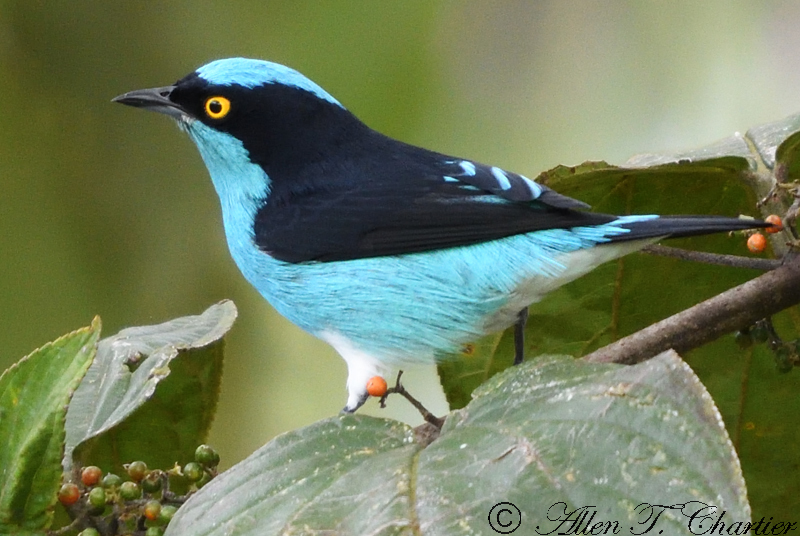
The black-faced dacnis is about 11 cm (4.3 in) long and weighs 9.5 to 13 g (0.34 to 0.46 oz). It has a thin, sharply pointed bill. The species is sexually dimorphic. Adult males have a turquoise blue crown and a wide black mask from just above the bill to past the eye; the color continues around the hindcrown and nape. Their mantle, upper edge of the scapulars, and back are black. The lower edge of the scapulars, rump, and uppertail coverts are turquoise. Their wings and tail are black with turquoise edges on the tertials and innermost secondaries. Their throat, breast, and flanks are turquoise and their belly, undertail coverts, and underwing coverts are white. Adult females have an olive-brown head and upperparts. Their wings and tail are darker brown. Their throat is pale grayish and their breast pale brown to olive-brown that becomes buffy white or whitish on the central belly and undertail coverts. Their underwing coverts are white. Both sexes have a yellow iris, a black bill with a gray base to the mandible, and blackish legs and feet.
Range & habitat
The black-faced dacnis is a bird of the Amazon Basin and Guiana Shield. It is found from western Venezuela's southern Táchira south along Colombia's Eastern Andes. From there its range encompasses the southeastern third of Colombia and east through Venezuela's Amazonas and Bolívar states, the Guianas, and northern Brazil. From southeastern Colombia its range continues south through eastern Ecuador and eastern Peru into northwestern and northern Bolivia. From Colombia, Peru, and Bolivia its range extends east through Brazil. There it is found north of a line roughly traced from west-central Mato Grosso east to western Tocantins, from there west and again east on an arc through far western Pará, and then northeast along the north bank of the Amazon River. There is also a disjunct population south of the Amazon in northeastern Pará. (The map does not reflect the Brazilian range as shown in vanPerlo.) The black-faced dacnis inhabits the canopy and edges of humid terra firme and várzea forest, clearings with scattered trees, and shade coffee plantations. To a much lesser extent it also occurs in gallery forest. In western Venezuela it is found below 450 m (1,500 ft) and reaches 1,300 m (4,300 ft) in the southeast. It reaches 1,200 m (3,900 ft) in Colombia, is mostly below 1,200 m (3,900 ft) in Ecuador, and reaches 1,400 m (4,600 ft) in Peru and Brazil.
Wikipedia: “Distribution and habitat”
What it does
The black-faced dacnis feeds primarily on arthropods and small fruits, and probably also feeds on nectar. It forages mostly singly and in pairs and sometimes in family groups, and it regularly joins mixed-species feeding flocks. It forages mostly in the forest canopy, actively seeking food in vegetation and sometimes hanging upside down to reach it. It also gleans prey from leaves while briefly hovering after a short sally from a perch.
Wikipedia: “Feeding”
Listen
Looking for field recordings…
Where it lives
Recorded sightings
—
geo-referenced records in GBIF, from museums, herbaria and field observers.
Drag the globe to turn it. Dots are where records exist, not a range map; darker means more records.
In the stacks
Searching the stacks…
Every page naming Dacnis lineata in the Biodiversity Heritage Library →
This page is assembled live from iNaturalist, GBIF, Wikipedia, the Source Library and the Internet Archive. It is not yet part of the hand-edited codex. iNaturalist taxon 10512.