On eBird ↗
Black-legged Dacnis
Live sightings near you, the range map, bar charts of when it is seen, and Macaulay Library photos and recordings.
Black-legged Dacnis
Dacnis nigripes
The black-legged dacnis (Dacnis nigripes) is a Near Threatened species of bird in the family Thraupidae, the tanagers and allies. It is endemic to Brazil.
From the article Black-legged dacnis on Wikipedia (CC BY-SA), quoted section by section
Description
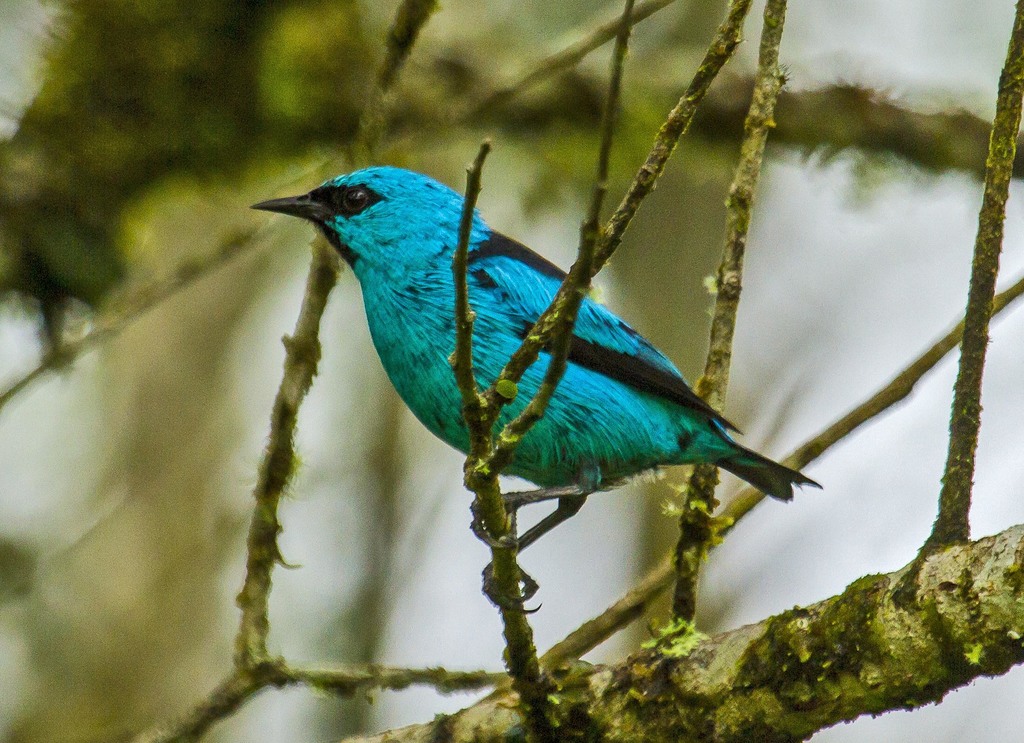
The black-legged dacnis is 11 cm (4.3 in) long and weighs about 14 g (0.49 oz). The species is sexually dimorphic. Adult males have a mostly greenish blue to turquoise head and nape with a small black mask from the lores to behind the eye. Their mantle has a triangular black patch. Their scapulars are turquoise and their back, rump, and uppertail coverts light turquoise to greenish blue. Their wing's coverts and inner flight feathers are black with blue edges and the outer flight feathers are black. Their tail is black with blue edges on the outermost pair of feathers. They have a thin black throat patch and light turquoise underparts. Adult females have a mostly brownish olive head with a greenish to turquoise blue wash on the forecrown and cheeks. Their upperparts are also mostly brownish olive, with a greenish to turquoise blue wash on the scapulars and rump. Their wings are brownish olive and their tail is dusky. Their throat and underparts are dull buff. Both sexes have a dark reddish brown or brown iris, a black bill, and black or dusky legs and feet.
Range & habitat
The black-legged dacnis is found intermittently in the Serra do Mar region of southeastern Brazil from central Espírito Santo south to Santa Catarina state. It is a bird of the Atlantic Forest where it inhabits humid forest and woodlands both primary and secondary. It also is found in smaller patches of forest. In elevation it ranges from sea level to 1,700 m (5,600 ft).
Wikipedia: “Distribution and habitat”
What it does
The black-legged dacnis feeds primarily on insects, fruits, and nectar with smaller amounts of seeds. It often forages in groups of up to about five individuals and regularly joins mixed-species feeding flocks. It typically forages from the forest's mid-level to the canopy, taking much food by gleaning while perched and sometimes taking insects in mid-air.
Wikipedia: “Feeding”
Listen
Looking for field recordings…
Where it lives
Recorded sightings
—
geo-referenced records in GBIF, from museums, herbaria and field observers.
Drag the globe to turn it. Dots are where records exist, not a range map; darker means more records.
In the stacks
Searching the stacks…
Every page naming Dacnis nigripes in the Biodiversity Heritage Library →
This page is assembled live from iNaturalist, GBIF, Wikipedia, the Source Library and the Internet Archive. It is not yet part of the hand-edited codex. iNaturalist taxon 10510.