On eBird ↗
Sand Partridge
Live sightings near you, the range map, bar charts of when it is seen, and Macaulay Library photos and recordings.
Sand Partridge
Ammoperdix heyi
The sand partridge (Ammoperdix heyi) is a gamebird in the pheasant family Phasianidae of the order Galliformes, gallinaceous birds.
This partridge has its main native range from Egypt and Israel east to south Arabia. It is closely related and similar to its counterpart in southeast Turkey and east to Pakistan, the see-see partridge, Ammoperdix griseogularis.
From the article Sand partridge on Wikipedia (CC BY-SA), quoted section by section
Description
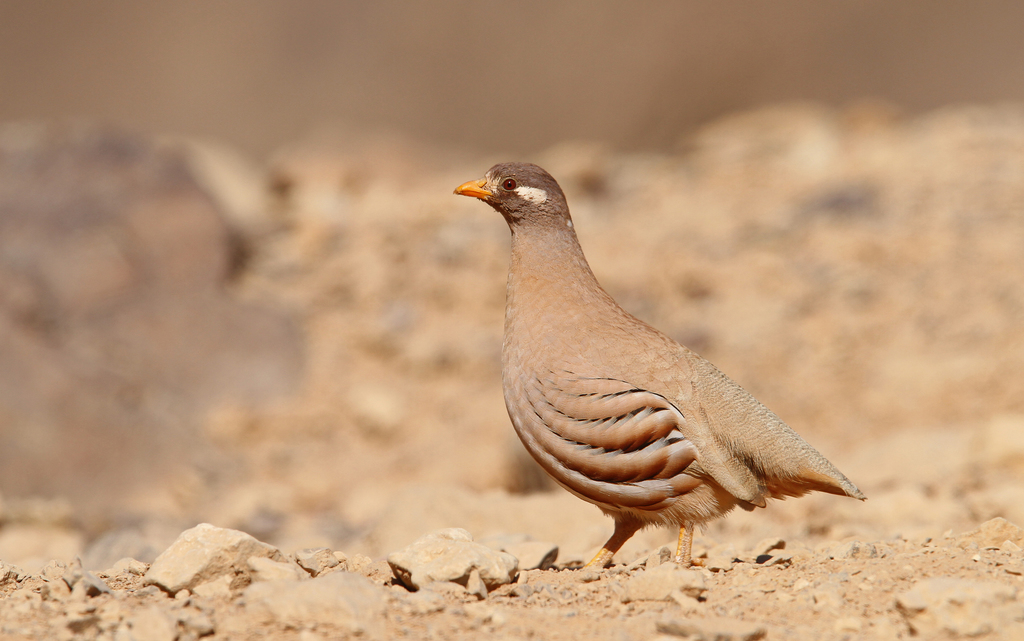
Source: The sand partridge is a rotund bird, mainly sandy-brown with wavy white and brown flank stripes. It ranges from 22–25 cm in height, and 180-200 g in weight. Its wingspan ranges from 39–41 cm. They can live for up to 4 years. When disturbed, sand partridge prefers to run rather than fly, but if necessary it flies a short distance on rounded wings. The song is a slurred kwa-kwa-kwa
Sexual dimorphism. Source: Males are larger than the females and have orange bills, rather than dull yellowish bills. The male has a grey head with a white stripe in front of the eye and a white cheek patch. The neck sides are plain, and not speckled with white. The head pattern is the best distinction from the see-see partridge. Females are a very washed-out version of males. They are sandier and greyer than males with fewer markings and have pinkish bars instead of white spots on the side of the neck. Females are more difficult to distinguish from its relative due to the weak head pattern. Male and female juveniles resemble adult females.
Range & habitat
Sand partridges are endemic across the Middle East. Populations are distributed across Eastern Egypt, Eastern Sudan, Israel, Jordan, Saudi Arabia, Yemen, Oman, and the United Arab Emirates (UAE). The four subspecies of the sand partridge are native to specific parts of the Middle East. The Ammoperdix heyi heyi is distributed from the Jordan Valley to the Egyptian Sinai Peninsula to Saudi Arabia. The Ammopredix heyi nicolli is distributed across Northern Egypt. The Ammoperdix heyo cholmleyi is distributed from Egypt to Northern Sudan. The Ammoperdix heyi intermedius is distributed from Western Saudi Arabia to Yemen east into Oman and to the Musandam Peninsula in the UAE.
Wikipedia: “Distribution”
What it does
Sand partridges are omnivorous birds. They feed on a mixed diet of plant matter and insects. During the summer, the sand partridge forages mostly for seeds and berries. Seeds come mostly from Acacia spp. and grasses. Berries come mostly from the toothbrush tree/mustard tree (Salvadora persica) and myrrhs (Commiphora spp.). Insects are mostly locusts. In Arabia specifically, sand partridges eat leaves and buds of desert thorn (Lycium shawii), Rhazya stricta and Sideroxylon mascatense. Habitats with woody vegetation height of 2–3 m between rocks are ideal foraging grounds for the sand partridge, as it provides food and also sufficient shelter from predator attacks.
Wikipedia: “Diet”
Listen
Looking for field recordings…
Where it lives
Recorded sightings
—
geo-referenced records in GBIF, from museums, herbaria and field observers.
Drag the globe to turn it. Dots are where records exist, not a range map; darker means more records.
In the stacks
Searching the stacks…
Every page naming Ammoperdix heyi in the Biodiversity Heritage Library →
This page is assembled live from iNaturalist, GBIF, Wikipedia, the Source Library and the Internet Archive. It is not yet part of the hand-edited codex. iNaturalist taxon 1050.