On eBird ↗
Green Honeycreeper
Live sightings near you, the range map, bar charts of when it is seen, and Macaulay Library photos and recordings.
Green Honeycreeper
Chlorophanes spiza
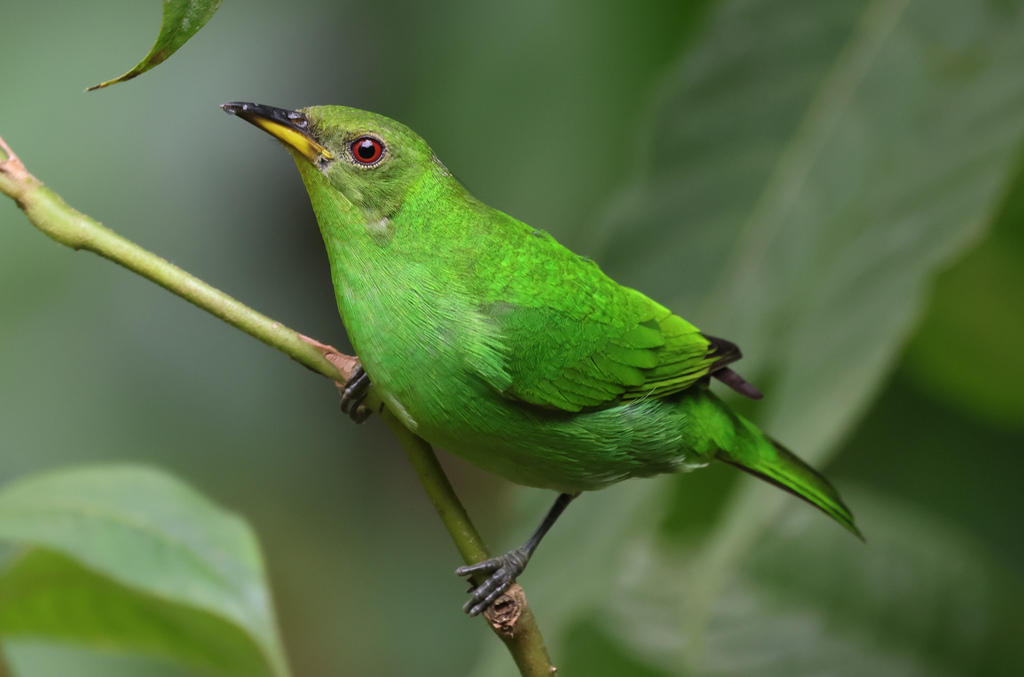
The green honeycreeper (Chlorophanes spiza) is a small bird in the tanager family. It is found in the tropical New World from southern Mexico south to Brazil, and on Trinidad. It is the only member of the genus Chlorophanes. The purplish honeycreeper (Chlorophanes purpurascens), a bird from Venezuela known only from the type specimen, is now thought to be an intergeneric hybrid between the green honeycreeper and either the red-legged honeycreeper or the blue dacnis.
From the article Green honeycreeper on Wikipedia (CC BY-SA), quoted section by section
Description
The green honeycreeper is about 13 cm (5.1 in) long and weighs 14 to 23 g (0.49 to 0.81 oz) with an average of about 19 g (0.67 oz). It has a slender and slightly decurved bill. The species is sexually dimorphic. Adult males of the nominate subspecies C. s. spiza have a mostly deep black head. Their throat, nape, and upper- and underparts are glossy viridian green that from some angles appears bluish. Their wing's primary coverts and flight feathers are dusky with viridian green edges. Their tail is viridian green with a black stripe in the center of the central pair of feathers. Their bill is mostly bright honey yellow with a black culmen. Adult females have a grass-green head and upperparts and paler green underparts. Their bill has a black maxilla and a dull honey yellow mandible with a dusky neutral gray tip and base. Both sexes have a bright reddish brown iris and gray legs and feet with yellow toe pads. Juveniles of both sexes resemble adult females but are duller overall with a more grayish belly. Their iris is a duller reddish brown than adults'. The other subspecies of the green honeycreeper differ from the nominate and each other thus:
C. s. guatemalensis: largest subspecies; males are deeper green than nominate, approaching turquoise C. s. argutus: males are more turquoise than guatemalensis but less than subtropicalis C. s. …
Range & habitat
The subspecies of the green honeycreeper are found thus:
C. s. guatemalensis: from northern Oaxaca and southern Veracruz in southern Mexico across northern Guatemala, Belize, and northern Honduras C. s. argutus: from extreme eastern Honduras south on the Caribbean slope through Nicaragua, Costa Rica, and Panama into northwestern Colombia; from central Puntarenas and far west-central San José provinces in Costa Rica through Panama into Colombia C. s. exsul: from Valle del Cauca Department in southwestern Colombia south through western Ecuador into extreme northwestern Peru C. s. subtropicalis: Colombian Andes east into the Serranía del Perijá on the Colombia-Venezuela border and the western slope of the Venezuelan Andes from Táchira to Trujillo C. s. spiza: southeastern Colombia east along eastern slope of the Venezuelan Andes; Venezuelan Coastal Ranges from Carabobo to the Paria Peninsula; Trinidad; from Amazonas and western and southern Bolívar in Venezuela east across the Guianas and much of Amazonian Brazil C. s. caerulescens from southeastern Colombia south through eastern Peru and western Brazil into northern Bolivia C. s. axillaris: eastern Brazil from Paraiba south to extreme northern Rio Grande do Sul The green honeycreeper inhabits the interior and edges of humid forest both primary and secondary. It is primarily a canopy species though is found lower at forest edges. …
Wikipedia: “Distribution and habitat”
What it does
The green honeycreeper feeds primarily on fruit and on lesser amounts of nectar and arthropods. In a study in Trinidad about 2/3 of the observed foraging was for fruit, and half of the fruit was Miconia berries. The species forages singly, in pairs, and as a member of mixed-species feeding flocks. Though it takes fruit and most insects from fruiting trees, it does sometimes take insects in mid-air.
Wikipedia: “Feeding”
Listen
Looking for field recordings…
Where it lives
Recorded sightings
—
geo-referenced records in GBIF, from museums, herbaria and field observers.
Drag the globe to turn it. Dots are where records exist, not a range map; darker means more records.
In the stacks
Searching the stacks…
Every page naming Chlorophanes spiza in the Biodiversity Heritage Library →
This page is assembled live from iNaturalist, GBIF, Wikipedia, the Source Library and the Internet Archive. It is not yet part of the hand-edited codex. iNaturalist taxon 10485.