On eBird ↗
Lark Sparrow
Live sightings near you, the range map, bar charts of when it is seen, and Macaulay Library photos and recordings.
Lark Sparrow
Chondestes grammacus
The lark sparrow (Chondestes grammacus) is a fairly large New World sparrow. It is the only member of the genus Chondestes.
From the article Lark sparrow on Wikipedia (CC BY-SA), quoted section by section
Description
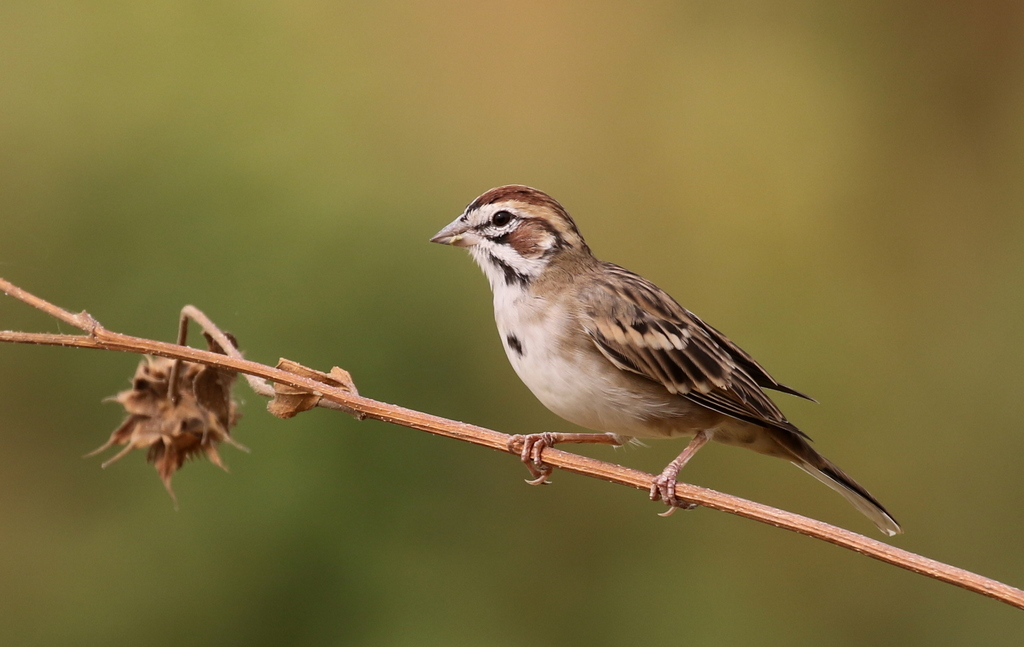
The lark sparrow is distinctive. Adults have a typically sparrow-like dark-streaked brown back, and white underparts except for a dark central spot. The cheeks and crown sides are chestnut, with white eyebrow and crown stripes. The dark tail's corners are also white. Young lark sparrows are duller, and the underparts are streaked. Measurements:
Length: 5.9–6.7 in (15–17 cm) Weight: 0.8–1.2 oz (24–33 g) Wingspan: 11.0 in (28 cm)
Range & habitat
It breeds in southern Canada, much of the United States, and northern Mexico. It is much less common in the east, where its range is contracting. The populations in Mexico and adjacent states of the United States are resident, but other birds are migratory, wintering in the southern United States, Mexico and south to Guatemala. It is a very rare vagrant to western Europe, with two accepted records in Great Britain in 1981 and 1991.
Wikipedia: “Distribution and habitat”
What it does
They forage on the ground or in low bushes. They mainly eat seeds, but insects, including grasshoppers, are also eaten in the breeding season. They form flocks on migration or in winter. When an occupied nest is approached by a predator, adult female lark sparrows are known to exhibit a distraction display.
Wikipedia: “Diet and behaviour”
Listen
Looking for field recordings…
Where it lives
Recorded sightings
—
geo-referenced records in GBIF, from museums, herbaria and field observers.
Drag the globe to turn it. Dots are where records exist, not a range map; darker means more records.
In the stacks
Searching the stacks…
Every page naming Chondestes grammacus in the Biodiversity Heritage Library →
This page is assembled live from iNaturalist, GBIF, Wikipedia, the Source Library and the Internet Archive. It is not yet part of the hand-edited codex. iNaturalist taxon 10479.