On eBird ↗
Chestnut-breasted Chlorophonia
Live sightings near you, the range map, bar charts of when it is seen, and Macaulay Library photos and recordings.
Chestnut-breasted Chlorophonia
Chlorophonia pyrrhophrys
The chestnut-breasted chlorophonia (Chlorophonia pyrrhophrys) is a bird species in the family Fringillidae (formerly in Thraupidae). It is found in Colombia, Ecuador, Peru, and Venezuela. Its natural habitat is subtropical or tropical moist montane forests.
From the article Chestnut-breasted chlorophonia on Wikipedia (CC BY-SA), quoted section by section
Description
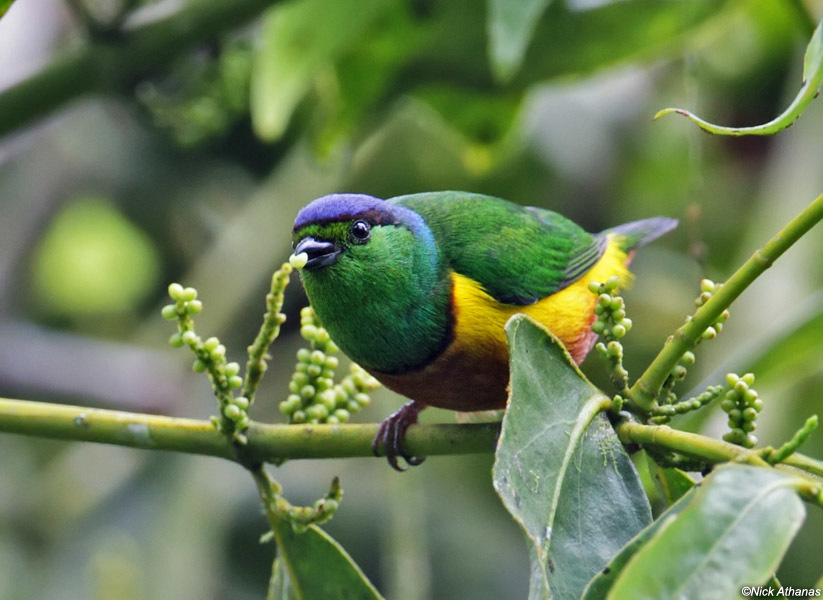
The chestnut-breasted chlorophonia is a chunky, short-tailed, stubby-billed bird. It is about 12 cm (4.7 in) long and weighs 16 to 18 g (0.56 to 0.63 oz). The species is sexually dimorphic. Adult males have a green forehead and a rich cyanine-blue crown and nape. They have a thin dark red band between them that extends past the eye and a thin pale blue band at the base of the nape. Their lores, face, throat, and upper breast are shiny emerald-green with a thin black line beneath the upper breast. Their mantle, back, and upperwing coverts are bright green and their rump bright yellow. Their tail's central feathers are dusky with thin green edges and the rest dusky with wide green edges. Their primary coverts and most flight feathers are blackish with bright green edges; their tertials are green. The center of their lower breast, belly, and vent are deep chestnut with bright yellow on either side. Adult females are duller and plainer than males. They have a turquoise-blue crown and nape. The rest of their face and upper breast are generally patterned like the male's but a paler green and lack the black line below the upper breast and the pale blue band below the nape. Their back and rump are a slightly darker green than their upper breast and their upperwing coverts dusky with wide green edges. Their tail is like the male's. …
Range & habitat
The chestnut-breasted chlorophonia has a highly disjunct distribution along the Andes. One population is in the Serranía del Perijá on the Venezuela-Colombia border. Another stretches from Trujillo state in western Venezuela southwest slightly into Colombia. Others are found intermittently in Colombia's Central and Western Andes and on the western Andean slope into northern Ecuador as far as Pichincha Province. A population also extends from the southern end of Colombia's Central Andes south on the eastern slope through Ecuador into northern Peru's eastern Cajamarca and western Piura departments. Another in Peru extends intermittently from Amazonas Department south to Junín Department. The chestnut-breasted chlorophonia inhabits the interior and edges of humid to wet montane forest including cloudforest heavy with epiphytes. It also occurs in mature secondary forest and occasionally in elfin forest. In elevation it occurs between 1,800 and 3,000 m (5,900 and 9,800 ft) in Venezuela, between 1,500 and 3,000 m (4,900 and 9,800 ft) in Colombia, mostly between 1,500 and 2,750 m (4,900 and 9,000 ft) in Ecuador, and between 1,700 and 2,450 m (5,600 and 8,000 ft) in Peru.
Wikipedia: “Distribution and habitat”
What it does
The chestnut-breasted chlorophonia feed mostly on mistletoe (Loranthaceae) berries and lesser amounts of other berries and fruits. It occasionally includes insects in its diet. It usually forages in pairs and sometimes in family or other slightly larger groups. It seldom joins mixed-species feeding flocks and also seldom shares fruiting trees with other species. It forages mostly in the forest canopy, especially in clumps of epiphytes.
Wikipedia: “Feeding”
Listen
Looking for field recordings…
Where it lives
Recorded sightings
—
geo-referenced records in GBIF, from museums, herbaria and field observers.
Drag the globe to turn it. Dots are where records exist, not a range map; darker means more records.
In the stacks
Searching the stacks…
Every page naming Chlorophonia pyrrhophrys in the Biodiversity Heritage Library →
This page is assembled live from iNaturalist, GBIF, Wikipedia, the Source Library and the Internet Archive. It is not yet part of the hand-edited codex. iNaturalist taxon 10462.