On eBird ↗
Blue-crowned Chlorophonia
Live sightings near you, the range map, bar charts of when it is seen, and Macaulay Library photos and recordings.
Blue-crowned Chlorophonia
Chlorophonia occipitalis
The blue-crowned chlorophonia (Chlorophonia occipitalis) is a species of bird in the Fringillidae family. It is found in El Salvador, Guatemala, Honduras, Mexico, and Nicaragua. Its natural habitat is subtropical or tropical moist montane forests.
From the article Blue-crowned chlorophonia on Wikipedia (CC BY-SA), quoted section by section
Description
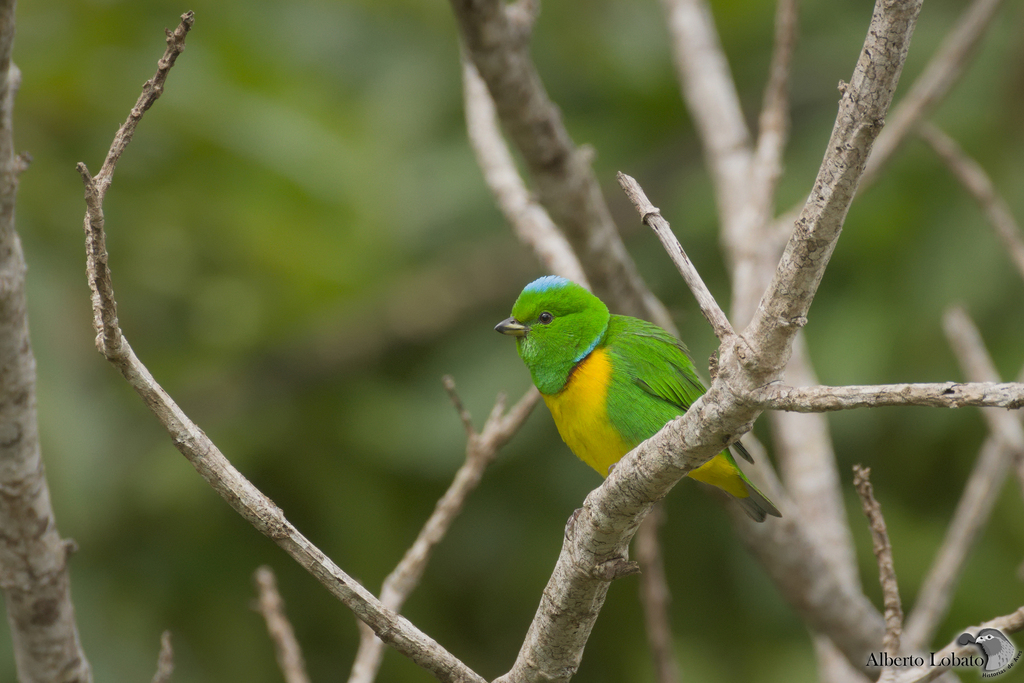
The blue-crowned chlorophonia is a chunky, short-tailed, stubby-billed bird. It is about 13 cm (5.1 in) long and weighs 25 to 27.5 g (0.88 to 0.97 oz). The species is sexually dimorphic. Adult males have a mostly shiny emerald-green head with a circular turquoise-blue patch in the center of the crown. Their throat and upper breast are the same green. They have a thin turquoise-blue collar under the nape and a thin black and chestnut line under the upper breast. Their upperparts are a slightly darker shiny green than their head. The upper side of their tail is green and the underside gray. Most flight feathers are black with green edges; their tertials are green. Their lower breast, belly, and undertail coverts are bright yellow and their sides and flanks green. Adult females have a smaller turquoise-blue crown patch than males and a light cerulean-blue collar. Their upperparts and tail are shiny green and their wings are like the male's. The center of their breast and belly and their undertail coverts are yellow and the rest of their underparts are green. Both sexes have a light brown to brown iris, a dusky maxilla with a bluish gray base, a bluish gray mandible with a dusky tip, and dark gray legs and feet.
Range & habitat
The blue-crowned chlorophonia has a disjunct distribution. It is found in several populations of various sizes from Veracruz in southeastern Mexico south through Guatemala, northern El Salvador, and much of Honduras into north-central Nicaragua. In the breeding season it inhabits montane evergreen forest including cloudforest and pine–oak forest. Outside that season it inhabits lower elevation evergreen and secondary forest and also shady plantations. Sources differ about its elevational range. One states it is from 1,000 to 2,500 m (3,300 to 8,200 ft). Another places it between 500 and 2,500 m (1,600 and 8,200 ft) but mostly between 1,000 and 2,000 m (3,300 and 6,600 ft). A third, which addresses its range outside Mexico, places it between 100 and 2,400 m (300 and 7,900 ft) but below 600 m (2,000 ft) only in winter.
Wikipedia: “Distribution and habitat”
What it does
The blue-crowned chlorophonia feeds almost exclusively on fruit but possibly includes insects in its diet. It favors the berries of mistletoe (Loranthaceae) and other small berries. It forages mostly in the forest canopy. During the breeding season it usually forages in pairs. Outside that season it may gather in small flocks of up to about 12 individuals. Though the species may share fruiting trees with other species, if seldom joins mixed-species feeding flocks.
Wikipedia: “Feeding”
Listen
Looking for field recordings…
Where it lives
Recorded sightings
—
geo-referenced records in GBIF, from museums, herbaria and field observers.
Drag the globe to turn it. Dots are where records exist, not a range map; darker means more records.
In the stacks
Searching the stacks…
Every page naming Chlorophonia occipitalis in the Biodiversity Heritage Library →
This page is assembled live from iNaturalist, GBIF, Wikipedia, the Source Library and the Internet Archive. It is not yet part of the hand-edited codex. iNaturalist taxon 10459.