On eBird ↗
Fan-tailed Warbler
Live sightings near you, the range map, bar charts of when it is seen, and Macaulay Library photos and recordings.
Fan-tailed Warbler
Euthlypis lachrymosa
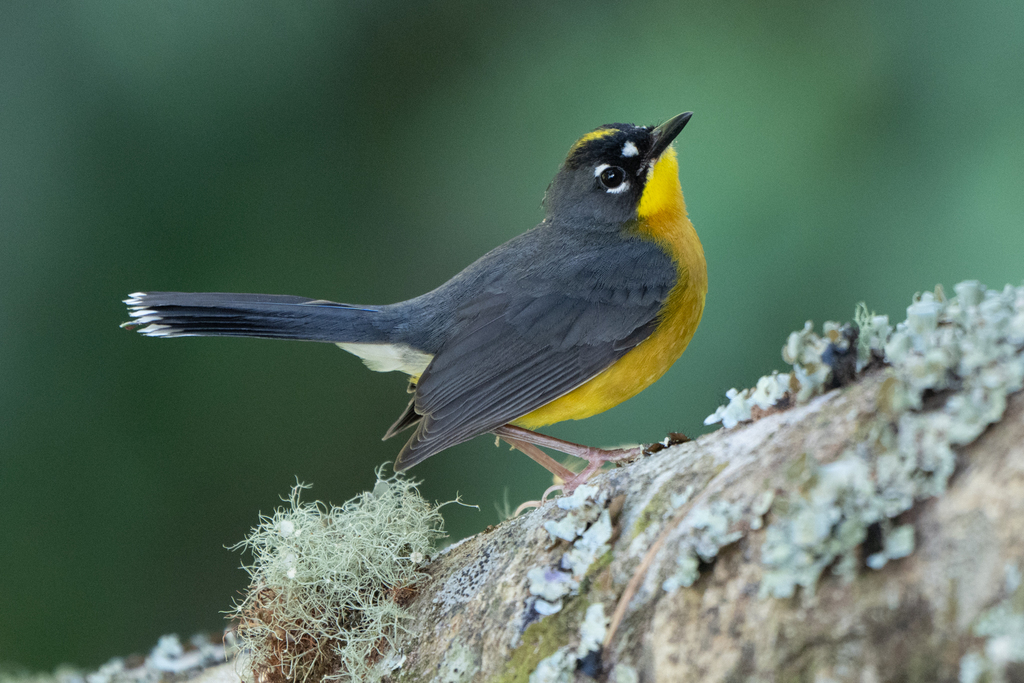
The fan-tailed warbler (Basileuterus lachrymosus) is a New World warbler in the genus Basileuterus that lives along the Pacific slope from northern Mexico to Nicaragua. Vagrant records exist for Arizona, New Mexico and Texas. It is yellow on its throat and underparts with a tawny wash on its chest. The head is gray with a black-framed yellow crown and white around the eyes. The undertail coverlets are white. They are 5.8-6.3 in (14.5–16 cm) long and have...
From the article Fan-tailed warbler on Wikipedia (CC BY-SA), quoted section by section
Description
The fan-tailed warbler is about 15 cm (5.9 in) long and weighs 10 to 21 g (0.35 to 0.74 oz). The sexes have the same plumage. Adults have a black forecrown, a narrow yellow crown patch, a white spot on the lores, and thin white crescents above and below the eye on an otherwise dark gray face. Their upperparts and wings are dark gray with a faint olive wash on the mantle. Their tail is long, graduated, and dark gray with white feather tips. Their throat, breast, and belly are rich yellow, their flanks are washed with tawny-yellow, and their undertail coverts are white. Birds in the southern part of their range have more black on their face, are darker gray above, and have a richer tawny wash than more northerly birds, though the differences are clinal. They have a dark iris, a black bill, and dusky pinkish legs and feet. Juveniles have an ash-gray head and upperparts. Their wings' greater and median coverts have buff tips that show as two thin wing bars. Their throat, breast, and flanks are brownish gray and their belly and undertail coverts pale buffy olive. They have a paler bill and legs than adults.
Range & habitat
The fan-tailed warbler is found "on the Pacific slope of Mexico from southern Sonora south to Guatemala, El Salvador, and Honduras (locally also in interior valleys) to central Nicaragua and on the Gulf slope of Mexico from eastern San Luis Potosí and southern Tamaulipas to Veracruz and north-central Oaxaca." South of Mexico is it found intermittently. It has also been recorded as a vagrant in the U. S. states of Arizona, New Mexico, and Texas. The fan-tailed warbler inhabits semi-deciduous and evergreen forest with an intact understory in the foothills and lower mountain slopes. It favors "rugged, rocky areas such as ravines and forest-covered lava flows". Overall it ranges in elevation from 50 to 1,800 m (200 to 5,900 ft). In El Salvador, Guatemala, and Honduras it ranges from 250 to 1,850 m (800 to 6,100 ft).
Wikipedia: “Distribution and habitat”
What it does
The fan-tailed warbler feeds on insects and other invertebrates. It takes most prey on the ground and in low vegetation by gleaning from leaves and rocks. It regularly attends army ant swarms to capture prey fleeing from the ants; up to 12 individuals have been seen doing so. It has also been observed several times following nine-banded armadillos (Dasypus novemcinctus), apparently for the same reason. In the non-breeding season individual birds and pairs may join mixed-species feeding flocks.
Wikipedia: “Feeding”
Listen
Looking for field recordings…
Where it lives
Recorded sightings
—
geo-referenced records in GBIF, from museums, herbaria and field observers.
Drag the globe to turn it. Dots are where records exist, not a range map; darker means more records.
In the stacks
Searching the stacks…
Every page naming Euthlypis lachrymosa in the Biodiversity Heritage Library →
This page is assembled live from iNaturalist, GBIF, Wikipedia, the Source Library and the Internet Archive. It is not yet part of the hand-edited codex. iNaturalist taxon 10446.