- Animals
- ›Arthropods
- ›Hexapods
- ›Insects
- ›Winged and Once-winged Insects
- ›Dragonflies and Damselflies
- ›Damselflies
- ›Lestoidea
- ›Spreadwings and allies
- ›Lestes
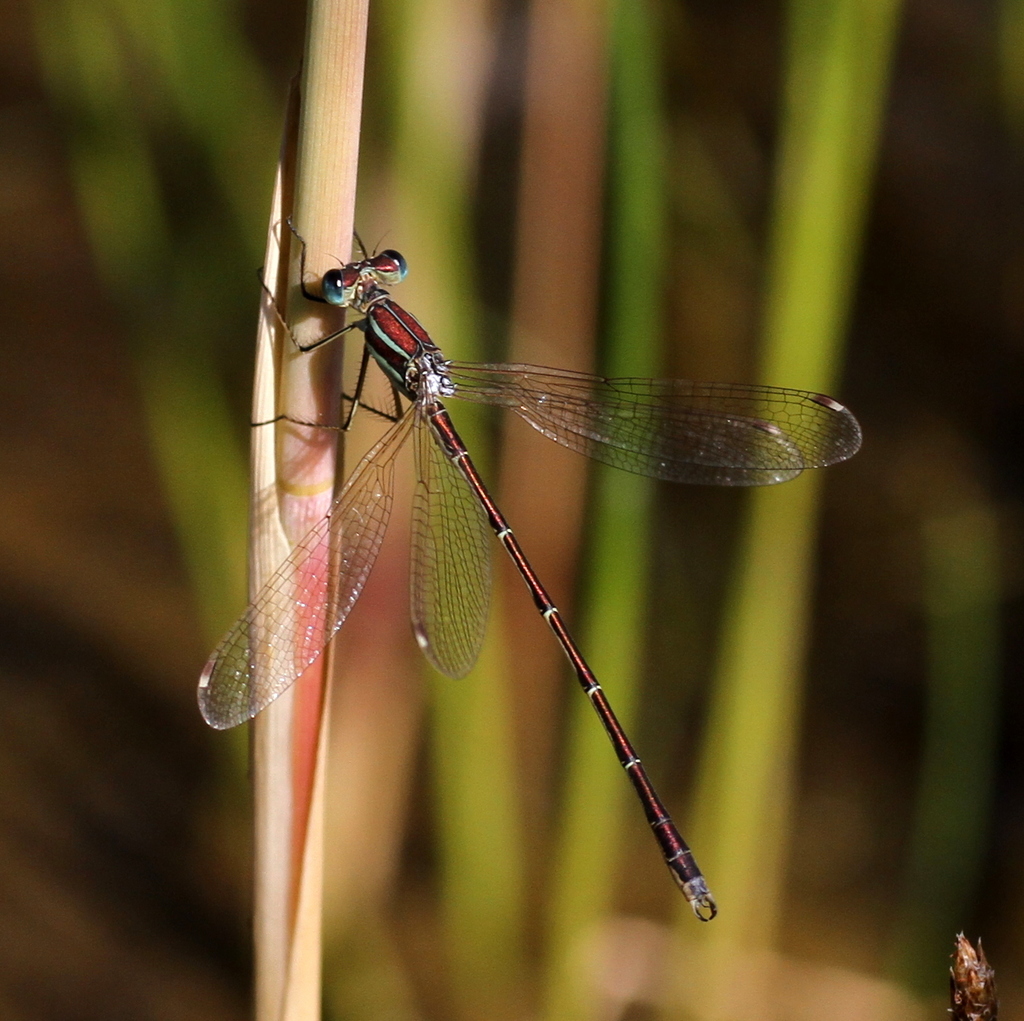
Migrant Spreadwing
Lestes barbarus
Lestes barbarus is a species of damselfly of the family Lestidae, the spreadwings. Its common names in English include southern emerald damselfly, shy emerald damselfly, and migrant spreadwing.
From the article Lestes barbarus on Wikipedia (CC BY-SA), quoted section by section
Range & habitat
Lestes barbarus is a European–central Asian species with isolated populations in North Africa and a range expanding northward. It is found across southern Europe in a band across Spain, France, Italy and Greece to India and Mongolia. It is less common in northern Europe, although some are found as far north as Sweden. It breeds in the Netherlands in coastal dunes and is increasing in number. It is at the edge of its range in the Channel Islands, where it has been breeding since 1995. It is also found in North Africa; it gets its Latin name as the first specimen was found in Barbary, North Africa. It is a damselfly of still water and can be found in stagnant and slightly brackish water. This species was first recorded in Britain at Winterton Dunes, Norfolk, on 30 July 2002. In 2003 and 2004 it was noted at Sandwich Bay, Kent. In 2018 it was proven to have bred in Britain for the first time.
Wikipedia: “Distribution and habitat”
What it does
The flight period is from March to October in the south of its range but in north it flies mainly from June to August. Its behaviour is similar to that of L. sponsa, but it is more likely to be found away from water. After mating the pair usually remain in tandem while the female lays eggs on waterside plants. The eggs overwinter in diapause and the larvae hatch in spring. The larvae develop within two months, the adults emerging in late spring.
Wikipedia: “Behaviour”
Listen
Looking for field recordings…
Where it lives
Recorded sightings
—
geo-referenced records in GBIF, from museums, herbaria and field observers.
Drag the globe to turn it. Dots are where records exist, not a range map; darker means more records.
In the stacks
Searching the stacks…
Every page naming Lestes barbarus in the Biodiversity Heritage Library →
This page is assembled live from iNaturalist, GBIF, Wikipedia, the Source Library and the Internet Archive. It is not yet part of the hand-edited codex. iNaturalist taxon 104420.