On eBird ↗
Large-footed Finch
Live sightings near you, the range map, bar charts of when it is seen, and Macaulay Library photos and recordings.
Large-footed Finch
Pezopetes capitalis
The large-footed finch, (Pezopetes capitalis), is a passerine bird which is endemic to the highlands of Costa Rica and western Panama. Despite its name, it is not a true finch, but rather a member of the large Emberizidae family, which also includes buntings, American sparrows, juncos and towhees. It is the only member of the genus Pezopetes.
From the article Large-footed finch on Wikipedia (CC BY-SA), quoted section by section
Description
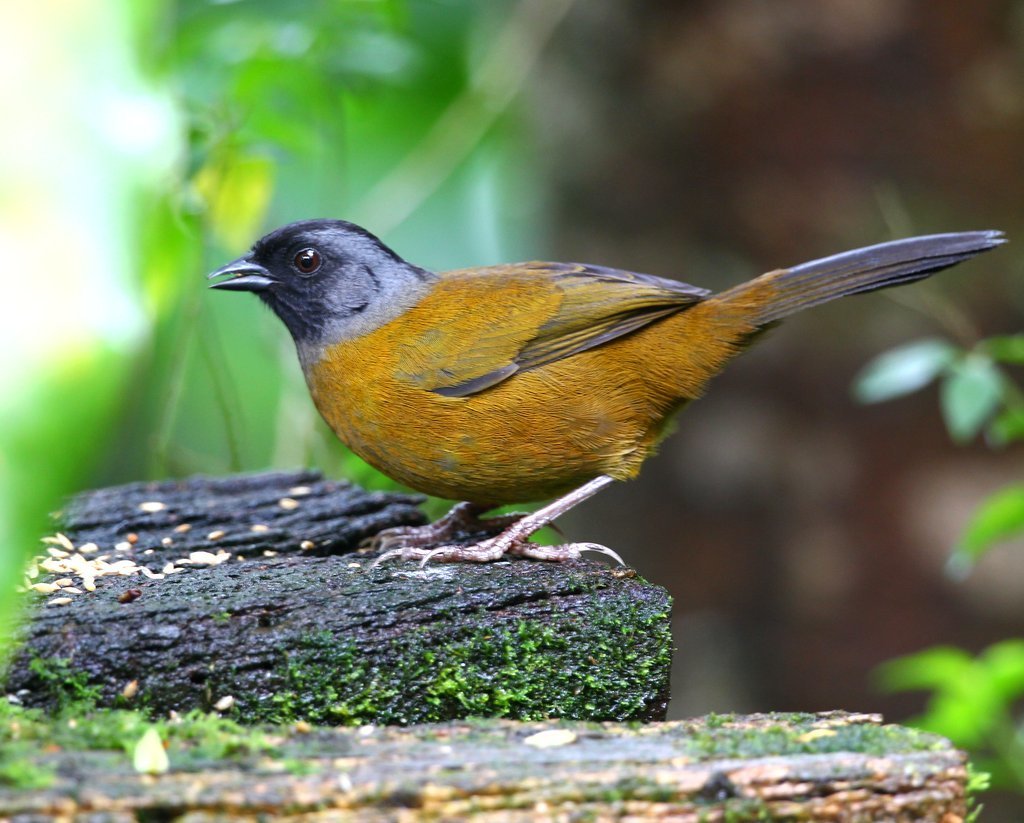
The large-footed finch is one of the heaviest in its diverse family. It is 17 to 20 cm (6.7 to 7.9 in) long and weighs about 56 g (2.0 oz). It has a long tail and very large legs and feet but a disproportionately small slender bill. The sexes have the same plumage. Adults have a black crown and a dark gray supercilium. Their face from the bill to just past the eye and down through the throat is black and the rest of their face and their nape are dark gray. Their upperparts and wing coverts are olive green. Their tail is blackish with thin olive green feather edges. Their flight feathers are dusky with wide olive green edges. Their underparts are mostly a paler olive green than the upperparts and more yellowish in the center of the breast and belly. Both sexes have a reddish or mouse-brown iris, a black bill, and black or brownish legs and feet. Immature birds have olive green rather than gray on the head and their underparts have heavy black streaks.
Range & habitat
The large-footed finch has a somewhat disjunct distribution. It has a few small ranges in the northern part of Costa Rica's Cordillera Central and a large continuous one from Costa Rica's western Cartago and northeastern San José provinces south through the Cordillera Central and Cordillera de Talamanca into western Panama's Bocas del Toro and Chiriquí provinces. It primarily inhabits the edges and understory of montane evergreen forest and secondary forest where it favors areas with bamboo, and also in brushy openings and pastures. In Costa Rica it also is found in paramo. Its overall range in elevation is stated to be between 2,150 and 3,350 m (7,100 and 11,000 ft). In Costa Rica it is found "from 2,000 m (6,600 ft) to above timberline". It occurs locally down to 1,500 m (4,900 ft) in Panama.
Wikipedia: “Distribution and habitat”
What it does
The large-footed finch's diet has not been detailed but is known to include seeds, insects, and fruits. It hops on the ground while foraging, stopping to scratch leaf litter with both feet together; the backward kicks can send debris up to 30 cm (12 in) away. It typically is in pairs year-round and is not known to join mixed-species feeding flocks.
Wikipedia: “Feeding”
Listen
Looking for field recordings…
Where it lives
Recorded sightings
—
geo-referenced records in GBIF, from museums, herbaria and field observers.
Drag the globe to turn it. Dots are where records exist, not a range map; darker means more records.
In the stacks
Searching the stacks…
Every page naming Pezopetes capitalis in the Biodiversity Heritage Library →
This page is assembled live from iNaturalist, GBIF, Wikipedia, the Source Library and the Internet Archive. It is not yet part of the hand-edited codex. iNaturalist taxon 10440.