On eBird ↗
Connecticut Warbler
Live sightings near you, the range map, bar charts of when it is seen, and Macaulay Library photos and recordings.
Connecticut Warbler
Oporornis agilis
The Connecticut warbler (Oporornis agilis) is a small songbird of the New World warbler family.
From the article Connecticut warbler on Wikipedia (CC BY-SA), quoted section by section
Description
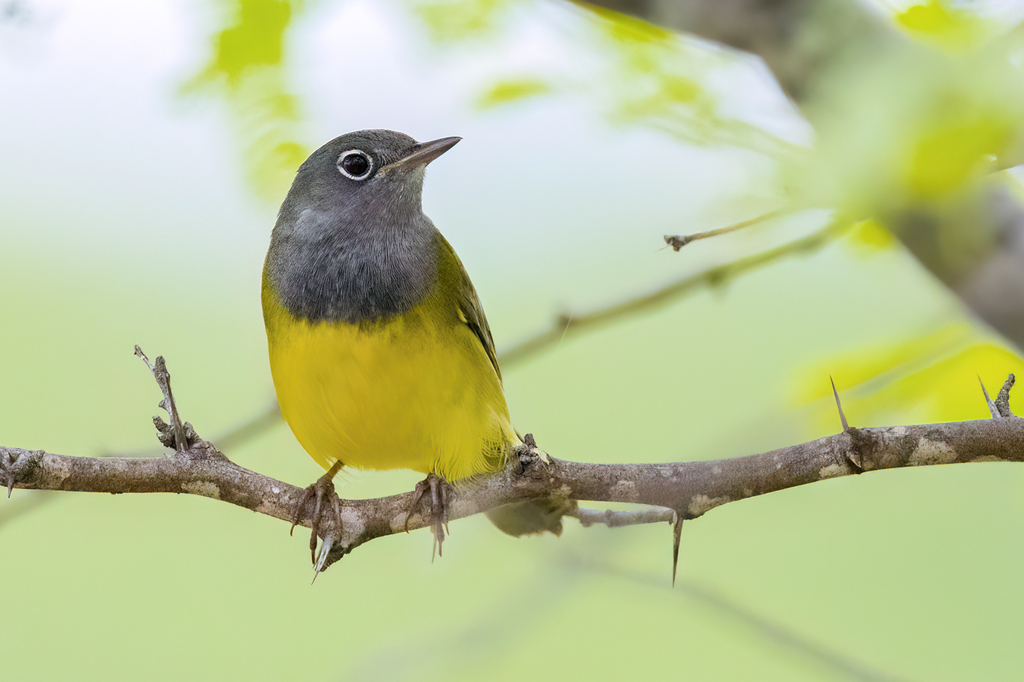
These medium-sized warblers measure 13–15 cm (5.1–5.9 in) in length, with a 22–23 cm (8.7–9.1 in) wingspan. Connecticut warblers weigh 10 g (0.35 oz) when they fledge, attaining an average weight of around 15 g (0.53 oz) as adults. However, birds preparing for migration pack on more weight to survive the strenuous journey and can weigh up to 25 g (0.88 oz). This species has light yellow underparts and olive upperparts; they have a light eye-ring, pink legs, a long tail, and a thin pointed bill. Males have a grey hood; females and immatures are more brown and have a whitish throat.
They forage on the ground, picking among dead leaves, or hop along branches. Like most warblers, these birds mainly eat insects and similar small invertebrates. They will also supplement their diet occasionally with seeds and berries. They are "skulking" birds that usually spend their time foraging within dense, low vegetation. Such behavior often renders them difficult to see well. Despite its name, this bird only rarely visits Connecticut during migration. It was named by Alexander Wilson who observed the first classified specimen. They are fairly elusive birds, but it appears that their numbers may be declining due to loss of winter habitat.
Range & habitat
Their breeding habitat is bogs or open deciduous woods near water, especially with poplar, spruce, tamarack or aspen, in central Canada and states bordering the Great Lakes. These habitats tend to be in rather remote areas that are hard to access for fieldwork; therefore, there is little data available on this species of birds. The nest is an open cup well-concealed in moss or a clump of grass. It is made of "dry grasses, stalk of weeds, and horsehairs".
Wikipedia: “Habitat”
What it does
The Connecticut warbler walks on the ground to forage insects and other sources of food. Its tail bobs up and down, which is reminiscent of wren and sandpiper behaviour. When it comes to sociability, the Connecticut warbler is a solitary species; however, groups of about twenty-five will come together in the fall before migration. It also will join other species, such as Blackpoll warblers, to feed during the fall. Males are highly territorial during breeding season, they defend an area which ranges from 0.24–0.48 hectares. When it comes to parental care, both the male and the female will feed the juvenile. They will defend their young by screeching at predators.
Wikipedia: “Behavior”
Listen
Looking for field recordings…
Where it lives
Recorded sightings
—
geo-referenced records in GBIF, from museums, herbaria and field observers.
Drag the globe to turn it. Dots are where records exist, not a range map; darker means more records.
In the stacks
Searching the stacks…
Every page naming Oporornis agilis in the Biodiversity Heritage Library →
This page is assembled live from iNaturalist, GBIF, Wikipedia, the Source Library and the Internet Archive. It is not yet part of the hand-edited codex. iNaturalist taxon 10431.