- Animals
- ›Chordates
- ›Vertebrates
- ›Reptiles
- ›Snakes and Lizards
- ›Lizards
- ›Geckos
- ›Typical Geckos
- ›Lepidodactylus
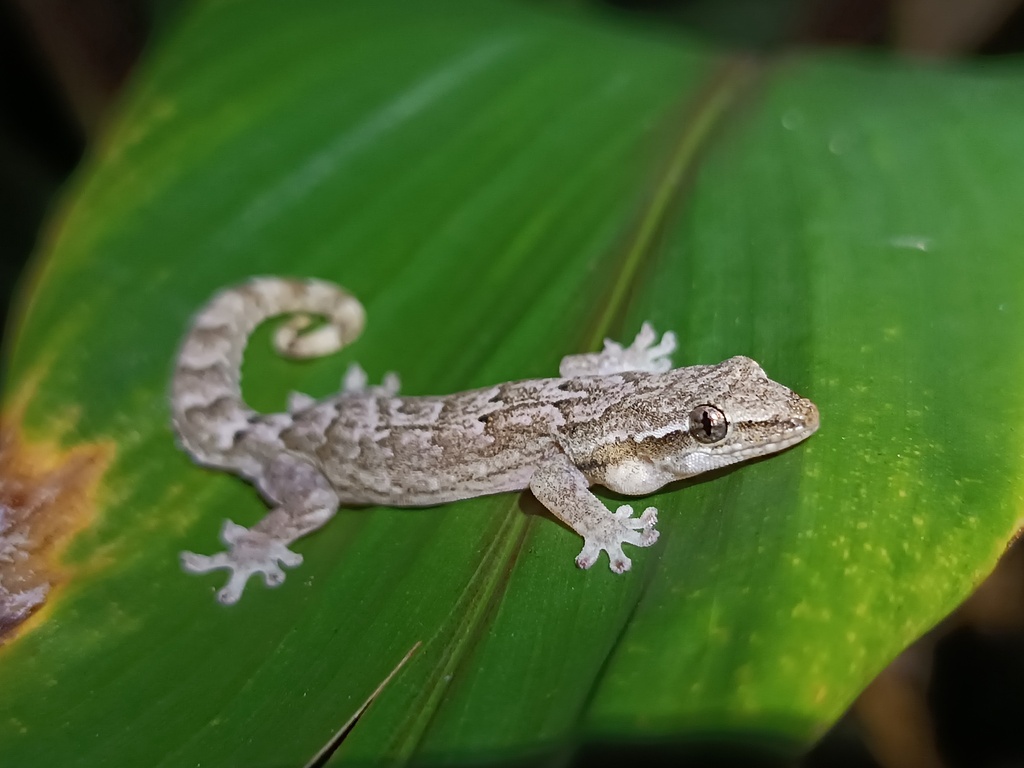
Mourning Gecko
Lepidodactylus lugubris
Lepidodactylus lugubris (mourning gecko, common smooth-scaled gecko) is a female-only species of gecko. This small (10.5 cm total length), nocturnal gecko feeds on small insects and flower nectar. This species is notable because it is parthenogenic, and there are no remaining males that have been found. Females engage in pseudocopulation, stimulating both to produce viable eggs. These eggs are adhered to surfaces in protected locations. Most clutches consist of two eggs, and clutches are laid two to...
From the article Lepidodactylus lugubris on Wikipedia (CC BY-SA), quoted section by section
Description
Lepidodactylus lugubris measure 8.5–10 cm in length including tail (4–4.4 cm snout-to-vent). L. lugubris is cryptically coloured, typically light to dark tan with dark spots down the length of its back and a brown strip from the ear to the tip of the nose. This species is capable of changing color, and so the same individual may appear light or dark at different times during the day.
Range & habitat
This species is widespread in coastal regions of the Indian and Pacific oceans, including the Maldives, Sri Lanka, India, Myanmar, Malaysia, Vietnam, Thailand, Cambodia, Japan, Taiwan, China, Indonesia, Singapore, Philippines, Papua New Guinea, Fiji, Australia (Cocos Island), Western Samoa, Guam, the Society Islands, Pitcairn, and the Mascarene Islands. It has been introduced widely in the Neotropics, including in Mexico, Brazil, Guatemala, Honduras, El Salvador, Nicaragua, Costa Rica, Panama, Florida, The Bahamas, Guadeloupe, Ecuador (including the Galapagos), Colombia and Chile, as well as to Hawai'i and the Seychelles in the Indian Ocean.
Wikipedia: “Distribution”
What it does
L. lugubris is primarily nocturnal, but is occasionally encountered exposed but near cover during the day. This species is all female, and reproduces via parthenogenesis. While males occasionally occur, they are very rare and often sterile. Females lay 1–2 eggs at a time, and glue them to surfaces in protected locations. Clutches are laid every 4–6 weeks. The obligate parthenogenetic mechanism involves premeiotic endoreplication of the chromosomes.
Wikipedia: “Behavior and ecology”
Where it lives
Recorded sightings
—
geo-referenced records in GBIF, from museums, herbaria and field observers.
Drag the globe to turn it. Dots are where records exist, not a range map; darker means more records.
In the stacks
Searching the stacks…
Every page naming Lepidodactylus lugubris in the Biodiversity Heritage Library →
This page is assembled live from iNaturalist, GBIF, Wikipedia, the Source Library and the Internet Archive. It is not yet part of the hand-edited codex. iNaturalist taxon 104226.