- Animals
- ›Chordates
- ›Vertebrates
- ›Ray-finned Fishes
- ›Carps, Characins, Catfishes and Allies
- ›Minnows, Suckers, Carps, and Loaches
- ›Carps and Minnows
- ›Cyprinids
- ›Labeonines
- ›Labeo
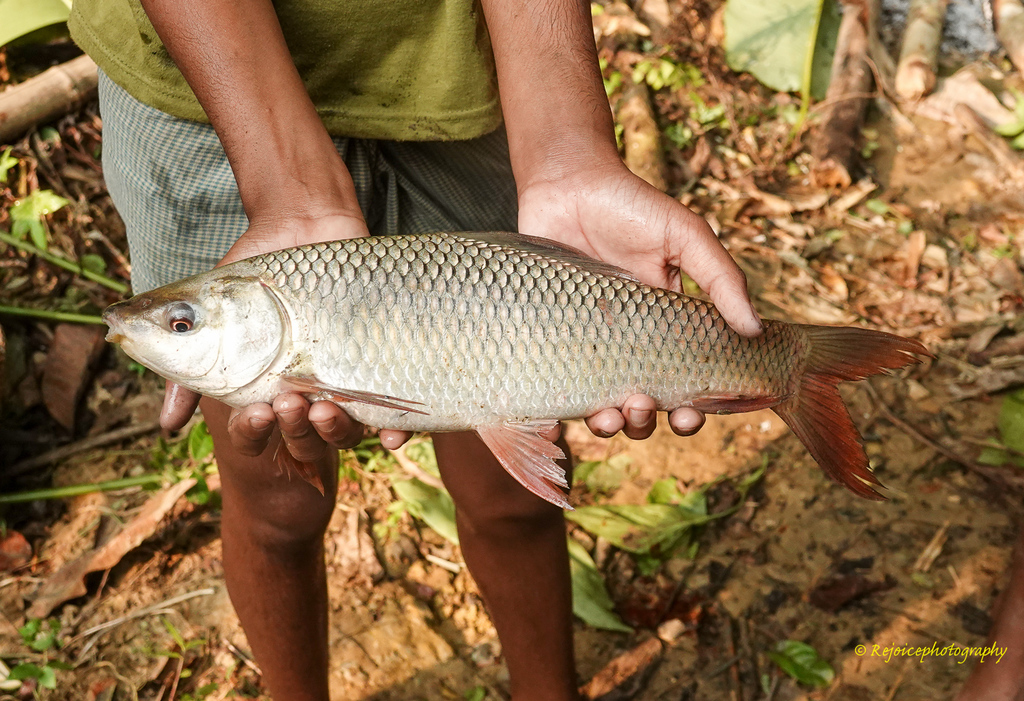
Bata
Labeo bata
Labeo bata is fish in genus Labeo. It is commonly known as bata, and is a native fish to India and Bangladesh. It is a popular game fish and is popular for its taste. It lives in ponds, rivers, etc. Its maximum length is 25–35 centimetres (9.8–13.8 in). It eats protozoa, algae, and tiny fishes. It is a slow-moving fish, so with any active and aggressive it will be nervous. The age and growth of Labeo bata...
From the article Labeo bata on Wikipedia (CC BY-SA), quoted section by section
Description
It is a popular game fish and is popular for its taste. Its maximum length is 25–35 centimetres (9.8–13.8 in). It eats protozoa, algae, and tiny fishes. It is a slow-moving fish, so with any active and aggressive it will be nervous. The age and growth of Labeo bata (Ham.) was studied by the analysis of annuli found on the scale and by length-frequency distribution. The fish attained lengths of 131, 194, 236, 277, 314, 341 and 364 mm at the end of the 1st, 2nd, 3rd, 4th, 5th, 6th and 7th years of life respectively. The increase in length of scale bears a constant relationship with the increase in length of fish. The growth rate of the fish was found high during the 1st and 2nd years, and decreased gradually afterwards till the 7th year. Both sexes showed more or less similar growth rate. The seasonal growth curve was chiefly influenced by feeding intensity in fishes of 1st year class, while in adults it was affected by feeding intensity as well as by maturation of the gonads. The body is elongate. Its dorsal profile is more convex than the ventral. The snout slightly projects beyond the mouth, often studded with pores. A pair of small maxillary barbells is hidden inside the labial fold. There is no cartilaginous support to the lips. The dorsal originates midway between the snout tip and the anterior base of anal. …
Where it lives
Recorded sightings
—
geo-referenced records in GBIF, from museums, herbaria and field observers.
Drag the globe to turn it. Dots are where records exist, not a range map; darker means more records.
In the old herbals & bestiaries

History of Rare Plants
Carolus Clusius · 1601 · p.454

History of Rare Plants
Carolus Clusius · 1601 · p.125

Rariorum Plantarum Historia (with Fungorum Historia)
Carolus Clusius · 1601 · p.460

History of Rare Plants
Carolus Clusius · 1601 · p.281

De Indiae utriusque re naturali et medica
Willem Piso · 1658 · p.284

Herbarium Portatile, Oder Behendes Kräuter- und Gewächs-Buch: Darinn nicht allein 1363. so wol Einheimische als Außländndische Kräuter mit Lateinisch und Deutscher Benennung abgebildet, sondern auch die meisten, so in der Medicin gebräuchlich, kürtzlich erkläret werden
Panckow, Thomas · 1656 · p.372
In the stacks
Searching the stacks…
Every page naming Labeo bata in the Biodiversity Heritage Library →
This page is assembled live from iNaturalist, GBIF, Wikipedia, the Source Library and the Internet Archive. It is not yet part of the hand-edited codex. iNaturalist taxon 103752.