On eBird ↗
Cocos Finch
Live sightings near you, the range map, bar charts of when it is seen, and Macaulay Library photos and recordings.
Cocos Finch
Pinaroloxias inornata
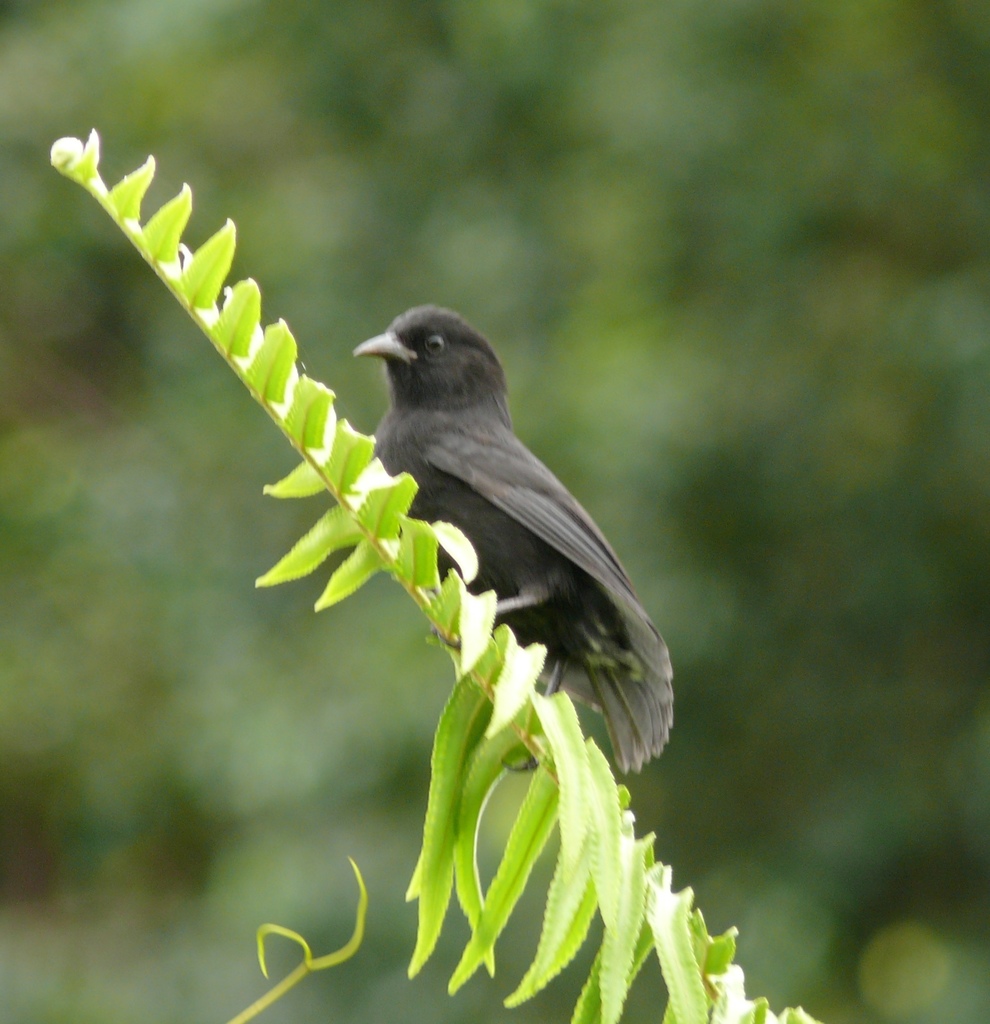
The Cocos finch (Pinaroloxias inornata) or Cocos Island finch, is the only one of Darwin's finches not native to the Galápagos Islands, and the only member of the genus Pinaroloxias. Sometimes classified in the family Emberizidae, more recent studies have shown it to belong in the tanager family, Thraupidae. It is endemic to Cocos Island, a Pacific island which is approximately 360 miles (580 km) south of Costa Rica.
From the article Cocos finch on Wikipedia (CC BY-SA), quoted section by section
Description
The Cocos finch is about 12 cm (4.7 in) long and weighs about 12.5 g (0.44 oz). The bird has a black decurved pointed bill for eating berries and insects that are its main diet. They are sexually dimorphic in that the males are almost entirely black, having black feathers from the tail, breast, nape, and crown. Unlike male finches found on the Galapágos islands, male Cocos finches have black beaks year-round, never changing color. Female Cocos finches have a lighter brown complexion compared to males. There is a black splattering of feathers on their breast area down to the flank and rump. The belly of the female Cocos finch is milky white compared to the mantle of the bird. The nape and crown area are more noticeably black. The young are similar, but have yellow bills. The call of a Cocos finch can be described as a "buzzy" like sound with a high-pitched ending note. The beginning of the call can form a "djirr" sound followed by a high pitched "tiew" sound. Calls can also include a high pitched "phzzzz" sound.
Range & habitat
The Cocos finch is exclusively found in Cocos Island (which takes up a 1,997 km2 area), 580 km southeast from Costa Rica. Cocos finches are not known to have traveled outside of Cocos Island, making its habitat and reproduction range to only be 30 km2 (12 sq mi) of the entire island. The habitat of the Cocos finch is mostly within hibiscus thickets, closed-canopy forest, and woodland forest. The climate within Cocos Island is described to be a typical rainforest climate with high humidity and chances for rainfall. The island has a varied landscape with bodies of lakes, streams, and caves and is home to other species including endemic lizards (only two species) and some migratory birds.
Wikipedia: “Distribution and habitat”
Listen
Looking for field recordings…
Where it lives
Recorded sightings
—
geo-referenced records in GBIF, from museums, herbaria and field observers.
Drag the globe to turn it. Dots are where records exist, not a range map; darker means more records.
In the stacks
Searching the stacks…
Every page naming Pinaroloxias inornata in the Biodiversity Heritage Library →
This page is assembled live from iNaturalist, GBIF, Wikipedia, the Source Library and the Internet Archive. It is not yet part of the hand-edited codex. iNaturalist taxon 10367.