On eBird ↗
Yellow-rumped Cacique
Live sightings near you, the range map, bar charts of when it is seen, and Macaulay Library photos and recordings.
Yellow-rumped Cacique
Cacicus cela
The yellow-rumped cacique (Cacicus cela) is a passerine bird in the New World family Icteridae. It breeds in much of northern South America from Panama, Venezuela and Trinidad south to Peru, Bolivia and central Brazil. However, they have been sighted as far north as Nayarit state in Mexico.
From the article Yellow-rumped cacique on Wikipedia (CC BY-SA), quoted section by section
Description
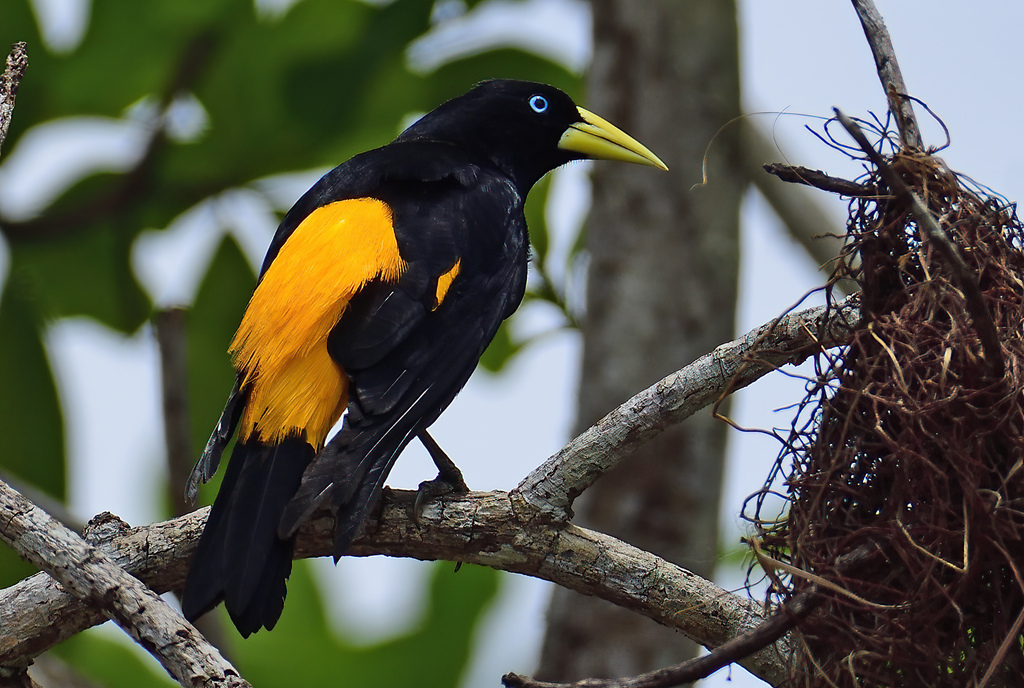
The male is on average 28 centimetres (11 in) long and weighs about 104 grams (3.7 oz), with the female 23 centimetres (9.1 in) long and weighing approximately 60 grams (2.1 oz). The yellow-rumped cacique is a slim bird, with a long tail, blue eyes, and a pale yellow pointed bill. It has mainly black plumage, apart from a bright yellow rump, tail base, lower belly and wing "epaulets". The female is duller black than the male, and the juvenile bird resembles the female, but has dark eyes and a brown bill base. The song of the male yellow-rumped cacique is a brilliant mixture of fluting notes with cackles, wheezes and sometimes mimicry. There are also many varied calls, and an active colony can be heard from a considerable distance.
Range & habitat
The yellow-rumped cacique is a bird associated with open woodland or cultivation with large trees.
Wikipedia: “Distribution and habitat”
What it does
This gregarious bird eats large insects (such as beetles, caterpillars, crickets, grasshoppers and katydids), spiders (such as orb-weavers), nectar and fruit (such as chupa-chupa and figs).
Breeding. It is a colonial breeder, with up to 100 bag-shaped nests in a tree, which usually also contains an active wasp nest. The females build the nests, incubate, and care for the young. Each nest is 30–45 cm long and widens at the base, and is suspended from the end of a branch. Females compete for the best sites near the protection of the wasp nest. The normal clutch is two dark-blotched pale blue or white eggs. Females begin incubating after laying the second egg; hatching occurs after 13 or 14 days. The young fledge in 34 to 40 days, usually only one per nest.
Wikipedia: “Behaviour and ecology”
Listen
Looking for field recordings…
Where it lives
Recorded sightings
—
geo-referenced records in GBIF, from museums, herbaria and field observers.
Drag the globe to turn it. Dots are where records exist, not a range map; darker means more records.
In the stacks
Searching the stacks…
Every page naming Cacicus cela in the Biodiversity Heritage Library →
This page is assembled live from iNaturalist, GBIF, Wikipedia, the Source Library and the Internet Archive. It is not yet part of the hand-edited codex. iNaturalist taxon 10359.