- Animals
- ›Arthropods
- ›Hexapods
- ›Insects
- ›Winged and Once-winged Insects
- ›Dragonflies and Damselflies
- ›Damselflies
- ›Coenagrionoid Damselflies
- ›Narrow-winged Damselflies
- ›Ischnura
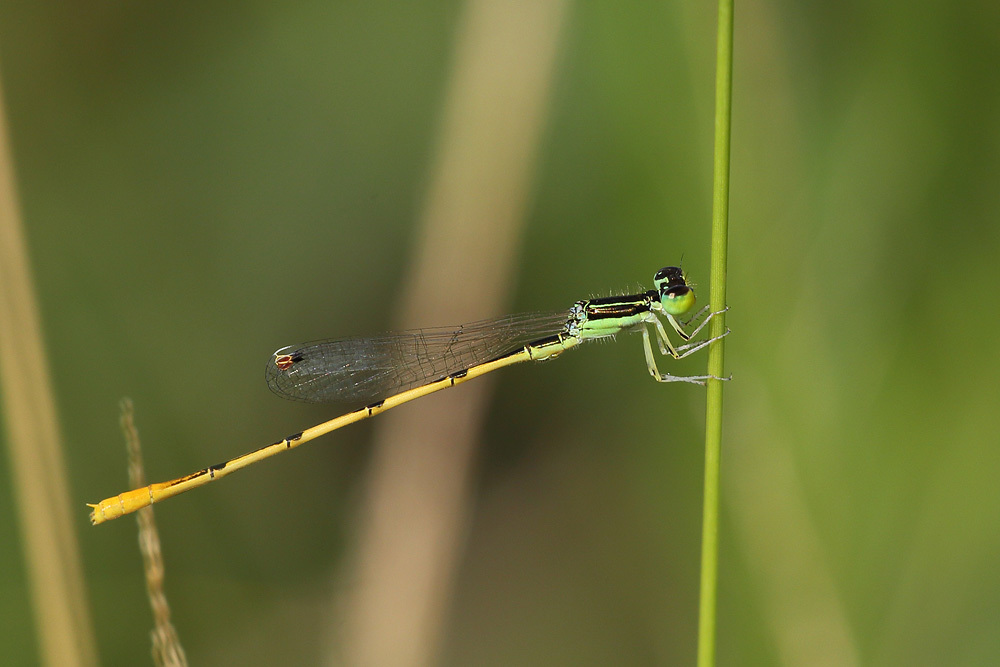
Citrine Forktail
Ischnura hastata
The citrine forktail (Ischnura hastata) is a damselfly of the family Coenagrionidae.
From the article Citrine forktail on Wikipedia (CC BY-SA), quoted section by section
Description
This species is 20–27 mm in length, and its hindwing is 11–15 mm long; it is thus considerably smaller than most European members of the genus Ischnura. Adult males have a black head and thorax, with blue markings, and a largely yellow abdomen, with black markings on its upper surface. The term citrine refers to its yellowish colouration. Adult females are initially largely orange, marked with black above on the head and rear part of the abdomen. They undergo a colour change, through brown or olive to greyish, as they mature. Male citrine forktails are the only damselflies in the world with the pterostigma situated away from the leading edge of the wing.
Range & habitat
It is native to North and South America, and there is a population on the Azores. The Azorean population is likely to have been present since the late 19th Century, it was not identified as this species until 1990.
Wikipedia: “Distribution”
In human culture
In North America, this species has a typical dragonfly life-history. However, the population on the Azores reproduces by parthenogenesis, making it the only population of Odonata anywhere in the world known to reproduce by this means. In the southern United States, adults are on the wing year-round, while farther north the flight season is from April to November, and in the Azores from May to August.
Wikipedia: “Life history”
Listen
Looking for field recordings…
Where it lives
Recorded sightings
—
geo-referenced records in GBIF, from museums, herbaria and field observers.
Drag the globe to turn it. Dots are where records exist, not a range map; darker means more records.
In the stacks
Searching the stacks…
Every page naming Ischnura hastata in the Biodiversity Heritage Library →
This page is assembled live from iNaturalist, GBIF, Wikipedia, the Source Library and the Internet Archive. It is not yet part of the hand-edited codex. iNaturalist taxon 103494.