On eBird ↗
Yellow-striped Brushfinch
Live sightings near you, the range map, bar charts of when it is seen, and Macaulay Library photos and recordings.
Yellow-striped Brushfinch
Atlapetes citrinellus
The yellow-striped brushfinch (Atlapetes citrinellus) is a species of bird in the family Passerellidae, the New World sparrows. It is endemic to Argentina.
From the article Yellow-striped brushfinch on Wikipedia (CC BY-SA), quoted section by section
Description
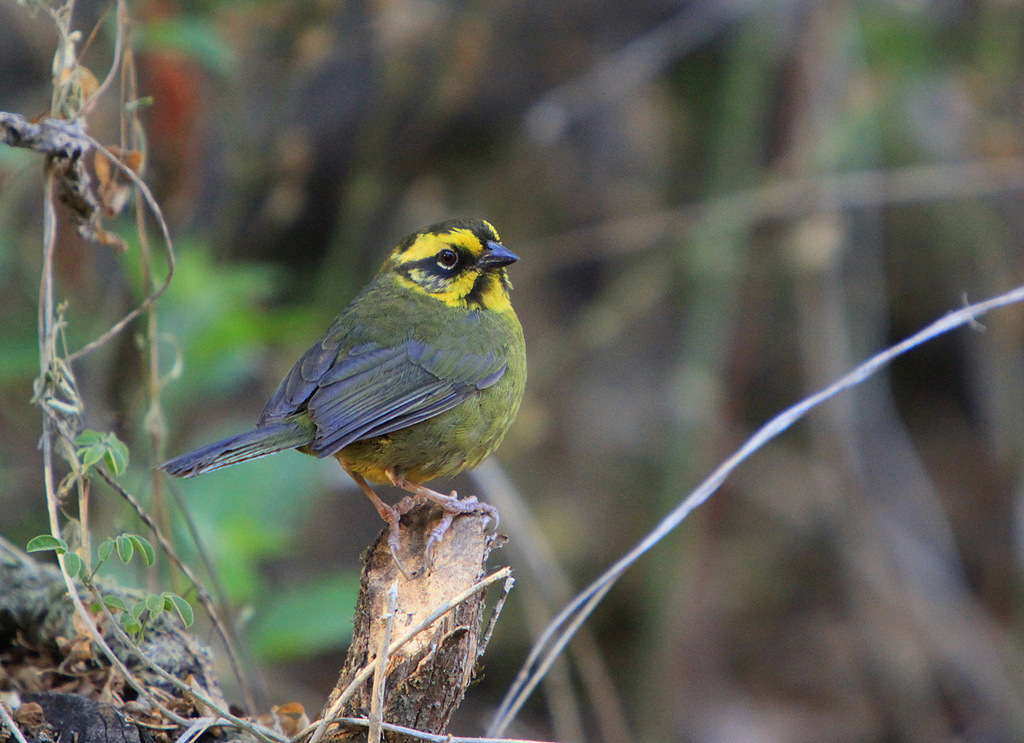
The yellow-striped brushfinch is about 17 cm (6.7 in) long; one male weighed 28 g (0.99 oz). The sexes have the same plumage. Adults have a blackish forehead that merges to dark brownish olive on the crown and nape. They have a wide yellow supercilium, a white eye-ring, and a blackish line from the lores through the eye. The line continues around the back of the ear coverts, which are grizzled yellow. They are bright yellow on the cheek below the ear coverts and have a black chin whose color continues as wide black stripes below the yellow. Their upperparts are greenish. Their wings are blackish with greenish yellow edges on the flight feathers. Their tail is blackish with greenish yellow feather edges. Their underparts are mostly olive with a somewhat yellower center of the belly and undertail coverts. They have a dark reddish iris, a black bill, and grayish black to dusky pink legs and feet.
Range & habitat
The yellow-striped brushfinch is found in the Andes of northwestern Argentina from Jujuy and Salta provinces south to Catamarca Province. It is primarily a bird of the Yungas forest. Though that biome also stretches north well into Bolivia, it is not known why this species' range does not continue throughout it. It also regularly occurs in woodland dominated by alder (Alnus) and in secondary forest. In all forest types it favors the undergrowth and edges. In elevation it ranges between 700 and 3,100 m (2,300 and 10,200 ft).
Wikipedia: “Distribution and habitat”
What it does
The yellow-striped brushfinch's diet has not been extensively studied. It is known to feed primarily on invertebrates and also a variety of fruits, all of which are taken year-round. It is an important disperser of fruit seeds. It usually forages in pairs or family groups. It takes most live prey on the ground or low in vegetation; fruit is taken mostly in the understory but also as high as the canopy.
Wikipedia: “Feeding”
Listen
Looking for field recordings…
Where it lives
Recorded sightings
—
geo-referenced records in GBIF, from museums, herbaria and field observers.
Drag the globe to turn it. Dots are where records exist, not a range map; darker means more records.
In the stacks
Searching the stacks…
Every page naming Atlapetes citrinellus in the Biodiversity Heritage Library →
This page is assembled live from iNaturalist, GBIF, Wikipedia, the Source Library and the Internet Archive. It is not yet part of the hand-edited codex. iNaturalist taxon 10328.