- Animals
- ›Chordates
- ›Vertebrates
- ›Ray-finned Fishes
- ›Carps, Characins, Catfishes and Allies
- ›Catfishes
- ›Siluroidei
- ›North American Freshwater Catfishes
- ›Ictalurus
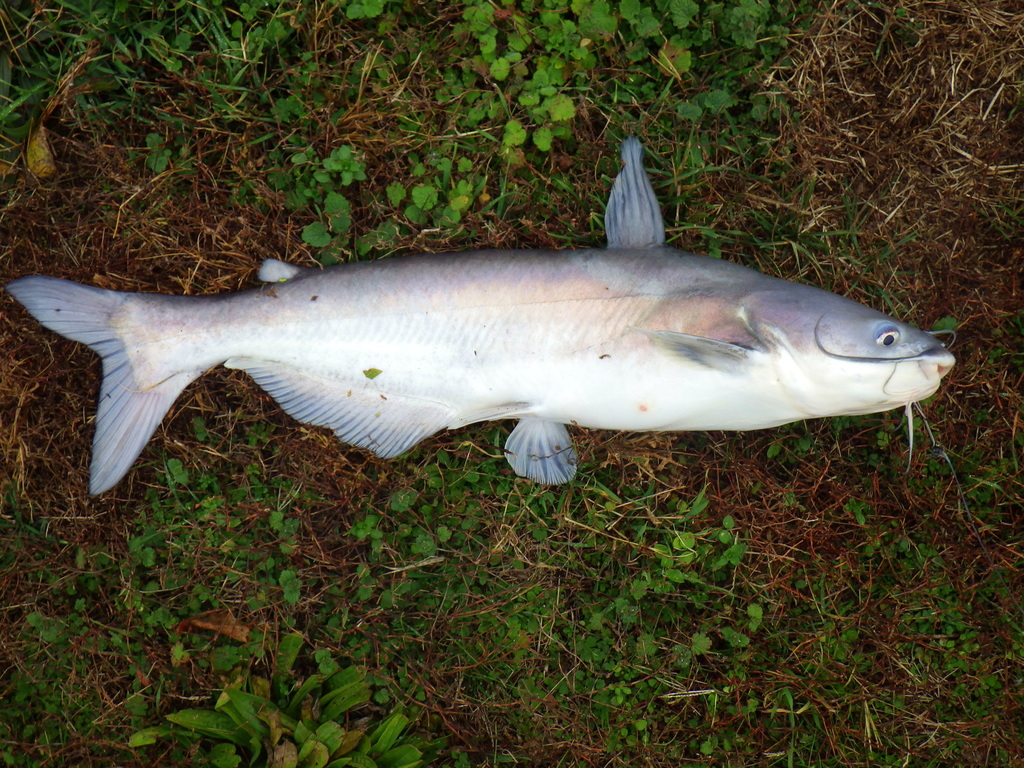
Blue Catfish
Ictalurus furcatus
The blue catfish (Ictalurus furcatus) is a large species of North American catfish, reaching a length of 65 in (170 cm) and a weight of 143 lb (65 kg). The continent's largest catfish, it can live to 20 years, with a typical fish being between 25–46 in (64–117 cm) and 30–70 lb (14–32 kg). Native distribution is primarily in the Mississippi River and Louisiana drainage systems, including the Missouri, Ohio, Tennessee, and Arkansas Rivers, the Des Moines River in south-central Iowa, the Rio Grande, and south along the Gulf Coast to Belize and Guatemala.
An omnivorous predator, it has been introduced in a number of reservoirs and rivers, notably the Santee Cooper lakes of Lake Marion and Lake Moultrie in South Carolina, the James River in Virginia, Powerton Lake in Pekin, Illinois, and Lake Springfield in Springfield, Illinois. It is also found in some lakes in Florida.
From the article Blue catfish on Wikipedia (CC BY-SA), quoted section by section
What it does
The blue catfish is an opportunistic predator, eating any species of fish it can take (including cannibalism), along with insects, crawfish, crabs, freshwater mussels, clams, worms, frogs, and other readily available aquatic food sources. The species is noted for taking injured fish beneath marauding schools of striped bass in open water in reservoirs, and feeding on wounded baitfish that have been washed through dam spillways or power-generation turbines. It is one of the few species of fish in the Mississippi River basin able to eat adult Asian carp.
Wikipedia: “Diet”
Where it lives
Recorded sightings
—
geo-referenced records in GBIF, from museums, herbaria and field observers.
Drag the globe to turn it. Dots are where records exist, not a range map; darker means more records.
In the stacks
Searching the stacks…
Every page naming Ictalurus furcatus in the Biodiversity Heritage Library →
This page is assembled live from iNaturalist, GBIF, Wikipedia, the Source Library and the Internet Archive. It is not yet part of the hand-edited codex. iNaturalist taxon 103276.