On eBird ↗
Brewer's Blackbird
Live sightings near you, the range map, bar charts of when it is seen, and Macaulay Library photos and recordings.
Brewer's Blackbird
Euphagus cyanocephalus
Brewer's blackbird (Euphagus cyanocephalus) is a medium-sized New World blackbird. It is named after the ornithologist Thomas Mayo Brewer.
From the article Brewer's blackbird on Wikipedia (CC BY-SA), quoted section by section
Description
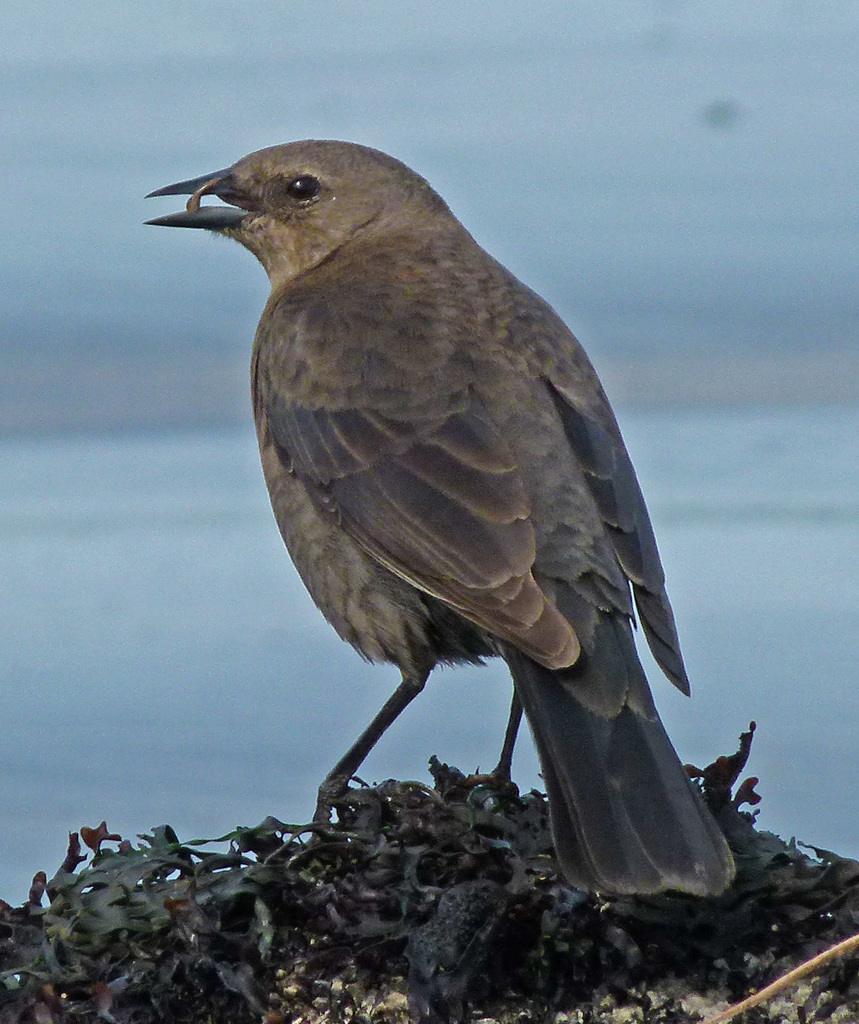
Adult males have black plumage with an iridescent purple head and neck and glossy bluish-green highlights on the rest of the body. The feet and legs are black and the eye is bright yellow. The female is brownish-grey with slight hints of the male's iridescence. The female's eyes are dark brown, while the male's is bright yellow. Overall, they resemble the eastern member of the same genus, the rusty blackbird; Brewer's blackbird, however, has a shorter bill and the male's head is iridescent purple. This bird is often mistaken for the common grackle but has a shorter tail. The call is a sharp check which is also distinguishable. This bird is in a different family from the Eurasian blackbird.
Range & habitat
Their breeding habitat is open and semi-open areas, often near water, across central and western North America. They are also very common in parking lots or around schools, and easily acclimate to the presence of people. They can live in low elevation, as low as below sea level in Southern California, and elevations as high as 8,000 feet. They are capable of surviving in diverse environments, including marshlands and forests. These birds are often permanent residents in the west. Other birds migrate to the Southeastern United States and Mexico in Spring. The range of this bird has been expanding east in the Great Lakes region. They have expanded their habitat as recently as the 20th century.
Wikipedia: “Habitat”
What it does
When Brewer's blackbirds identify threats, such as hawks or even humans, they dive towards them and emit an alarm call. Sometimes, when particularly threatened, they will use physical force on predators. Brewer's blackbirds often walk along the ground. They can be seen making jerking motions with their heads. In colder months, these birds tend to flock together and forage. Sometimes, other species of blackbirds will join these flocks. During nesting season, their foraging behavior becomes more independent. Brewer's blackbirds have been seen cleverly following vehicles plowing fields, eating the churned up insects.
Wikipedia: “Behavior”
Listen
Looking for field recordings…
Where it lives
Recorded sightings
—
geo-referenced records in GBIF, from museums, herbaria and field observers.
Drag the globe to turn it. Dots are where records exist, not a range map; darker means more records.
In the stacks
Searching the stacks…
Every page naming Euphagus cyanocephalus in the Biodiversity Heritage Library →
This page is assembled live from iNaturalist, GBIF, Wikipedia, the Source Library and the Internet Archive. It is not yet part of the hand-edited codex. iNaturalist taxon 10325.