On eBird ↗
Rusty Blackbird
Live sightings near you, the range map, bar charts of when it is seen, and Macaulay Library photos and recordings.
Rusty Blackbird
Euphagus carolinus
The rusty blackbird (Euphagus carolinus) is a medium-sized New World blackbird, closely related to grackles ("rusty grackle" is an older name for the species). It is a bird that prefers wet forested areas, breeding in the boreal forest and muskeg across northern Canada, and migrating southeast to the United States during winter.
Formerly abundant, the rusty blackbird has undergone one of the most rapid declines of any abundant bird species in North America in recent years, for reasons that are not well understood.
From the article Rusty blackbird on Wikipedia (CC BY-SA), quoted section by section
Description
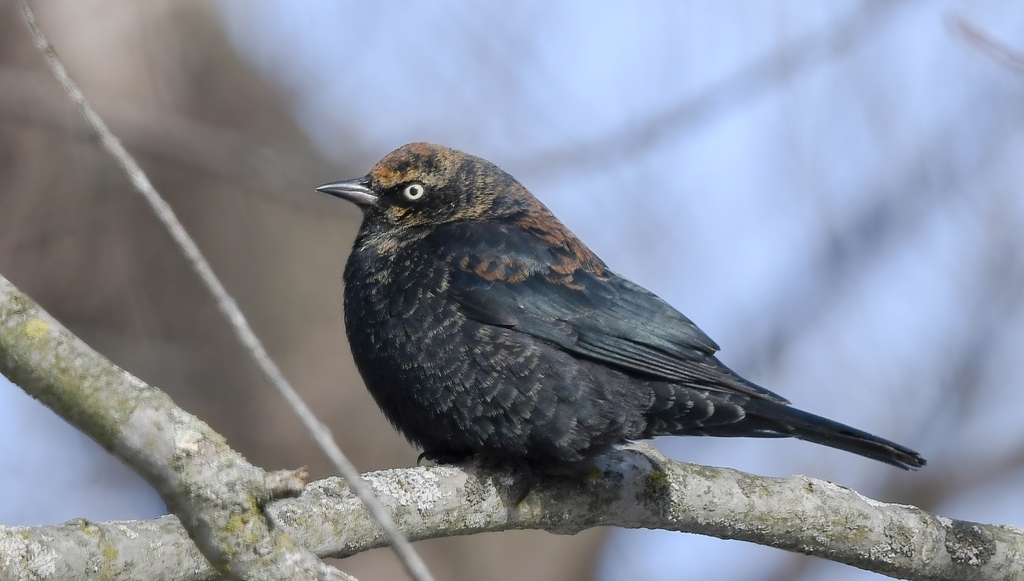
Adults have a pointed bill and a pale yellow eye. They have black plumage with faint green and purple gloss; the female is greyer. "Rusty" refers to the brownish winter plumage. They resemble the western member of the same genus, the Brewer's blackbird; however, Brewer's has a longer bill and the male's head is iridescent green.
Range & habitat
Their breeding habitat is wet temperate coniferous forests and muskeg across Canada, New England, the Upper Peninsula of Michigan, the Adirondack Mountains in New York and Alaska. Birds usually nest at the edge of ponds and wetlands with the cup nest located in a tree or dense shrub, often over the water. Emerging dragonflies and their larvae are important food items during the summer. These birds migrate to the eastern and southeastern United States, into parts of the Grain Belt, sometimes straying into Mexico. Additional vagrants have been reported inn Greenland and Russian Siberia.
Wikipedia: “Habitat”
What it does
Rusty blackbirds forage on wet ground or in shallow water, mainly eating insects, crustaceans, small fish during the breeding season. In winter, their diet is more flexible, and contains grains (e.g., corn and rice) and other seeds. In fragmented landscapes, overwintering populations may also rely on the mast of seed-producing trees, such as pecans and oaks. They very rarely will attack small passerine birds in periods of extreme food shortage. They feed in flocks during migration and on the wintering grounds, both in conspecific and mixed-flocks alongside red-winged blackbirds, common grackles, and European starlings. They more often roost with other blackbirds; some small roosts are in brushy vegetation in old fields and others are in massive mixed flocks—sometimes in the urban areas. The species nests relatively early for a boreal forest bird. They linger in the boreal zone to complete their molt. Their autumn migration is slow, with birds often remaining in the northern states well into December; spring migration is much more rapid. The largest wintering concentrations are found in the lower Mississippi Valley, with smaller concentrations in the Piedmont and south Atlantic coastal plain. Fairly quiet in fall migration and most of the winter, both males and females will sing (particularly on warm days) in the late winter and spring. …
Wikipedia: “Behavior”
Listen
Looking for field recordings…
Where it lives
Recorded sightings
—
geo-referenced records in GBIF, from museums, herbaria and field observers.
Drag the globe to turn it. Dots are where records exist, not a range map; darker means more records.
In the stacks
Searching the stacks…
Every page naming Euphagus carolinus in the Biodiversity Heritage Library →
This page is assembled live from iNaturalist, GBIF, Wikipedia, the Source Library and the Internet Archive. It is not yet part of the hand-edited codex. iNaturalist taxon 10322.