- Animals
- ›Chordates
- ›Vertebrates
- ›Ray-finned Fishes
- ›Spiny-rayed fishes
- ›Perches, Scorpionfishes, Sticklebacks, and Allies
- ›Perches, groupers and allies
- ›Groupers
- ›Hyporthodus
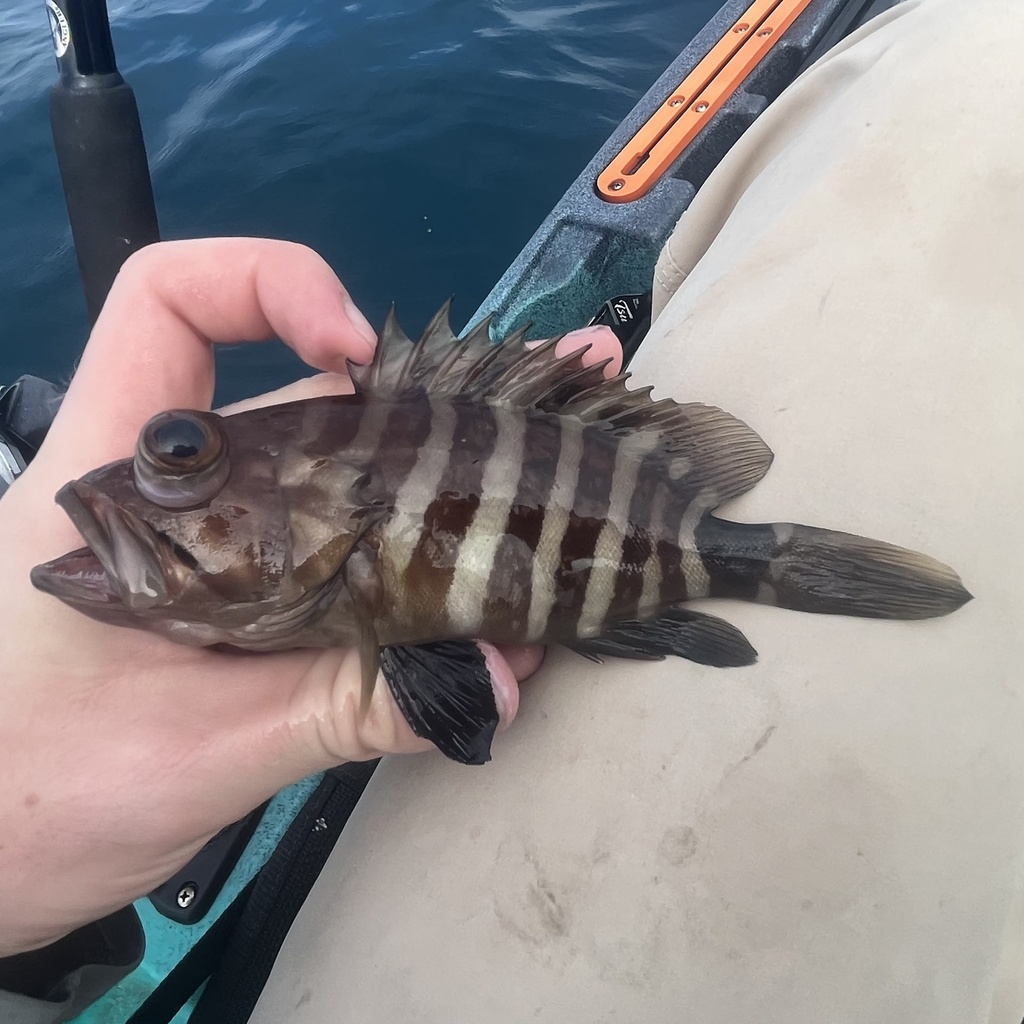
Misty Grouper
Hyporthodus mystacinus
Hyporthodus mystacinus, the misty grouper, black grouper, convict grouper, eightbar grouper or moustache grouper, is a species of marine ray-finned fish, a grouper from the subfamily Epinephelinae which is part of the family Serranidae, which also includes the anthias and sea basses. It is primarily found in the Caribbean and the Gulf of Mexico with populations present around the Galapagos Islands and Central American coastlines.
From the article Hyporthodus mystacinus on Wikipedia (CC BY-SA), quoted section by section
Description
Hyporthodus mystacinus has a robust, relatively deep and oval body which is laterally compressed. The body is deepest at the origin of dorsal fin and its standard length is 2.4 to 2.9 times its depth at this point. It has a convex are between the eyes. The preopercle is rounded with enlarged serrations, the smaller serrations at the corner being encased in flesh. The dorsal fin contains 11 spines and 14-15 soft rays while the anal fin has 3 spines and 8-9 soft rays. The membranes between the dorsal fin spines are deeply notched. The caudal fin is rounded. The adults have an overall colour of chocolate brown marked with pale spots and 9-10 dark vertical bars on the head and the body which extend on to the dorsal and anal fins. The rearmost is on the base of the caudal fin and is the broadest and darkest. There are 3 diagonal dark stripes on the side of the head, one runs along the top of upper jaw and there are vertical bars on the cheek with a further two to the rear of the eye reaching the gill cover. Juveniles resemble adults but have a darker head and a wide black bar across the base of the tail. The maximum published total length is 160 centimetres (63 in) for males and 100 centimetres (39 in) for females while the maximum published weight is 107 kilograms (236 lb).
Range & habitat
Hyporthodus mystacinus is found in the western Atlantic Ocean and the eastern Pacific Ocean. In the western Atlantic it is found from North Carolina southwards along the eastern coast of the United States to the Florida Keys, The Bahamas, Bermuda and into the Gulf of Mexico and the Caribbean Sea. In South America they are found from Santa Marta in Colombia to Rio de Janeiro in Brazil. In the Eastern Pacific it has been recorded from the Galapagos and coastal Ecuador, as well as from the Paramount Seamount and the Costa Rican Cocos Island.
Wikipedia: “Distribution”
Where it lives
Recorded sightings
—
geo-referenced records in GBIF, from museums, herbaria and field observers.
Drag the globe to turn it. Dots are where records exist, not a range map; darker means more records.
In the stacks
Searching the stacks…
Every page naming Hyporthodus mystacinus in the Biodiversity Heritage Library →
This page is assembled live from iNaturalist, GBIF, Wikipedia, the Source Library and the Internet Archive. It is not yet part of the hand-edited codex. iNaturalist taxon 103160.